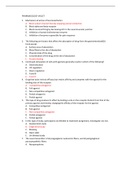
PHARMACOLOGY PACOP COMPILED QUESTIONS AND ANSWERS
PHARMACOLOGY VIOLET 1. Mechanism of action of local anesthetics. A. Block sodium channel thereby stopping axonal conduction B. Block alpha and beta receptor C. Block neuronal firing by decreasing Ach in the neuromuscular junction D. Inhibition of acetyl cholinesterase enzyme E. Inhibition of enzyme responsible for pain response 2. The following are factors that affect the absorption of drug from the gastrointestinal(GI) track except. A. Surface area of absorption B. Blood flow to the site of absorption C. Physical state of the drug D. Concentration of the drug at the site of absorption E. Protein binding 3. Continued stimulation of cells with agonists generally results in which of the following? A. Desensitization B. UP-regulation C. Down-regulation D. A and B E. A and C 4. Drug that lacks intrinsic efficacy but retains affinity and competes with the agonist for the binding sites of the receptor. A. Competitive antagonist B. Full agonist C. Non-competitive antagonist D. Partial antagonist E. Partial agonist 5. This type of drug produce its effect by binding a site on the receptor distinct from that of the primary agonist and thereby changing the affinity of the receptor for the agonist. A. Competitive antagonist B. Full agonist C. Non-competitive antagonist D. Partial antagonist E. Partial agonist 6. In this type of study, participants are blinded to treatment assignment, investigator are not. A. Double blind study B. Single blind study C. Masking D. Open-label E. Un-blinded study 7. The neurotransmitter of all preganglionic autonomic fibers, and all postganglionic parasympathetic fibers. A. Norepinephrine B. Noradrenaline C. Acetylcholine D. A and B E. A and C 8. The release of ach and other neurotransmitters by exocytosis is inhibited by: A. Acetylcholinesterase B. Botulinum toxin C. Reserpine D. Me tyrosine E. Guanethidine 9. All of the following are enzymes involved in the biosynthesis of epinephrine from tyrosine EXCEPT: A. Tyrosine hydroxylase B. Aromatic L amino acid decarboxylase C. Dopamine Beta-hydroxylase D. Phenyl ethanolamine-N-Methyl transferase E. Monoamine oxidase 10. Rate limiting enzyme in the synthesis of catecholamines A. Tyrosine hydroxylase B. Aromatic L-amino acid decarboxylase C. Dopamine beta-hydroxylase D. Phenyl ethanolamine-N-Methyl transferase E. COMT 11. All of the following are effects of activating beta 2 receptor EXCEPT: A. Bronchoconstriction B. Uterine Relaxation C. Glycogenolysis D. Gluconeogenesis E. Bronchodilation 12. All of the following are effects of activating alpha 1 receptor EXCEPT: A. Vascular smooth muscle relaxation B. Intestinal smooth muscle relaxation C. Increase contractive force of the heart D. Glycogenolysis in the liver E. Vascular smooth muscle constriction 13. Which of the following is a pharmacological effect of muscarinic stimulation in the cardiovascular system? A. Vasoconstriction B. Decrease in cardiac rate C. Positive chronotropic effect D. Positive dromotropic effect E. Positive inotropic effect 14. All of the following are naturally occurring chromonematic Alkaid EXCEPT: A. Pilocarpine B. Muscarine C. Acetylcholine D. Arecoline E. None of these 15. Which of the following is/are effects of cholinomimetic drugs? I. Stimulation of GI smooth muscle II. Stimulation of secretion of exocrine gland III. Bronchoconstriction IV. Tachycardia A. I and II B. II and III C. I, II and III D. I and IV E. I, II, III and IV
Document information
- Uploaded on
- August 9, 2022
- Number of pages
- 181
- Written in
- 2022/2023
- Type
- Exam (elaborations)
- Contains
- Questions & answers