

Psychological Therapies:
Lecture 1:
Asylums:
- Very little understanding into the cause of psychological disorders-
people were labelled as insane, mad- they were placed in asylums
- Conditions and treatments for ‘insanity’ and ‘lunacy’ were inhumane
- Bethlehem Hospital (1676): In the 18th century people used to go to
Bedlam to stare at the lunatics. For a penny one could peer into their
cells, view the freaks of the "show of Bethlehem" and laugh at their
antics, generally of a sexual nature or violent fights. Entry was free on
the first Tuesday of the month. Visitors were permitted to bring long
sticks with which to poke and enrage the inmates. In 1814 alone, there
were 96,000 such visits.
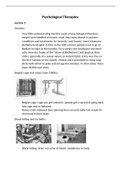
Belgian cage and rotary chair (1800s):
- Belgian cage: cage you got locked in. people got o sacred of going back
into cage and so behaved
- Rotary chair: believed that spinning them around really fast would fix
chemicals in their brain.
Blood letting and ice baths:
- Blood letting: drain out some of blood- misbalance in body
, - Ice baths: put in bath, covered with wood and tied down, they couldn’t
escape.
Asylums- movement to more humane treatments:
- Philippe Pinel unchaining of inmates at LA Bicetre in Paris (1793):
publicly unchaining people to create statement
- 1860s- efforts made to improve conditions
Moral Therapy:
- 19th century: Moral therapy led by Philippe Pinel and Jean-Baptiste
Pussin: actually need to talk to people, not just lock them up.
- Institutionalised patients treated as normally as possible
- Restraint and seclusion eliminated
- Setting that encourages social interaction
- Positive consequences for appropriate interactions and behaviour
- Led to patients being cured and returning home.
Move toward a Medical Model:
- General paresis- psychological symptoms include personality changes,
mood changes and dementia
- 1905 – discovered that general paresis had a physical cause (untreated
syphilis)
- Lent support to the Somatogenic Hypotheses i.e. biological impairments
cause/explain psychological problems
- The term ‘mental illness’ arose in literature
- Gave rise to the medical model and psychiatry
- Research to identify biological causes and treatments
Biomedical Treatments:
- Use of medical techniques to manage disordered behaviour
- Biological therapies directly affect the biological functioning of the body
and brain
- Medication and therapy can be combined approaches
1. Psychopharmacology – use of drugs/ medication
2. Electroconvulsive therapy (ECT)
Psychopharmacology:
Anti-anxiety drugs:
, - Used for the treatment of anxiety disorders
- Benzodiazepines e.g. Ativan, Xanax, Valium- potential for addiction,
body build up tolerance and then you can have withdraw symptoms
- Sedative effect that relieves symptoms of anxiety in 20- 30 minutes
when taken orally
- Beta blockers- used for social anxiety disorder
- Side effects: drowsiness, light-headedness, confusion, dry mouth,
nausea, vomiting, constipation, insomnia, blurred vision, addiction
(physical and psychological)
Antipsychotic drugs (First Generation/Typical):
- Positive symptom: something that wasn’t there before
- Negative symptom: a decrease in a certain function
- Used to treat psychotic symptoms, particularly positive symptoms e.g.
hallucinations and delusions
- E.g. Chlorpromazine, Haloperidol
- Block certain dopamine receptors in the brain which reduces the effect
of dopamine in synaptic transmission
- Side effects: movement disorders similar to Parkinson’s disease (e.g.
tremors, muscle rigidity, impaired motor coordination); tardive
dyskinesia, reduced emotionality
- Long-term effects: decreased cognitive functioning
Antipsychotic drugs (Second Generation/Atypical)
- Used to treat psychotic symptoms, positive and some negative
symptoms e.g. hallucinations, delusions, flat affect, poor attention span
- E.g. Chlorpromazine, Haloperidol, Seroquel
- Suppresses release of dopamine in the one pathway that may cause
psychosis; also, partially blocks serotonin receptors resulting in fewer
negative side effects and improvement in negative symptoms
- Increasingly prescribed ‘off-label’ e.g. PTSD, eating disorders, mood
disorders
- Side effects: weight gain, diabetes, drowsiness, blood lipid level changes,
changes in the electrical rhythms of the heart
Mood Stabilising Drugs:
- Used in the treatment of bipolar disorder
- Lithium – treatment of choice for many years
Lecture 1:
Asylums:
- Very little understanding into the cause of psychological disorders-
people were labelled as insane, mad- they were placed in asylums
- Conditions and treatments for ‘insanity’ and ‘lunacy’ were inhumane
- Bethlehem Hospital (1676): In the 18th century people used to go to
Bedlam to stare at the lunatics. For a penny one could peer into their
cells, view the freaks of the "show of Bethlehem" and laugh at their
antics, generally of a sexual nature or violent fights. Entry was free on
the first Tuesday of the month. Visitors were permitted to bring long
sticks with which to poke and enrage the inmates. In 1814 alone, there
were 96,000 such visits.
Belgian cage and rotary chair (1800s):
- Belgian cage: cage you got locked in. people got o sacred of going back
into cage and so behaved
- Rotary chair: believed that spinning them around really fast would fix
chemicals in their brain.
Blood letting and ice baths:
- Blood letting: drain out some of blood- misbalance in body
, - Ice baths: put in bath, covered with wood and tied down, they couldn’t
escape.
Asylums- movement to more humane treatments:
- Philippe Pinel unchaining of inmates at LA Bicetre in Paris (1793):
publicly unchaining people to create statement
- 1860s- efforts made to improve conditions
Moral Therapy:
- 19th century: Moral therapy led by Philippe Pinel and Jean-Baptiste
Pussin: actually need to talk to people, not just lock them up.
- Institutionalised patients treated as normally as possible
- Restraint and seclusion eliminated
- Setting that encourages social interaction
- Positive consequences for appropriate interactions and behaviour
- Led to patients being cured and returning home.
Move toward a Medical Model:
- General paresis- psychological symptoms include personality changes,
mood changes and dementia
- 1905 – discovered that general paresis had a physical cause (untreated
syphilis)
- Lent support to the Somatogenic Hypotheses i.e. biological impairments
cause/explain psychological problems
- The term ‘mental illness’ arose in literature
- Gave rise to the medical model and psychiatry
- Research to identify biological causes and treatments
Biomedical Treatments:
- Use of medical techniques to manage disordered behaviour
- Biological therapies directly affect the biological functioning of the body
and brain
- Medication and therapy can be combined approaches
1. Psychopharmacology – use of drugs/ medication
2. Electroconvulsive therapy (ECT)
Psychopharmacology:
Anti-anxiety drugs:
, - Used for the treatment of anxiety disorders
- Benzodiazepines e.g. Ativan, Xanax, Valium- potential for addiction,
body build up tolerance and then you can have withdraw symptoms
- Sedative effect that relieves symptoms of anxiety in 20- 30 minutes
when taken orally
- Beta blockers- used for social anxiety disorder
- Side effects: drowsiness, light-headedness, confusion, dry mouth,
nausea, vomiting, constipation, insomnia, blurred vision, addiction
(physical and psychological)
Antipsychotic drugs (First Generation/Typical):
- Positive symptom: something that wasn’t there before
- Negative symptom: a decrease in a certain function
- Used to treat psychotic symptoms, particularly positive symptoms e.g.
hallucinations and delusions
- E.g. Chlorpromazine, Haloperidol
- Block certain dopamine receptors in the brain which reduces the effect
of dopamine in synaptic transmission
- Side effects: movement disorders similar to Parkinson’s disease (e.g.
tremors, muscle rigidity, impaired motor coordination); tardive
dyskinesia, reduced emotionality
- Long-term effects: decreased cognitive functioning
Antipsychotic drugs (Second Generation/Atypical)
- Used to treat psychotic symptoms, positive and some negative
symptoms e.g. hallucinations, delusions, flat affect, poor attention span
- E.g. Chlorpromazine, Haloperidol, Seroquel
- Suppresses release of dopamine in the one pathway that may cause
psychosis; also, partially blocks serotonin receptors resulting in fewer
negative side effects and improvement in negative symptoms
- Increasingly prescribed ‘off-label’ e.g. PTSD, eating disorders, mood
disorders
- Side effects: weight gain, diabetes, drowsiness, blood lipid level changes,
changes in the electrical rhythms of the heart
Mood Stabilising Drugs:
- Used in the treatment of bipolar disorder
- Lithium – treatment of choice for many years


