Euthanasia
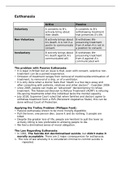
Active Passive
Voluntary A consents to B’s A consents to B’s
actively bring about withdrawing treatment
their death. that preserves A's life.
Non-Voluntary B actively brings about B withdraws life-
A's death. A is not in a preserving treatment
postin to communicate from A when A is not in
consent. a position to consent.
Involuntary B actively brings about B withdraws life-
A's death against A’s preserving treatment
communicated will. from A against A’s
communicated will.
The problem with Passive Euthanasia:
• It is legal in Britain but an issue is that, even with consent, selective non-
treatment can be a pained experience.
• Omission of treatment ranges from removal of medicine/discontinuation of
treatment, to removal of a drip, or of a ventilator.
• It is only done when a doctor feels that “death is a few days away and
after consulting with patients, relatives and other doctors” - Guardian 2006
• since 2005, people can make an “advanced” decision/proxy to refuse
treatment. The Advanced Decision to Refuse Treatment (ADRT) is refusing
life-saving treatments when the individual lacks the mental capacity.
• July 2018, Supreme Court ruled that when families and doctors agree to
withdraw treatment form a PVS (Persistent Vegetative State), this can be
done without Court of Protection.
Applying the Trolley Problem (Philippa Foot):
• Passive euthanasia shown to be more morally digestible.
• Pull the lever, one person dies. Leave it and do nothing, 5 people are
killed.
• Despite the greater loss of life, people are hesitant to pull the lever as
actively killing is less preferable to allowing people to die.
• We feel a diminished sense of moral obligation.
The Law Regarding Euthanasia:
• In 1961, The Suicide Act decriminalised suicide, but didn't make it
morally acceptable. There are 2 major consequences for euthanasia:
1. The rule of law whereby it is considered criminal to commit suicide is
repealed.
, 2. (a) person who aids and abets another’s suicide shall be liable for a term
of up to 14 years.
(b) person who aids and abets another’s suicide can be charged with
murder/ manslaughter
• This law seems to reinforce the sanctity of life through the
punishments,
• Another argument against euthanasia is guilt. Many with lifelong/terminal
conditions are aware of being a ‘burden’ to those they care about,
leading them to be manipulated/persuaded into ending their life.
Legal elements of this topic:
1. To decide who gets prosecuted, Crown Prosecution Service use The
Public Interest Test, so they only get prosecuted if it’s in the public’s
interest to do so. They also take the consequences for the victim and any
views expressed by the victim/their family into account.
2. Legal Precedence. If one does a crime and gets 10 years, another who
commits virtually the exact same crime should get 10 years too. If one
case has been rejected for euthanasia because they aren’t ill enough to
die, all cases where you are not ill enough to die should be rejected.
Vitalism:
• The view that the human life is always sacred because it possesses a soul
from God.
• Suicide Act generally is not vitalist. It suggests life isn't equal and there are
cases where it’s better to die than to live.
• Diane Petty Case: paralysed from the neck down due to Motor Neurone
Disease. Asked for doctor-assisted suicide on the basis of self-
determination —> free choice of one’s acts/states without external
compulsion.
• Both her doctors and then the European Court of Human Rights denied her
because:
• the law recognises the right to life, not the right to die.
• her condition was not life-threatening, so passive euthanasia not
allowed.
Baby Charlotte Case (2005):
• Born prematurely with sever brain damage and used as a legal precedence
for Quality of Life by QoL campaigners.
• Parents wanted doctors to keep supporting her, but High Court issued DNR
to doctors because condition did not justify medical assistance to stay
alive.
• She was in constant pain, on 95% oxygen kept in a box, she had no
pleasure.
• But, a month later her state improved, so the legal judgement for the DNR
was revoked in 2005.
Active Passive
Voluntary A consents to B’s A consents to B’s
actively bring about withdrawing treatment
their death. that preserves A's life.
Non-Voluntary B actively brings about B withdraws life-
A's death. A is not in a preserving treatment
postin to communicate from A when A is not in
consent. a position to consent.
Involuntary B actively brings about B withdraws life-
A's death against A’s preserving treatment
communicated will. from A against A’s
communicated will.
The problem with Passive Euthanasia:
• It is legal in Britain but an issue is that, even with consent, selective non-
treatment can be a pained experience.
• Omission of treatment ranges from removal of medicine/discontinuation of
treatment, to removal of a drip, or of a ventilator.
• It is only done when a doctor feels that “death is a few days away and
after consulting with patients, relatives and other doctors” - Guardian 2006
• since 2005, people can make an “advanced” decision/proxy to refuse
treatment. The Advanced Decision to Refuse Treatment (ADRT) is refusing
life-saving treatments when the individual lacks the mental capacity.
• July 2018, Supreme Court ruled that when families and doctors agree to
withdraw treatment form a PVS (Persistent Vegetative State), this can be
done without Court of Protection.
Applying the Trolley Problem (Philippa Foot):
• Passive euthanasia shown to be more morally digestible.
• Pull the lever, one person dies. Leave it and do nothing, 5 people are
killed.
• Despite the greater loss of life, people are hesitant to pull the lever as
actively killing is less preferable to allowing people to die.
• We feel a diminished sense of moral obligation.
The Law Regarding Euthanasia:
• In 1961, The Suicide Act decriminalised suicide, but didn't make it
morally acceptable. There are 2 major consequences for euthanasia:
1. The rule of law whereby it is considered criminal to commit suicide is
repealed.
, 2. (a) person who aids and abets another’s suicide shall be liable for a term
of up to 14 years.
(b) person who aids and abets another’s suicide can be charged with
murder/ manslaughter
• This law seems to reinforce the sanctity of life through the
punishments,
• Another argument against euthanasia is guilt. Many with lifelong/terminal
conditions are aware of being a ‘burden’ to those they care about,
leading them to be manipulated/persuaded into ending their life.
Legal elements of this topic:
1. To decide who gets prosecuted, Crown Prosecution Service use The
Public Interest Test, so they only get prosecuted if it’s in the public’s
interest to do so. They also take the consequences for the victim and any
views expressed by the victim/their family into account.
2. Legal Precedence. If one does a crime and gets 10 years, another who
commits virtually the exact same crime should get 10 years too. If one
case has been rejected for euthanasia because they aren’t ill enough to
die, all cases where you are not ill enough to die should be rejected.
Vitalism:
• The view that the human life is always sacred because it possesses a soul
from God.
• Suicide Act generally is not vitalist. It suggests life isn't equal and there are
cases where it’s better to die than to live.
• Diane Petty Case: paralysed from the neck down due to Motor Neurone
Disease. Asked for doctor-assisted suicide on the basis of self-
determination —> free choice of one’s acts/states without external
compulsion.
• Both her doctors and then the European Court of Human Rights denied her
because:
• the law recognises the right to life, not the right to die.
• her condition was not life-threatening, so passive euthanasia not
allowed.
Baby Charlotte Case (2005):
• Born prematurely with sever brain damage and used as a legal precedence
for Quality of Life by QoL campaigners.
• Parents wanted doctors to keep supporting her, but High Court issued DNR
to doctors because condition did not justify medical assistance to stay
alive.
• She was in constant pain, on 95% oxygen kept in a box, she had no
pleasure.
• But, a month later her state improved, so the legal judgement for the DNR
was revoked in 2005.