STATISTICS EPIDEMIOLOGY SOLUTION Q&A
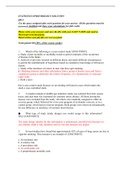
1. Which of the following is a case-control study? [ONE POINT] a. Study of past mortality or morbidity trends to permit estimates of the occurrence of disease in the future b. Analysis of previous research in different places and under different circumstances to permit the establishment of hypotheses based on cumulative knowledge of all known factors c. Study of the incidence of cancer in men who have quit smoking d. Obtaining histories and other information from a group of known cases and from a comparison group to determine the relative frequency of a characteristic or exposure under study e. Both a and c this is case control study because we are dealing with known cases which makes the study a case controlled study. 2. A random sample of middle age sedentary males was selected from four census tracts, and each man was examined for coronary artery disease. All those having the disease were excluded from the study. All others were randomly assigned to either an exercise group, which followed for a two-year program of systematic exercise, or to a control group, which had no exercise program. Both groups were observed semiannually for any difference in incidence of coronary heart disease. ● What type of study (study design) you would assign to this information? Why? [ONE POINT] The study design suitable for this information is randomized controlled trial because we can estimate relative risk, incidence and we can also measure any impact 3. Several studies have found that approximately 92% of cases of lung cancer are due to cigarette smoking. This measure is an example of: [ONE POINT] a. An incidence rate b. A relative risk c. A prevalence risk d. An attributable risk e. A proportionate mortality ratio this is attributable risk because it shows the difference in percent of people exposed to smoking and who don’t exposed to smoking 4. Researchers select 100 patients with colon cancer and 300 patients without colon cancer. Of the 100 patients with colon cancer, 15 smoke cigars while 40 of the 300 patients without colon cancer smoke cigars. a. Calculate a measure of association between colon cancer and cigar smoking. Show your work. [ONE POINT] Odds of exposure(case) = 15/85 = 0.18 Odds of exposure(control) = 40/360 = 0.11 Odds of ratio = 0.18/0.11 = 1.64 b. Interpret the measure of association you calculated. [ONE POINT] the odds of ratio is 1.64 which means we more chances of exposure among cases than the control group.
Document information
- Uploaded on
- June 26, 2022
- Number of pages
- 13
- Written in
- 2021/2022
- Type
- Exam (elaborations)
- Contains
- Questions & answers