ATI MED SURG STUDY GUIDE
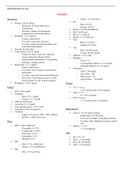
Lab Values Electrolytes Sodium: 136-145 mEq/L − Maintains cell fluids; helps nerves communicate − Deviation: changes in neurological complications; seizure precautions Potassium: 3.5-5.0 mEq/L − Cardiac complications − Too much: stops heart (asystole) − Too little: cardiac electrical instability and ventricular dysrhythmias Chloride: 98-106 mEq/L Total calcium: 9.0-10.5 mg/dL − Needed for bones, teeth, nerve impulses, muscle contraction, blood clotting − Muscle/cardiac implications r/t contractility − Imbalance: tingling, spasms Magnesium: 1.3-2.1 mg/dL − Cardiac implications − Too much: muscle weakness, hypotension, bradycardia − Too little: ventricular tachycardia/fibrillation − Prevents K+ from being excreted: too little decreased K+ levels heart problems Phosphorus: 3.0-4.5 mg/dL Kidneys BUN: 10-20 mg/dL Creatinine − Male: 0.6-1.2 mg/dL − Female: 0.5-1.1 mg/dL GFR: 90-120 mL/min Ammonia: 15-110 mg/dL Urine specific gravity: 1.015-1.030 Urine pH: 4.6-8.0 (average 6.0) Urinalysis − Negative for: glucose, RBC, WBC, albumin − Bacteria 1000 colonies/mL Blood WBC: 5,000-10,000/mm3 − Neutrophils: 45-75% − Lymphocytes: 16-46% − Monocytes: 4-11% − Eosinophils: 1-8% − Basophils: 0-3% RBC − Male: 4.7-6.1 million/mm3 − Female: 4.2-5.4 million/mm3 Hgb − Male: 14-18 g/100 mL − Female: 12-16 g/100 mL Hct − Male: 42-52% − Female: 37-47% Platelet: 150,000-400,000/mm3 MCV: 80-90 mm3 MCH: 27-31 pg/cell MCHC: 31-37% Hb/cell ESR − Male: 0-17 mm/h − Female: 0-25 mm/h Iron − Male: 80-180 mcg/dL − Female: 60-160 mcg/dL Albumin: 3.1-4.3 g/dL Bilirubin − Total: 0-1.0 − Unconjugated (indirect): 0.2-0.8 mg/dL − Conjugated (direct): 0.1-1.0 mg/dL Cholesterol − Total: 200 mg/dL − LDL (bad): 100 − HDL (good): 40 − Triglycerides: 150 mg/dL Clotting PT: 11-13 sec − 1.5-2x normal value if on Coumadin INR: 0.7-1.8 − 2-3 if on Coumadin PTT: 25-40 sec − 1.5-2x normal value if on heparin Blood Glucose Glucose: 70-105 mg/dL (fasting) − Postprandial: 70-140 mg/dL − Too much: polydipsia, polyphagia, polyuria − Too little: chills, diaphoresis, hunger, altered LOC HgbA1c: 6.5% − 7% for diabetics ABG pH: 7.35-7.45 PaCO2: 35-45 mmHg PaO2: 80-100 mmHg HCO3: 22-26 mmol/L @ShopWithKey on Etsy Cardiac Creatinine phosphokinase MB (CK-MB): 30-170 units/L − Increases 4-6 hours after MI and remains elevated for 24-72 hours Troponin: 0.2 ng/dL − Gold standard for determining if there was an MI GI/Endocrine Stomach pH: 1.5-2.5 Liver enzymes − ALT/SGPT: 8-20 units/L − AST/SGOT: 5-40 units/L (Kaplan says 8-20 units/L) − ALP: 42-128 units/L − Total protein: 6-8 gm/dL Pancreatic enzymes − Amylase: 56-90 IU/L − Lipase: 0-110 units/L − Prothrombin time: 0.8-1.2 TSH: 0.5-5.0 mcU/mL Med Levels Digoxin: 0.5-2.0 ng/mL Lithium: 0.8-1.4 mEq/L Dilantin: 10-20 mcg/mL Theophylline: 10-20 mcg/mL Metabolic Panel (BMP or CMP): test can be basic or comprehensive; assesses fluid/electro status, glucose, renal and liver function Complete blood count (CBC): assesses amount of cells in blood – platelets, WBC, RBC, Hgb, Hct Arterial Blood Gases (ABGs): assesses for acid-base imbalances in body – test important for respiratory or metabolic conditions Coagulation Levels: assesses clotting times (PT/INR or aPTT) – test important for many blood disorders and for pts on anticoagulants Lipid Panel (Lipid Profile): assesses for risk of cardiovascular disease by measuring lipoproteins, triglycerides, cholesterol Hemoglobin A1C: assesses average blood glucose level during past 3 months – great test to check glucose management in DM pts Drug Levels: assesses amount of drug present in system – many pts are on drugs with very narrow therapeutic drug range; this test helps determine if drug is sub-therapeutic or toxic in pts system Metabolic Panel • Glucose: 70–100 mg/dL • Calcium: 8.5–10.5 mg/L • Chloride: 95–105 mEq/L • Magnesium: 1.5–2.5 mg/dL • Phosphorus:2.5–4.5 mg/dL • Potassium: 3.5–5 mEq/L • Sodium: 135–145 mEq/L • BUN: 5–20 • Serum creatinine: 0.6–1.2 mg/dL • Total Protein: 6.2–8.2 g/dL • Albumin: 3.4–5.4 g/dL • Bilirubin: 0.1–1 mg/dL (1) (formed w/ breakdown of RBC – high levels in pts w/ jaundice) These 3 enzymes found in liver – if elevated, can indicate liver problems and other diseases: • ALP (alkaline phosphatase): 40–120 U/L (international units per liter) • ALT (alanine transaminase): 7–56 U/L • AST (aspartate transaminase) 10–40 U/L *this blood test can be ordered as BMP (basic metabolic panel) or CMP (comprehensive metabolic panel). CMP includes liver function Complete Blood Count • RBC: 4.5–5.5 million • WBC: 5,000–10,000 • Platelets: 150,000–400,000 • Hemoglobin: o 12–16 g/dL (women) @ShopWithKey on Etsy o 14–18 g/dL (men) • Hematocrit: o 37–47% (women) o 42–52% (men) Coagulation Levels • INR/PT: o PT (prothrombin time): 10–12 seconds (normal level for pts not on Warfarin) o INR (international normalized ration): 1 (normal level for pts not on Warfarin). When taking anticoagulant Warfarin, INR should be 2–3 INR level calculated from PT level • aPTT (activated partial thromboplastin time): o Normal 30–40 seconds (not on Heparin) o If on Heparin, aPTT needs to be 1.5–2.5 times normal range Lipid Panel (risk for cardiovascular disease) • LDL (low density lipoprotein): 100 mg/dL (want LOW) • HDL (high density lipoprotein): 60 mg/dL (want HIGH) • Total Cholesterol: 200 mg/dL • Triglycerides: 150 mg/ dL Hemoglobin A1C • 4–6% (target without diabetes) • 7% (target with diabetes) Leukocytosis: high WBC count; Causes: infection, inflammation, leukemia, extreme stress, meds-SE, etc. WBC w/ differential: looks at 5 types of WBCs • Monocytes (4-13%): fights infection and foreign substances • Eosinophils (1-5%): plays role in allergic response and parasite infections • Neutrophils (40-70%): fights bacterial infections • Basophils (0.1-2%): plays role in inflammatory conditions and allergy response • Lymphocytes (20-40%): fights viral infections RBC: 4.5-5.5 million – also called erythrocytes or red blood corpuscles • Main function is transport O2 throughout body and deliver CO2 to lungs to be exhaled….helps detect anemia, hemorrhage, etc. • Anemia: low RBC count • Polycythemia: high RBC; blood cancer – bone marrow make too many RBC Hemoglobin: protein on RBC that helps carry O2 in body • 12–16 g/dL (women) • 14–18 g/dL (men) Hematocrit: amount of RBCs compared to total blood volume • 37–47% (women) • 42–52% (men) Red blood cell indices (indices is plural form for index): this is a further look at the RBC. It tells us size of RBC and specifics about hgb, which is helpful w/ anemia (iron deficiency, vit-B12, folate etc.) • Mean Corpuscular Volume (MCV): size of RBC (80-100 fl) • Mean Corpuscular Hgb (MCH): amount of hgb in RBC (27-33 pg) • Mean Corpuscular Hgb Concentration (MCHC): RBC Hgb concentration (33-36 g/dL) • Red Cell Distribution Width (RDW) - (11-15%): measures variation of RBC size @ShopWithKey on Etsy Frequently used abbreviations Apply to memory 1. ac – before meals. As in taking medicine before meals 2. ad lib – at liberty 3. B.i.d. – twice daily. As in taking a medicine twice times daily. 4. T.i.d. – three times daily. As in taking a medicine three times daily. 5. Q.i.d. – four times daily. As in taking a medicine four times daily. 6. Q2h – every 2 hours. As in taking a medicine every 2 hours. 7. Q3h – every 3 hours. As in taking a medicine every 3 hours. 8. qAM – every morning 9. qPM – every evening 10. qhs – at bedtime 11. cap – capsule 12. gtt – drops 13. tab – tablets 14. IM – intramuscular 15. SQ – subcutaneous. 16. IV – intravenous 17. BP – blood pressure 18. ADL – Activities of daily living 19. Oral – mouth 20. Axilla – under the arm 21. R – rectal 22. Tympanic – in the ear 23. Canthus – corner of eyes 24. C & S – culture and sensitivity 25. C/O – complaint of 26. CBC – complete blood count 27. WBC – white blood count 28. cc – chief complaint 29. COPD – Chronic obstructive pulmonary disease 30. CVA – Cerebrovascular accident (Stroke) 31. D/C – discontinue 32. DM – diabetes mellitus 33. DNR – Do not resuscitate 34. DVT – deep venous thrombosis (blood clot in large vein). 35. FX – Fracture 36. H&H – History and physical examination 37. h.s. – at bedtime 38. HA – headache 39. HTN – hypertension 40. I&D – incision and drainage @ShopWithKey on Etsy 41. IU – international units 42. LLQ – Left lower quadrant 43. LUQ – Left upper quadrant 44. Lytes – electrolytes (potassium, sodium, carbon dioxide, chloride) 45. N/V – nausea or vomiting 46. NPO – Nothing by mouth 47. O.D. – Right eye 48. O.S. – left eye 49. O.U. – both eyes 50. p.o – by mouth 51. PRN – as needed 52. PERRLA – Pupils equal, round, and reactive to light and accommodation 53. PMI – point of maximum impulse 54. R/O – Rule out 55. RLQ – Right lower quadrant 56. RUQ – right upper quadrant 57. SOB – shortness of breath 58. UA or u/a – urinalysis 59. URI – Upper respiratory infection 60. UTI – urinary tract infection 61. O&P – Ova & parasites 62. Tachy – fast 63. Brady – slow 64. Hypo – low 65. Hyper – high 66. Pnea – breathing 67. TB – Tuberculosis 68. ANA – American Nurse Association 69. ROM – Range of motion 70. PROM – Passive range of motion 71. w/ - with 72. BM – bowel movement 73. NKA – no known allergies 74. HOB – Head of Bed 75. ICU – Intensive Care Unit 76. DX – diagnosis 77. FBS – fasting blood sugar 78. PT – patient or pint 79. STAT – at once or immediately 80. VS – vital signs 81. W/C – wheelchair 82. TPR – temperature, pulse, respiration 83. CBR – complete bed rest
Document information
- Uploaded on
- June 14, 2022
- Number of pages
- 152
- Written in
- 2021/2022
- Type
- Exam (elaborations)
- Contains
- Questions & answers