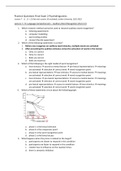
Practice Questions Final Exam 2 Psycholinguistics
Lecture 7 - 9, 11 + 12 (lab visit session 10 excluded), Leiden University, 2021-2022
Lecture 7 + 9: Language Comprehension – Auditory Word Recognition (Part I+II)
1. Which research method cannot be used to research auditory word recognition?
a. listening experiments
b. computer modelling
c. eye-tracking studies
d. connect the dot experiment
2. Which of the following statements is correct?
1. Before one recognizes an auditory word stimulus, multiple words are activated
2. After presenting the auditory stimulus comes the activation of words in the lexicon
a. Only 1 is correct
b. Only 2 is correct
c. Both are correct
d. Both are incorrect
3. Which of the following is the right model of word recognition?
a. hear stimulus → access to mental lexicon → pre-lexical representations → meanings
are activated → selection of correct word → word recognition point
b. pre-lexical representations → hear stimulus → access to mental lexicon → meanings
are activated → selection of correct word → word recognition point
c. hear stimulus → pre-lexical representations → access to mental lexicon → meanings
are activated → selection of correct word → word recognition point
d. pre-lexical representations → access to mental lexicon → hear stimulus → meanings
are activated → selection of correct word → word recognition point
4. Which of these statements is true about the following graph:
a. phase 1 is the lexical selection
b. phase 4 is the uniqueness point
c. phase 3 is the word recognition point
d. phase 2 is the lexical access
5. What happens when the prime is related to the target?
a. participants are slower to respond in this condition
b. participants are faster to respond in this condition
c. relation has no influence on the reaction times
d. there is semantic inhibition
, 6. How does semantic facilitation in speech comprehension experiments from speech
production experiments?
7. What does the cross-modal (associative) priming experiment look like?
8. True or false:
‘Trombone’ and ‘bone’ get activated at the same time
a. True
b. False
9. Which of the following sentences is incorrect about the cross-modal (associative) priming
experiment? (select 2)
a. A neutral context is a context in which both words are plausible
b. A biasing context is a context in which only one word makes sense in sentence
context
c. In the control context the word has no relation to the sentence context
d. In the carrier phrase the presented word makes sense in the sentence context
10. What does the cross-modal (associative) priming experiment show us?
a. competition
b. mismatch effects
c. multiple activation
d. lexical neighbourhood effects
11. Imagine there is an experiment with a design aligned with the visual world paradigm. There is
a picture of an ant, a slipper, a box and an bow. At which picture will the participant look if it
hears the word ‘row’?
a. ant
b. slipper
c. box
d. bow
12. The experiment with the visual world paradigms show us evidence of:
a. multiple activation
b. competition
c. lexical neighbourhood effects
d. mismatch effects
13. In the visual world paradigm with beaker as stimulus, what kind of word is the word ‘beetle’
a. cohort
b. rhyme
c. control
d. reference
14. In the visual world paradigm with beaker as stimulus, what kind of word is the word
‘carriage’
a. cohort
b. rhyme
c. control
d. reference
15. The visual world paradigm experiment uses:
a. reaction times (pressing buttons)
b. lexical decision
c. eye-tracking
d. mapping
Lecture 7 - 9, 11 + 12 (lab visit session 10 excluded), Leiden University, 2021-2022
Lecture 7 + 9: Language Comprehension – Auditory Word Recognition (Part I+II)
1. Which research method cannot be used to research auditory word recognition?
a. listening experiments
b. computer modelling
c. eye-tracking studies
d. connect the dot experiment
2. Which of the following statements is correct?
1. Before one recognizes an auditory word stimulus, multiple words are activated
2. After presenting the auditory stimulus comes the activation of words in the lexicon
a. Only 1 is correct
b. Only 2 is correct
c. Both are correct
d. Both are incorrect
3. Which of the following is the right model of word recognition?
a. hear stimulus → access to mental lexicon → pre-lexical representations → meanings
are activated → selection of correct word → word recognition point
b. pre-lexical representations → hear stimulus → access to mental lexicon → meanings
are activated → selection of correct word → word recognition point
c. hear stimulus → pre-lexical representations → access to mental lexicon → meanings
are activated → selection of correct word → word recognition point
d. pre-lexical representations → access to mental lexicon → hear stimulus → meanings
are activated → selection of correct word → word recognition point
4. Which of these statements is true about the following graph:
a. phase 1 is the lexical selection
b. phase 4 is the uniqueness point
c. phase 3 is the word recognition point
d. phase 2 is the lexical access
5. What happens when the prime is related to the target?
a. participants are slower to respond in this condition
b. participants are faster to respond in this condition
c. relation has no influence on the reaction times
d. there is semantic inhibition
, 6. How does semantic facilitation in speech comprehension experiments from speech
production experiments?
7. What does the cross-modal (associative) priming experiment look like?
8. True or false:
‘Trombone’ and ‘bone’ get activated at the same time
a. True
b. False
9. Which of the following sentences is incorrect about the cross-modal (associative) priming
experiment? (select 2)
a. A neutral context is a context in which both words are plausible
b. A biasing context is a context in which only one word makes sense in sentence
context
c. In the control context the word has no relation to the sentence context
d. In the carrier phrase the presented word makes sense in the sentence context
10. What does the cross-modal (associative) priming experiment show us?
a. competition
b. mismatch effects
c. multiple activation
d. lexical neighbourhood effects
11. Imagine there is an experiment with a design aligned with the visual world paradigm. There is
a picture of an ant, a slipper, a box and an bow. At which picture will the participant look if it
hears the word ‘row’?
a. ant
b. slipper
c. box
d. bow
12. The experiment with the visual world paradigms show us evidence of:
a. multiple activation
b. competition
c. lexical neighbourhood effects
d. mismatch effects
13. In the visual world paradigm with beaker as stimulus, what kind of word is the word ‘beetle’
a. cohort
b. rhyme
c. control
d. reference
14. In the visual world paradigm with beaker as stimulus, what kind of word is the word
‘carriage’
a. cohort
b. rhyme
c. control
d. reference
15. The visual world paradigm experiment uses:
a. reaction times (pressing buttons)
b. lexical decision
c. eye-tracking
d. mapping