

Samenvatting Immunopathologie:
Les 1: Herhaling
Begrippen:
Infectie: het binnendringen van MO in ons lichaam (vermenigvuldigen) en daar schade
aanrichten (ziekteverschijnselen)
Besmetting: (of contaminatie) overbrengen van ziektekiemen op weefsels of voorwerpen.
Het leidt niet altijd tot infectie bv. Als er voldoende goede weerstand is
→ Als het wel tot infectie leidt hangt het af van:
• De virulentie (aanvalskracht) vh mo
• De immuniteit/weerstand vd gastheer (de mens)
Ontsteking: reactie vh lichaam op infectie
Kenmerken → dolor, calor, tumor en rubor
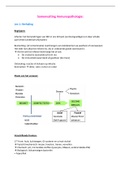
Plaats van het verweer:
Verschillende fronten:
1ste front: huid, luchtwegen, GI-systeem en urinair stelsel
→ Fysisch/mechanisch: niezen, hoesten, tranen, vervellen
→ Chemisch: pH, microcidale stoffen (lysozyme, RNasen, antimicrobiële EW)
→ Biologisch: lichaamseigen bacteriën
= Aspecifiek
,2de front: ontstekingsreactie
→ NK-cellen
→ Ontsteking/koorts = acute fase!
→ Antimicrobiële EW
• Acute fase EW, complement factoren en interferonen
= Aspecifiek
3de front: humorale en cellulaire acties vh specifiek verweer
→ Humoraal: Ig’s + cytokines (B-cellen en plasmacellen
→ Cellulair: T-cellen en NK-cellen
= Specifiek
Ontstekingsreactie:
Function laesa = functieverlies
Intacte huid doorbroken → invaderen
de MO, start van complex proces van
biochemische reacties (zodat ze niet
inde bloedbaan komen)
Cellen en eiwitten betrokken en
resulteert in versch symptomen van
een ontsteking (rubor, calor, dolor en
tumor) → vaak ook pyrogene stoffen
vrij door koortscentrum in de hersenen
te stimuleren (temp. Verhoging)
Neutro, MF en DC → fagocyteren van
invaderende bacteriën (zetten
cytokinen vrij, interleukines en TNF),
cytokine geven vasodilatie (uitzetten bloedvaten)
Cytokinen leiden ook tot aantrekken en stimulatie van andere fagocyterende cellen, deze
secreteren lytische enzymen en cytokinen, de zenuwuiteinden stimuleren
Lokale ophoping van dode cellen en vloeistof geeft pus of etter
Acute fase eiwitten:
Reactie op infectie of trauma
MF secreteren daar IL-1, IL-6 en TNF (veroorzaken reacties in lever)
• Via bloedstroom in de lever (bacteriële infecties)
• Lever produceert APP’s:
o C-reactief proteïne (CRP)
o Serum amyloïd A (SAA) → rekruteren immuuncellen naar plaats ontsteking
,Andere APP’s:
• Complement componenten: opsonisatie, lyse en
rekruteren immuuncellen naar plaats vd ontsteking
• Fibrinogeen: coagulatie
• Mannose binden eiwit: activering complement
• Alfa-1 antitrypsine: downreguleren vd ontstekingsreactie
• Ferritine: Fe-binding en opslag
• Haptoglobine: recuperatie van Fe uit Hgb voor opslag
inde lever
Complement factoren:
• 20-tal inactieve eiwitten in bloed
• Infectie → sequentie van reacties
o Klassieke pathway (AG-AL)
o Alternatieve pathway (vreemde celopp structuren)
o Lectine-pathway (binden welbepaalde koolhydraten)
• Vorming MAC = membraan aanvallend complex → lyse van bacteriële cellen
Cellen vh immuunsysteem:
Alle bloedcellen afgeleid van
pluripotente hematopoietische
stamcel → Pluripotent = leukocyt of
RBC of BP
NS verweer: myeloïde lijn
(eosinofielen, basofielen en
neutrofielen, monocyten MF en DC)
S verweer: lymfoïde lijn
Beide: NK en fagocyten
Moleculen specifiek verweer:
• Antigenen
• Immuunglobulinen
• MHC moleculen
• T-cel receptoren
, Antigenen:
Kan verschillende epitopen hebben
• Immunogeen: lokt immuunrespons uit en is zelf
doel van deze respons
• Tolerogeen: herhaalde blootstelling →
verminderde respons (immunogenen →
verhoogde respons)
• Allergeen: antigeen waartegen men een
hypergevoelige respons ontwikkelt
• Vaccin
• Hapteen
Immuunglobulinen:
Humaan Ig: 4 polypeptiden
• 2 identieke lichte ketens (kappa en lambda)
• 2 identieke zware ketens
→ Aan elkaar met S-S bruggen
NH terminus: 1L + 1H → epitoop bindingsplaats
(bestaan uit domeinen)
De hinge regio
Fab fragment = antigeen binden fragment
Fc = constant (crystalizable) fragment
Werking antilichamen:
1. Opsonisatie
Extracellulaire bacteriën worden door IgG’s
gemerkt waardoor ze een betere prooi
vormen voor MF
Les 1: Herhaling
Begrippen:
Infectie: het binnendringen van MO in ons lichaam (vermenigvuldigen) en daar schade
aanrichten (ziekteverschijnselen)
Besmetting: (of contaminatie) overbrengen van ziektekiemen op weefsels of voorwerpen.
Het leidt niet altijd tot infectie bv. Als er voldoende goede weerstand is
→ Als het wel tot infectie leidt hangt het af van:
• De virulentie (aanvalskracht) vh mo
• De immuniteit/weerstand vd gastheer (de mens)
Ontsteking: reactie vh lichaam op infectie
Kenmerken → dolor, calor, tumor en rubor
Plaats van het verweer:
Verschillende fronten:
1ste front: huid, luchtwegen, GI-systeem en urinair stelsel
→ Fysisch/mechanisch: niezen, hoesten, tranen, vervellen
→ Chemisch: pH, microcidale stoffen (lysozyme, RNasen, antimicrobiële EW)
→ Biologisch: lichaamseigen bacteriën
= Aspecifiek
,2de front: ontstekingsreactie
→ NK-cellen
→ Ontsteking/koorts = acute fase!
→ Antimicrobiële EW
• Acute fase EW, complement factoren en interferonen
= Aspecifiek
3de front: humorale en cellulaire acties vh specifiek verweer
→ Humoraal: Ig’s + cytokines (B-cellen en plasmacellen
→ Cellulair: T-cellen en NK-cellen
= Specifiek
Ontstekingsreactie:
Function laesa = functieverlies
Intacte huid doorbroken → invaderen
de MO, start van complex proces van
biochemische reacties (zodat ze niet
inde bloedbaan komen)
Cellen en eiwitten betrokken en
resulteert in versch symptomen van
een ontsteking (rubor, calor, dolor en
tumor) → vaak ook pyrogene stoffen
vrij door koortscentrum in de hersenen
te stimuleren (temp. Verhoging)
Neutro, MF en DC → fagocyteren van
invaderende bacteriën (zetten
cytokinen vrij, interleukines en TNF),
cytokine geven vasodilatie (uitzetten bloedvaten)
Cytokinen leiden ook tot aantrekken en stimulatie van andere fagocyterende cellen, deze
secreteren lytische enzymen en cytokinen, de zenuwuiteinden stimuleren
Lokale ophoping van dode cellen en vloeistof geeft pus of etter
Acute fase eiwitten:
Reactie op infectie of trauma
MF secreteren daar IL-1, IL-6 en TNF (veroorzaken reacties in lever)
• Via bloedstroom in de lever (bacteriële infecties)
• Lever produceert APP’s:
o C-reactief proteïne (CRP)
o Serum amyloïd A (SAA) → rekruteren immuuncellen naar plaats ontsteking
,Andere APP’s:
• Complement componenten: opsonisatie, lyse en
rekruteren immuuncellen naar plaats vd ontsteking
• Fibrinogeen: coagulatie
• Mannose binden eiwit: activering complement
• Alfa-1 antitrypsine: downreguleren vd ontstekingsreactie
• Ferritine: Fe-binding en opslag
• Haptoglobine: recuperatie van Fe uit Hgb voor opslag
inde lever
Complement factoren:
• 20-tal inactieve eiwitten in bloed
• Infectie → sequentie van reacties
o Klassieke pathway (AG-AL)
o Alternatieve pathway (vreemde celopp structuren)
o Lectine-pathway (binden welbepaalde koolhydraten)
• Vorming MAC = membraan aanvallend complex → lyse van bacteriële cellen
Cellen vh immuunsysteem:
Alle bloedcellen afgeleid van
pluripotente hematopoietische
stamcel → Pluripotent = leukocyt of
RBC of BP
NS verweer: myeloïde lijn
(eosinofielen, basofielen en
neutrofielen, monocyten MF en DC)
S verweer: lymfoïde lijn
Beide: NK en fagocyten
Moleculen specifiek verweer:
• Antigenen
• Immuunglobulinen
• MHC moleculen
• T-cel receptoren
, Antigenen:
Kan verschillende epitopen hebben
• Immunogeen: lokt immuunrespons uit en is zelf
doel van deze respons
• Tolerogeen: herhaalde blootstelling →
verminderde respons (immunogenen →
verhoogde respons)
• Allergeen: antigeen waartegen men een
hypergevoelige respons ontwikkelt
• Vaccin
• Hapteen
Immuunglobulinen:
Humaan Ig: 4 polypeptiden
• 2 identieke lichte ketens (kappa en lambda)
• 2 identieke zware ketens
→ Aan elkaar met S-S bruggen
NH terminus: 1L + 1H → epitoop bindingsplaats
(bestaan uit domeinen)
De hinge regio
Fab fragment = antigeen binden fragment
Fc = constant (crystalizable) fragment
Werking antilichamen:
1. Opsonisatie
Extracellulaire bacteriën worden door IgG’s
gemerkt waardoor ze een betere prooi
vormen voor MF


