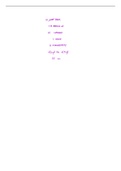
11 PREF
IN ADDINGUP
111 LUXURIES
I comp
11HOMOGENEITY
yip I clv.pl
Ill wi
, pig Ey
ME B
max qi y pi
ECON0013 Lecture Notes
Topic 1 : Budget
constraints and
consumer demand
Summary: Consumer choice is restricted by a↵ordability as captured by the budget constraint and this on its
own restricts the nature of demand functions in important ways. Dependence on the parameters of the budget
constraint are the basis for several ways to classify demands.
1.1 Budget constraint
Consumers purchase M goods q, lying in some set of possible values called the commodity space, typically q 0.
A↵ordability constrains them to choose from from within a budget set B of a↵ordable bundles. In the standard
model, prices p are constant and total spending has to remain within budget so that p0 q y where y is total budget.
Maximum a↵ordable quantity of any commodity is y/pi and slope @qi /@qj |B = pj /pi is constant and independent
of total budget as in Figure 1.1.
Figure 1.1: Budget set
In practical applications budget constraints are frequently kinked or discontinuous as a consequence, for example,
of taxation or non-linear pricing. If the price of a good rises with the quantity purchased (say because of taxation
1 c Ian Preston, 2007 - 2020
, convex
continuous
gradual din Be pi given qt
continuous
ECON0013 Lecture Notes
above a threshold) but without any discontinuity then the budget set is convex whereas if it falls (say because of a
bulk buying discount) or there is a jump (say because a price change applies to units below the threshold) then the
budget set is not convex. Examples are shown in Figures 1.2 and 1.3.
Figure 1.2: Nonlinear budget sets: rising price
Figure 1.3: Nonlinear budget sets: falling price
1.2 Marshallian demands
The consumer’s chosen quantities written as a function of y and p are the Marshallian demands or uncompensated
demands q = f (y, p)
Consider the e↵ects of changes in y and p on demand for, say, the ith good:
2 c Ian Preston, 2007 - 2020
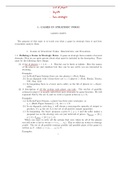
, LUXURY with pp
Necessity w t with pi I w indep of y
qi indep ofy
ECON0013 Lecture Notes
• total budget y
– the path traced out by demands as y increases is called the income expansion path (seen in Figure 1.4)
whereas the graph of fi (y, p) as a function of y is called the Engel curve (seen in Figure 1.5)
– we can summarise dependence in the total budget elasticity
y @qi @ ln qi
✏i = =
qi @y @ ln y
– if demand for a good rises with total budget, ✏i > 0, then we say it is a normal good and if it falls, ✏i < 0,
we say it is an inferior good
– if budget share of a good, wi = pi qi /y, rises with total budget, ✏i > 1, then we say it is a luxury or income
elastic good and if it falls, ✏i < 1, we say it is a necessity or income inelastic good. (These di↵erent cases
are shown in Figure 1.4.)
Figure 1.4: Variation with total budget
• own price pi
– the path traced out by demands as pi increases is called the o↵er curve (seen in Figure 1.6) whereas the
graph of fi (y, p) as a function of pi is called the demand curve (seen in 1.7)
– we can summarise dependence in the (uncompensated) own price elasticity
pi @qi @ ln qi
⌘ii = =
qi @pi @ ln pi
– if uncompensated demand for a good rises with own price, ⌘ii > 0, then we say it is a Gi↵en good
– if budget share of a good rises with price, ⌘ii > 1, then we say it is a price inelastic good and if it falls,
⌘ii < 1, we say it is a price elastic good. (These di↵erent cases are shown in Figure 1.6.)
4 c Ian Preston, 2007 - 2020
IN ADDINGUP
111 LUXURIES
I comp
11HOMOGENEITY
yip I clv.pl
Ill wi
, pig Ey
ME B
max qi y pi
ECON0013 Lecture Notes
Topic 1 : Budget
constraints and
consumer demand
Summary: Consumer choice is restricted by a↵ordability as captured by the budget constraint and this on its
own restricts the nature of demand functions in important ways. Dependence on the parameters of the budget
constraint are the basis for several ways to classify demands.
1.1 Budget constraint
Consumers purchase M goods q, lying in some set of possible values called the commodity space, typically q 0.
A↵ordability constrains them to choose from from within a budget set B of a↵ordable bundles. In the standard
model, prices p are constant and total spending has to remain within budget so that p0 q y where y is total budget.
Maximum a↵ordable quantity of any commodity is y/pi and slope @qi /@qj |B = pj /pi is constant and independent
of total budget as in Figure 1.1.
Figure 1.1: Budget set
In practical applications budget constraints are frequently kinked or discontinuous as a consequence, for example,
of taxation or non-linear pricing. If the price of a good rises with the quantity purchased (say because of taxation
1 c Ian Preston, 2007 - 2020
, convex
continuous
gradual din Be pi given qt
continuous
ECON0013 Lecture Notes
above a threshold) but without any discontinuity then the budget set is convex whereas if it falls (say because of a
bulk buying discount) or there is a jump (say because a price change applies to units below the threshold) then the
budget set is not convex. Examples are shown in Figures 1.2 and 1.3.
Figure 1.2: Nonlinear budget sets: rising price
Figure 1.3: Nonlinear budget sets: falling price
1.2 Marshallian demands
The consumer’s chosen quantities written as a function of y and p are the Marshallian demands or uncompensated
demands q = f (y, p)
Consider the e↵ects of changes in y and p on demand for, say, the ith good:
2 c Ian Preston, 2007 - 2020
, LUXURY with pp
Necessity w t with pi I w indep of y
qi indep ofy
ECON0013 Lecture Notes
• total budget y
– the path traced out by demands as y increases is called the income expansion path (seen in Figure 1.4)
whereas the graph of fi (y, p) as a function of y is called the Engel curve (seen in Figure 1.5)
– we can summarise dependence in the total budget elasticity
y @qi @ ln qi
✏i = =
qi @y @ ln y
– if demand for a good rises with total budget, ✏i > 0, then we say it is a normal good and if it falls, ✏i < 0,
we say it is an inferior good
– if budget share of a good, wi = pi qi /y, rises with total budget, ✏i > 1, then we say it is a luxury or income
elastic good and if it falls, ✏i < 1, we say it is a necessity or income inelastic good. (These di↵erent cases
are shown in Figure 1.4.)
Figure 1.4: Variation with total budget
• own price pi
– the path traced out by demands as pi increases is called the o↵er curve (seen in Figure 1.6) whereas the
graph of fi (y, p) as a function of pi is called the demand curve (seen in 1.7)
– we can summarise dependence in the (uncompensated) own price elasticity
pi @qi @ ln qi
⌘ii = =
qi @pi @ ln pi
– if uncompensated demand for a good rises with own price, ⌘ii > 0, then we say it is a Gi↵en good
– if budget share of a good rises with price, ⌘ii > 1, then we say it is a price inelastic good and if it falls,
⌘ii < 1, we say it is a price elastic good. (These di↵erent cases are shown in Figure 1.6.)
4 c Ian Preston, 2007 - 2020