

Question 1 pts
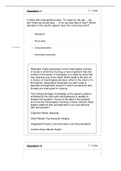
A client with schizophrenia says, “I’m away for the day ... but
don’t think we should play … or do we have feet of clay?” Which
alteration in the client’s speech does the nurse document?
Neologism
Word salad
Co
orrrec
ct! Clang association
Associative looseness
Rationale: Clang association is the meaningless rhyming
of words in which the rhyming is more important than the
context of the words. A neologism is a made-up word that
has meaning only to the client. Word salad is the term for
a mixture of meaningless phrases, either to the client or to
the listener. Associative looseness is a term used to
describe schizophrenic speech in which connections and
threads are interrupted or missing.
Test-Taking Strategy: Knowledge of the speech patterns
exhibited by the client with schizophrenia is needed to
answer this question. Focus on the data in the question
and note the meaningless rhyming of words. Review these
speech patterns with schizophrenia if you had difficulty
with this question.
Cognitive Ability: Applying
Client Needs: Psychosocial Integrity
Integrated Process: Communication and Documentation
Content Area: Mental Health
Question 2 pts
, A client with schizophrenia and his parents are meeting with the
nurse. One of the young man’s parents says to the nurse, “We
were stunned when we learned that our son had schizophrenia.
He was no different than from his older brother when they were
growing up. Now he’s had another relapse, and we can’t
understand why he stopped his medication.” Which response by
the nurse is appropriate?
Telling the parents, “Medication noncompliance is the most
frequent reason that people with this diagnosis relapse.”
Telling the parents, “Well, it’s his decision to take his medicine,
but it’s yours to have him live with you if he stops the
medication.”
Co
orrrec
ct!
Asking the client, “How can we help you to take your medicine or
to tell us when you’re having problems so that your medication
can be adjusted?”
Saying to the parents, “Your concerns are appropriate, but I
wonder whether your son was having trouble telling someone
that he had concerns about his medication.”
, Rationale: The therapeutic response is the one in which
the nurse models speaking directly to the client. This
facilitates further assessment of the situation and helps
elicit the causes of and motivations for the client’s
behavior for both the nurse and the family. In the correct
option, the nurse also seeks clarification of the degree of
openness and mutuality felt by the client and his family
toward each other. The nurse provides information to the
family when stating that noncompliance is the most
frequent reason for relapse in people with this diagnosis.
However, the statement is nontherapeutic at this time
because it does not facilitate the expression of feelings.
The nurse uses a superego style of communication when
stating, “Well, it’s his decision to take his medicine, but it’s
yours to have him live with you if he stops the medication.”
The content of this statement may be true, but it is
nontherapeutic in that it carries a threatening message
and may prevent the family from trusting the nurse. By
stating “Your concerns are appropriate, but I wonder
whether your son was having trouble telling someone that
he had concerns about his medication,” the nurse gives
approval and prematurely analyzes the client’s motivation
without sufficient assessment.
Test-Taking Strategy: Use your knowledge of therapeutic
communication techniques and remember to focus on the
client’s feelings. Also note that the correct option is the
only option in which the nurse directly addresses the
client. Review therapeutic communication techniques if
you had difficulty with this question.
Cognitive Ability: Applying
Client Needs: Psychosocial Integrity
Integrated Process: Communication and Documentation
Content Area: Mental Health
Question 3 pts
An acutely ill client with schizophrenia says to the nurse, “He
keeps saying that he likes you, and I keep telling him you’re
married, but he won’t listen, and I think he’s going to get fresh
with you.” Once the nurse has determined that the client is
, hallucinating, which response to the client would be most
appropriate statement?
Co
orrrec
ct!
“Try not to listen to the voices right now so that I can talk with
you.”
“I think that you can help him stop his behavior if you
concentrate.”
“Tell him I said to mind his p’s and q’s or I’ll call the police on
him.”
“I think that you’re trying to share your own feelings toward me,
but you’re shy.”
Rationale: The appropriate statement by the nurse is the
one that does not acknowledge the client’s hallucinations.
By responding “I think that you can help him stop his
behavior if you concentrate” or “Tell him I said to mind his
p’s and q’s or I’ll call the police on him,” the nurse
acknowledges the hallucinations. The nurse attempts to
interpret the client’s thinking with a statement such as “I
think that you’re trying to share your own feelings toward
me, but you’re shy.”
Test-Taking Strategy: Use your knowledge of therapeutic
communication techniques and remember that the nurse
should not acknowledge the client’s hallucinations. Also
note that the correct option is the only one that
encourages realistic verbalization from the client. Review
therapeutic communication techniques with a client who is
hallucinating if you had difficulty with this question.
Cognitive Ability: Applying
Client Needs: Psychosocial Integrity
Integrated Process: Communication and Documentation
Content Area: Mental Health
A client with schizophrenia says, “I’m away for the day ... but
don’t think we should play … or do we have feet of clay?” Which
alteration in the client’s speech does the nurse document?
Neologism
Word salad
Co
orrrec
ct! Clang association
Associative looseness
Rationale: Clang association is the meaningless rhyming
of words in which the rhyming is more important than the
context of the words. A neologism is a made-up word that
has meaning only to the client. Word salad is the term for
a mixture of meaningless phrases, either to the client or to
the listener. Associative looseness is a term used to
describe schizophrenic speech in which connections and
threads are interrupted or missing.
Test-Taking Strategy: Knowledge of the speech patterns
exhibited by the client with schizophrenia is needed to
answer this question. Focus on the data in the question
and note the meaningless rhyming of words. Review these
speech patterns with schizophrenia if you had difficulty
with this question.
Cognitive Ability: Applying
Client Needs: Psychosocial Integrity
Integrated Process: Communication and Documentation
Content Area: Mental Health
Question 2 pts
, A client with schizophrenia and his parents are meeting with the
nurse. One of the young man’s parents says to the nurse, “We
were stunned when we learned that our son had schizophrenia.
He was no different than from his older brother when they were
growing up. Now he’s had another relapse, and we can’t
understand why he stopped his medication.” Which response by
the nurse is appropriate?
Telling the parents, “Medication noncompliance is the most
frequent reason that people with this diagnosis relapse.”
Telling the parents, “Well, it’s his decision to take his medicine,
but it’s yours to have him live with you if he stops the
medication.”
Co
orrrec
ct!
Asking the client, “How can we help you to take your medicine or
to tell us when you’re having problems so that your medication
can be adjusted?”
Saying to the parents, “Your concerns are appropriate, but I
wonder whether your son was having trouble telling someone
that he had concerns about his medication.”
, Rationale: The therapeutic response is the one in which
the nurse models speaking directly to the client. This
facilitates further assessment of the situation and helps
elicit the causes of and motivations for the client’s
behavior for both the nurse and the family. In the correct
option, the nurse also seeks clarification of the degree of
openness and mutuality felt by the client and his family
toward each other. The nurse provides information to the
family when stating that noncompliance is the most
frequent reason for relapse in people with this diagnosis.
However, the statement is nontherapeutic at this time
because it does not facilitate the expression of feelings.
The nurse uses a superego style of communication when
stating, “Well, it’s his decision to take his medicine, but it’s
yours to have him live with you if he stops the medication.”
The content of this statement may be true, but it is
nontherapeutic in that it carries a threatening message
and may prevent the family from trusting the nurse. By
stating “Your concerns are appropriate, but I wonder
whether your son was having trouble telling someone that
he had concerns about his medication,” the nurse gives
approval and prematurely analyzes the client’s motivation
without sufficient assessment.
Test-Taking Strategy: Use your knowledge of therapeutic
communication techniques and remember to focus on the
client’s feelings. Also note that the correct option is the
only option in which the nurse directly addresses the
client. Review therapeutic communication techniques if
you had difficulty with this question.
Cognitive Ability: Applying
Client Needs: Psychosocial Integrity
Integrated Process: Communication and Documentation
Content Area: Mental Health
Question 3 pts
An acutely ill client with schizophrenia says to the nurse, “He
keeps saying that he likes you, and I keep telling him you’re
married, but he won’t listen, and I think he’s going to get fresh
with you.” Once the nurse has determined that the client is
, hallucinating, which response to the client would be most
appropriate statement?
Co
orrrec
ct!
“Try not to listen to the voices right now so that I can talk with
you.”
“I think that you can help him stop his behavior if you
concentrate.”
“Tell him I said to mind his p’s and q’s or I’ll call the police on
him.”
“I think that you’re trying to share your own feelings toward me,
but you’re shy.”
Rationale: The appropriate statement by the nurse is the
one that does not acknowledge the client’s hallucinations.
By responding “I think that you can help him stop his
behavior if you concentrate” or “Tell him I said to mind his
p’s and q’s or I’ll call the police on him,” the nurse
acknowledges the hallucinations. The nurse attempts to
interpret the client’s thinking with a statement such as “I
think that you’re trying to share your own feelings toward
me, but you’re shy.”
Test-Taking Strategy: Use your knowledge of therapeutic
communication techniques and remember that the nurse
should not acknowledge the client’s hallucinations. Also
note that the correct option is the only one that
encourages realistic verbalization from the client. Review
therapeutic communication techniques with a client who is
hallucinating if you had difficulty with this question.
Cognitive Ability: Applying
Client Needs: Psychosocial Integrity
Integrated Process: Communication and Documentation
Content Area: Mental Health


