Test Bank For Genetics from genes genomes 6 th Edition Hartwell 14
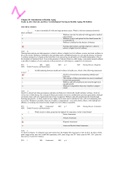
This is not the textbook!!! You are downloading Test Bank For Genetics from genes genomes 6 th Edition Hartwell 14 Genetics, 6e (Hartwell) Chapter 2 Mendel's Principles of Heredity 1) Why did Mendel perform reciprocal crosses? A) To obtain enough plants to perform the experiments that Mendel wanted. B) To test a hypothesis that stated the ovum carries all the information for progeny. C) To be able to breed plants year round. D) To determine whether the inheritance of a trait depends on which parent carries the trait. Answer: D Section: 2.01 Topic: Background - The Historical Puzzle of Inheritance Learning Objective: 02.01.03 Explain the importance of Mendel's inclusion of reciprocal crosses within his controlled breeding program of pea plants. Bloom's: 2. Understand Accessibility: KeyboardNavigation 2) What is the difference between cross- and self-fertilization? A) In cross-fertilization the pollen from one plant is used to fertilize the egg of another plant. B) In cross-fertilization the pollen from one plant is used to fertilize the egg from the same plant. C) In self-fertilization the pollen from one plant is used to fertilize the egg from another plant. D) In cross-fertilization insects are used to pollinate the plants, whereas in self-fertilization the investigator pollinates the plants. Answer: A Section: 2.01 Topic: Background - The Historical Puzzle of Inheritance Learning Objective: 02.01.02 Describe how Mendel cross-fertilized and self-fertilized pea plants. Bloom's: 2. Understand Accessibility: KeyboardNavigation 3) What is the outcome of crossing two pure-breeding plants with antagonistic traits? A) Only one of the traits will be seen in the progeny. B) Both traits will be seen in the progeny. C) Both traits will be seen in the progeny in a 3:1 ratio. D) Only one trait will be seen and it will be the trait of the female. Answer: A Section: 2.01 Topic: Background - The Historical Puzzle of Inheritance Learning Objective: 02.01.04 Predict the type of progeny produced by Mendel's crosses between pure-breeding plants with discrete, antagonistic traits, such as purple versus white flowers. Bloom's: 2. Understand Accessibility: KeyboardNavigatio
Written for
- Institution
-
Appalachian State University
- Course
-
Nursing
Document information
- Uploaded on
- May 2, 2022
- Number of pages
- 24
- Written in
- 2021/2022
- Type
- Exam (elaborations)
- Contains
- Questions & answers