Stress, Health and Disease Psychology Summary
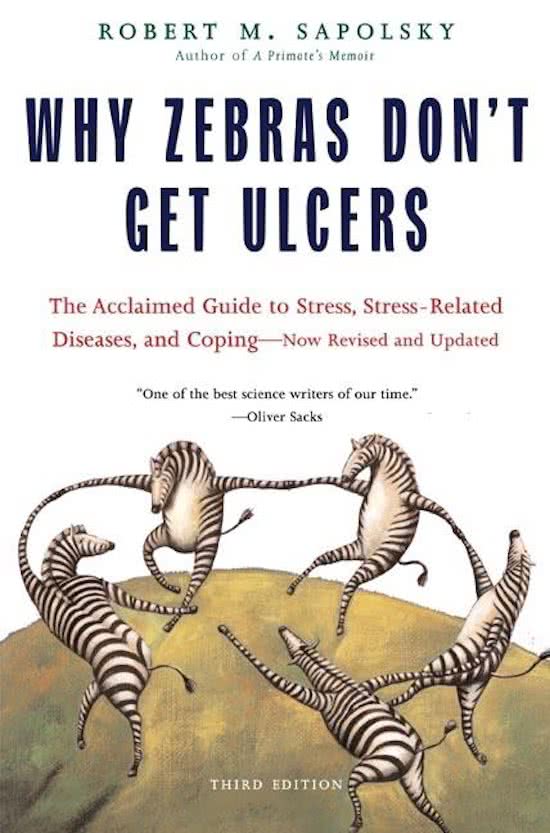
Sapolsky – Why Zebra’s Don’t Get Ulcers (third edition), 2004
Chapter 1
Types of stress(ors):
- acute physical
- chronical physical
- psychological
- social
Stressor: every possible threat to the attainment of psychobiological goals.
→ knocks you out of homeostatic balance
→ stressor can be from outside or the anticipation of it happening
Stress-response: negative emotional psychobiological response
→ re-establishes homeostasis
Hans Selye: 1930s, endocrinology – hormonal communication in the body. Discovered stress-related
disease. He found;
- The body has a surprisingly similar set of responses (which he called the general adaptation
syndrome, but which we now call the stress-response) to a broad array of stressors.
- If stressors go on for too long, they can make you sick
Homeostasis grounded in two ideas:
1. there is a single optimal level, number, amount for any given measure in the body (untrue)
2. you reach that ideal set point through some local regulatory mechanism, whereas allostasis
recognizes that any given set point can be regulated in a zillion different ways, each with its
own consequences
a. Allostase is een gebalanceerde staat van het lichaam. Het bereiken van allostase in
het lichaam is onder invloed van het afscheiden van stresshormonen en mediatoren
door het brein.
Vertebrates all have the same kind of bodily reaction to stress, because in all stressful situations the
organism needs to be ready to move rapidly.
Bodily stress response:
- increase breath/heart rate, sweat etc
- no reproduction (ovulation, erections, sex-drive)
- numbing the feeling of pain
- bad digestion
- growth and tissue repair halts
- immunity halts
- memory improves
- senses become sharper
Prolonged stress elicits stress related diseases → constantly mobilizing energy at the cost of energy
storage = never storing any surplus energy to put into long-term projects + stress hormones can
damage the brain when secreted for long period of time (allostatic load).
,Chapter 2
Autonomic nervous system:
- sympathetic: fight-or-flight, adrenaline/epinephrine, noradrenaline/norepinephrine, sex
o diverts blood flow to muscles
o neural route (neurotransmitters cause the next cell to do something different) or
o secretion of hormones by glands (messenger in bloodstream that affects events far
and wide)
▪ pituitary gland kicks the peripheral gland into action/secretion of hormones
▪ brain activates hormone secretion and can also inhibit it
▪ roger Guillemin and Andrew Schally began looking for brain hormones →
Nobel Prize 1976 → hypothalamus
▪ adrenal gland: adrenaline
- parasympathetic: calm vegetative activities
o diverts blood flow away from muscles
Stress hormones:
- epinephrine/norepinephrine: act within seconds
- glucocorticoids (=steroid=general chemical structure of 5 classes of hormones): act within
minutes or hours
(Thought of) Stress → hypothalamus secretes hormones like CRH (corticotropin releasing hormone).
→ CRH triggers pituitary to release ACTH (corticotropin) → adrenal gland → glucocorticoid +
adrenalin release
Complications:
- Taylor says that the fight-or-flight response differs in males and females. In females it’s tend-
and-befriend related to the hormone oxytocin. But females can have the fight-or-flight
response as well.
- stress causes a prompt decline in the secretion of growth hormone in rats, it causes a
transient increase in growth hormone secretion in humans
- in acute stress the glucocorticoids take too long to have effect → some help mediate the
recovery from the stress-response
- it is said that the stress-response is the same for every stressor, but this turns out to be
untrue as some stressors cause different reactions
o fe: Sympathetic arousal is a relative marker of anxiety and vigilance, while heavy
secretion of glucocorticoids is more a marker of depression.
- Two stressors can produce identical profiles of stress hormone release into the bloodstream.
Tissues in various parts of the body may be altered in their sensitivity to a stress hormone in
the case of one stressor, but not the other.
, Chapter 3
Stress response:
increase heart rate + blood pressure → increase blood flow through dilated arteries to muscles +
decrease blood flow to non-essential parts of your body (conserve water by inhibition of urine
formation in the kidneys fe)
Chronic Stress causes the heart to work hard for a long period of time, wearing it out and causing
1. hypertension (high blood pressure),
a. which can cause bifurcation: large blood vessels branch into smaller vessels which
are vulnerable to injury
b. plaque formation/atherosclerosis: crud sticks to damaged and inflamed blood
vessels
i. inflammatory damage is measured with C-reactive protein (CRP) which is
made in the liver and is secreted in response to a signal indicating injury
1. atherosclerosis can cause claudiation: lack of oxygen in legs and
chest.
ii. plaques teared loose are called thrombus. they can travel into smaller
arteries clogging it → myocardial infarct, a heart attack or brain infarct.
2. then left ventricular hypertrophy
3. and then cardiovascular disease (CVD).
a. also chances at this increase when one has high cholesterol
acute stress in already clogged coronary arteries: coronary arteries constrict, decreasing blood flow
to the heart even more → myocardial ischema: no more nutrients and oxygen in heart=chest
pain/angina pectoris
ambulatory electrocardiography: miniature ECG machine → finding: there were little ischemic crises
occurring all the time. So turns out, only when your cardiovascular systems are already damaged are
you sensitive to these crises.
when turning on the sympathetic nervous system all the time, you’re shutting of the
parasympathetic.
sudden cardiac death: extreme version of acute stress (positive or negative) causing ventricular
arrhythmia or, even worse, ventricular fibrillation (samentrekken spieren) plus ischemia in the
heart.
→ heeft te maken met het sympathische zenuwstelsel en komt meestal voor bij mensen van wie het
hartweefsel al wat beschadigd is en bij mensen die lijden aan atherosclerose.
Heart diseases are less common in women than in men, but they are still the biggest cause of death
in women in the US. The percentage is increasing in women, whereas it’s decreasing in men.
De volgende factoren vergroten de kans op hart- en vaatziekten bij vrouwen:
1. Stress.
2. Obesitas.
3. Smoking. The amount of smoking women decreases slower than men.
4. Oestrogen protects from heart diseases. From menopause on the oestrogen levels decrease.
a. De kind of oestrogen is important
b. De dose of oestrogen is important
Sapolsky – Why Zebra’s Don’t Get Ulcers (third edition), 2004
Chapter 1
Types of stress(ors):
- acute physical
- chronical physical
- psychological
- social
Stressor: every possible threat to the attainment of psychobiological goals.
→ knocks you out of homeostatic balance
→ stressor can be from outside or the anticipation of it happening
Stress-response: negative emotional psychobiological response
→ re-establishes homeostasis
Hans Selye: 1930s, endocrinology – hormonal communication in the body. Discovered stress-related
disease. He found;
- The body has a surprisingly similar set of responses (which he called the general adaptation
syndrome, but which we now call the stress-response) to a broad array of stressors.
- If stressors go on for too long, they can make you sick
Homeostasis grounded in two ideas:
1. there is a single optimal level, number, amount for any given measure in the body (untrue)
2. you reach that ideal set point through some local regulatory mechanism, whereas allostasis
recognizes that any given set point can be regulated in a zillion different ways, each with its
own consequences
a. Allostase is een gebalanceerde staat van het lichaam. Het bereiken van allostase in
het lichaam is onder invloed van het afscheiden van stresshormonen en mediatoren
door het brein.
Vertebrates all have the same kind of bodily reaction to stress, because in all stressful situations the
organism needs to be ready to move rapidly.
Bodily stress response:
- increase breath/heart rate, sweat etc
- no reproduction (ovulation, erections, sex-drive)
- numbing the feeling of pain
- bad digestion
- growth and tissue repair halts
- immunity halts
- memory improves
- senses become sharper
Prolonged stress elicits stress related diseases → constantly mobilizing energy at the cost of energy
storage = never storing any surplus energy to put into long-term projects + stress hormones can
damage the brain when secreted for long period of time (allostatic load).
,Chapter 2
Autonomic nervous system:
- sympathetic: fight-or-flight, adrenaline/epinephrine, noradrenaline/norepinephrine, sex
o diverts blood flow to muscles
o neural route (neurotransmitters cause the next cell to do something different) or
o secretion of hormones by glands (messenger in bloodstream that affects events far
and wide)
▪ pituitary gland kicks the peripheral gland into action/secretion of hormones
▪ brain activates hormone secretion and can also inhibit it
▪ roger Guillemin and Andrew Schally began looking for brain hormones →
Nobel Prize 1976 → hypothalamus
▪ adrenal gland: adrenaline
- parasympathetic: calm vegetative activities
o diverts blood flow away from muscles
Stress hormones:
- epinephrine/norepinephrine: act within seconds
- glucocorticoids (=steroid=general chemical structure of 5 classes of hormones): act within
minutes or hours
(Thought of) Stress → hypothalamus secretes hormones like CRH (corticotropin releasing hormone).
→ CRH triggers pituitary to release ACTH (corticotropin) → adrenal gland → glucocorticoid +
adrenalin release
Complications:
- Taylor says that the fight-or-flight response differs in males and females. In females it’s tend-
and-befriend related to the hormone oxytocin. But females can have the fight-or-flight
response as well.
- stress causes a prompt decline in the secretion of growth hormone in rats, it causes a
transient increase in growth hormone secretion in humans
- in acute stress the glucocorticoids take too long to have effect → some help mediate the
recovery from the stress-response
- it is said that the stress-response is the same for every stressor, but this turns out to be
untrue as some stressors cause different reactions
o fe: Sympathetic arousal is a relative marker of anxiety and vigilance, while heavy
secretion of glucocorticoids is more a marker of depression.
- Two stressors can produce identical profiles of stress hormone release into the bloodstream.
Tissues in various parts of the body may be altered in their sensitivity to a stress hormone in
the case of one stressor, but not the other.
, Chapter 3
Stress response:
increase heart rate + blood pressure → increase blood flow through dilated arteries to muscles +
decrease blood flow to non-essential parts of your body (conserve water by inhibition of urine
formation in the kidneys fe)
Chronic Stress causes the heart to work hard for a long period of time, wearing it out and causing
1. hypertension (high blood pressure),
a. which can cause bifurcation: large blood vessels branch into smaller vessels which
are vulnerable to injury
b. plaque formation/atherosclerosis: crud sticks to damaged and inflamed blood
vessels
i. inflammatory damage is measured with C-reactive protein (CRP) which is
made in the liver and is secreted in response to a signal indicating injury
1. atherosclerosis can cause claudiation: lack of oxygen in legs and
chest.
ii. plaques teared loose are called thrombus. they can travel into smaller
arteries clogging it → myocardial infarct, a heart attack or brain infarct.
2. then left ventricular hypertrophy
3. and then cardiovascular disease (CVD).
a. also chances at this increase when one has high cholesterol
acute stress in already clogged coronary arteries: coronary arteries constrict, decreasing blood flow
to the heart even more → myocardial ischema: no more nutrients and oxygen in heart=chest
pain/angina pectoris
ambulatory electrocardiography: miniature ECG machine → finding: there were little ischemic crises
occurring all the time. So turns out, only when your cardiovascular systems are already damaged are
you sensitive to these crises.
when turning on the sympathetic nervous system all the time, you’re shutting of the
parasympathetic.
sudden cardiac death: extreme version of acute stress (positive or negative) causing ventricular
arrhythmia or, even worse, ventricular fibrillation (samentrekken spieren) plus ischemia in the
heart.
→ heeft te maken met het sympathische zenuwstelsel en komt meestal voor bij mensen van wie het
hartweefsel al wat beschadigd is en bij mensen die lijden aan atherosclerose.
Heart diseases are less common in women than in men, but they are still the biggest cause of death
in women in the US. The percentage is increasing in women, whereas it’s decreasing in men.
De volgende factoren vergroten de kans op hart- en vaatziekten bij vrouwen:
1. Stress.
2. Obesitas.
3. Smoking. The amount of smoking women decreases slower than men.
4. Oestrogen protects from heart diseases. From menopause on the oestrogen levels decrease.
a. De kind of oestrogen is important
b. De dose of oestrogen is important