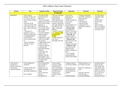
NUR 2407 EXAM 1 REVIEW
NUR 2407 EXAM 1 REVIEW | Guide your studies by knowing the drug classification and what it is used for with all meds included below; drugs in the same classifications have many similar side effects, nursing considerations, nursing interventions, and patient teaching. 10 Rights of Medication Administration – know what they are and what they mean (examples of each) right med right dose right time (within 30 min) right route right client right documentation ***NPO order overrides medication order!!! Proper documentation on MAR is required i.e. NPO. Later dose does not violate medication time because the order was followed. ***Pain meds can be given prior to physical therapy per medication order… Loading Dose: Large initial dose, known as the loading dose, of drug is given to achieve a rapid minimum effective concentration in the plasma. Illegible RX – nursing action (what to do?) Call the Physician Nursing considerations with regard to lack of medication compliance *** Asking why is part of the assessment. Why are they noncompliant? What is their education level? Half-life – what does it explain? Time period for a drug to decrease to one half of it’s peak level in the blood. Tolerance – what is it? Refers to a decreased responsiveness over the course of the therapy. Know the considerations with crushing medications – what can/can’t be crushed No longacting, sustained release, extended release, controlled release, enteric coated. (Ecotrine) Patient teaching for transdermal therapy Change location, make sure last medication is off, don’t rub ***Don’t shave because infection and quicker absorption. Can also cause irritation. Symptoms of allergic response and what to do Can’t breath, swell, rash… epinephrine or Benadryl *** Stop medication and call the doctor then Benadryl. Know the responses that the body has to adrenergics, cholinergics, adrenergic blockers, anticholinergics, sympathomimetics, sympatholytics. Sympathomimetics: AKA Adrenergic/Catecholamines Cause Hypertension, Tachycardia, Bronchodilation Used to treat wheezes, shock, and ADHD Activates the Adrenergic receptors Sympatholitics: AKA Adrenergic Blockers Cause hypotension and Bradycardia (must be monitored) Used to reduce BP, pulse, stop angina, and for glaucoma Blocks Adrenergic receptors Review the handout on ANS from class and compare it to the charts in purple boxes in Keep text that review what response each classification of these drugs causes – you will review that some classifications cause similar responses, yet responses may be more prominent in a specific classification – this takes critical thinking with regards to the medications primary purpose/effect Adrenergic beta blocker – Atenolol (Tenormin) – use, side effects RX that end in lol, RX to reduce B/P, RX to slow pulse, RX to stop angina, RX for glaucoma Use: to treat HTN, angina, MI, CHF Action: Blocks beta 1 adrenergic receptor sites and decrease sympathetic outflow to periphery Side Effects: Bradycardia, bronchoconstriction, drowsiness, dizziness, orthostatic hypotension, fainting, depression, alopecia, weakness, N/V/D, cool extremities, impotence and decreased libido Anticholinergics: side effects/nursing considerations (Cogentin) benzotropine – use, side effects, patient teaching ***Can be used to treat EPS except tardive dyskinesia Use: decrease involuntary symptoms of parkinsonism or drug induced parkinsonism Action: blocks cholinergic (muscarinic receptors) causes decrease in acetocholine to reduce excessive cholinergic activity Side effects: Nausea, vomiting, constipation, dry mouth, dry eyes, restlessness, flushing and dizziness, blurred vision and photophobia, pupil dilation, amnesia, confusion, weakness, hyperthermia, decreased sweating Anticholinergic - Atropine – use, side effects, nursing interventions and considerations with use and after dose Use: Eye exam (dilated pupils), pre-op to reduce salivation, increase HR for bradycardia Action: inhibits acetyholine by occupying the receptors, increase HR by blocking vagus stimulation Side effects: Can’t see, Can’t spit, Can’t pee, Can’t get rid of it CONSTIPATION Nursing interventions: Watch for tachycardia, Monitor fluid intake and fluid output, CONTRAINDICATED in Narrow angle glaucoma Cholinergics: side effects/nursing considerations Bethanacol Chloride (Urecholine) – use, side effects Use: Treat urinary retention Action: promotes contraction of the bladder, stimulates cholinergic (muscarinic receptors) Side effects: nausea, vomiting, diarrhea, salivation, sweating and flushing, frequent urination, blurred vision, bradycardia *** contraindicated in patients with asthma CNS Stimulant - Adderall (dextroamphetamine), Methylphenidate (Ritalin) – use, client teaching, nursing considerations, dose timing Use: ADHD, obesity, narcolepsy Action: increase neurotransmitter dopamine, serotonin and norepinephrine Side effects: Weight loss, insomnia, nervousness, HTN, tachycardia, palpitations decrease appetite, Nursing consideration: Controlled II drug, give before 4pm (should be used with lowest effective dose) Cholinergic - Aricept (donepezil) – use, side effects Use: Improve congnitive function in Alzheimer’s Disease Action: increases acetocholine in the brain and improves cognitive function i.e. dementia Side effects: nausea, GI upset and BLEEDING, bradycardia, and syncope, SEIZURES Sedative/Hypnotic Benzodiazepines – mechanism of action, side effects, precautions, contraindications (i.e. Alprazolam (Xanax), Lorazepam (Ativan), Midazolam (Versed), Temazepam (Restoril) Use: Anxiety, insomnia, agitation, pre-op, conscious sedation, delirium tremens (DT’s), status epilepticus Mechanism of action: Enhance inhibitory effects of transmitter GABA Side effects: dizziness, confusion, anxiety, drowsiness, Precautions: CAN CAUSE PERIDOXICAL EFFECT, use cautiously in patients with hepatic or renal dysfunction HIGH RISK of TOXICITY S/S weakness, slurred speech, ataxia, unccordination of movement, resp. depression ANTIDOTE – romazicon/flumazenil Contraindication: Kava-Kava and Valerian increase risk of sedation, Cimetidine increase benzo levels
Written for
- Institution
-
Rasmussen College
Document information
- Uploaded on
- April 29, 2022
- Number of pages
- 14
- Written in
- 2021/2022
- Type
- Exam (elaborations)
- Contains
- Questions & answers

Also available in package deal