

Respiration
Respiration overview
Respiration
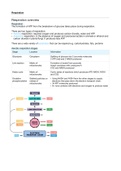
The formation of ATP from the breakdown of glucose takes place during respiration.
There are two types of respiration:
• Aerobic respiration: requires oxygen and produces carbon dioxide, water and ATP
• Anaerobic respiration: in the absence of oxygen and produces lactate in animals or ethanol and
carbon dioxide in plants/fungi. It produces less ATP
There are a wide variety of substrates that can be respired e.g. carbohydrates, fats, proteins
Aerobic respiration stages
Stage Location Information
Glycolysis Cytoplasm Splitting of glucose into 2 pyruvate molecules
2 ATP (net) and 2 NADH produced
Link reaction Matrix of Formation of acetyl from pyruvate
mitochondria Acetyl combines with coenzyme A
CO2 and NADH produced
Krebs cycle Matrix of Cyclic series of reactions which produces ATP, NADH, FADH
mitochondria and CO2
Oxidative Stalked particles on • Using NADH and FADH from the other stages to supply
phosphorylation cristae of electrons that pass down the electron transport chain.
mitochondria • 34 ATP molecules produced
• H+ ions combine with electrons and oxygen to produce water
, Mitochondria
Respiration occurs in mitochondria, which are organelles found within cells.
Occur in greater numbers in metabolically active cells and these mitochondria also have more
densely packed cristae which provide greater surface area for membrane enzymes and other
proteins
Structure:
Outer membrane Barrier that stops large molecules from entering the mitochondria and
interfering with the Krebs cycle. It allows pyruvate to cross into the matrix
inner membrane Has electron carriers and ATP synthase embedded within stalked particles
Inter membrane space Build up of H+ ions here which can diffuse through ATP synthase channels to
synthesise ATP in chemiosmosis
Cristae Inner membrane space is highly folded which increases the surface area to
hold electron carriers and ATP synthase molecules
Matrix where enzymes of the Krebs cycle are found
ATP synthase Spans the inner membrane and has a channel in it which allows H+ ions to
pass through which causes ATP synthesis.
Glycolysis
Glycolysis
• First stage in anaerobic and aerobic respiration
• Occurs in cytoplasm
Step 1: Phosphorylation of glucose
Hexose glucose is very stable and it needs to be phosphorylated to make it more reactive and
easier to split. Two phosphate groups are added to the hexose and this uses 2 molecules of ATP
Respiration overview
Respiration
The formation of ATP from the breakdown of glucose takes place during respiration.
There are two types of respiration:
• Aerobic respiration: requires oxygen and produces carbon dioxide, water and ATP
• Anaerobic respiration: in the absence of oxygen and produces lactate in animals or ethanol and
carbon dioxide in plants/fungi. It produces less ATP
There are a wide variety of substrates that can be respired e.g. carbohydrates, fats, proteins
Aerobic respiration stages
Stage Location Information
Glycolysis Cytoplasm Splitting of glucose into 2 pyruvate molecules
2 ATP (net) and 2 NADH produced
Link reaction Matrix of Formation of acetyl from pyruvate
mitochondria Acetyl combines with coenzyme A
CO2 and NADH produced
Krebs cycle Matrix of Cyclic series of reactions which produces ATP, NADH, FADH
mitochondria and CO2
Oxidative Stalked particles on • Using NADH and FADH from the other stages to supply
phosphorylation cristae of electrons that pass down the electron transport chain.
mitochondria • 34 ATP molecules produced
• H+ ions combine with electrons and oxygen to produce water
, Mitochondria
Respiration occurs in mitochondria, which are organelles found within cells.
Occur in greater numbers in metabolically active cells and these mitochondria also have more
densely packed cristae which provide greater surface area for membrane enzymes and other
proteins
Structure:
Outer membrane Barrier that stops large molecules from entering the mitochondria and
interfering with the Krebs cycle. It allows pyruvate to cross into the matrix
inner membrane Has electron carriers and ATP synthase embedded within stalked particles
Inter membrane space Build up of H+ ions here which can diffuse through ATP synthase channels to
synthesise ATP in chemiosmosis
Cristae Inner membrane space is highly folded which increases the surface area to
hold electron carriers and ATP synthase molecules
Matrix where enzymes of the Krebs cycle are found
ATP synthase Spans the inner membrane and has a channel in it which allows H+ ions to
pass through which causes ATP synthesis.
Glycolysis
Glycolysis
• First stage in anaerobic and aerobic respiration
• Occurs in cytoplasm
Step 1: Phosphorylation of glucose
Hexose glucose is very stable and it needs to be phosphorylated to make it more reactive and
easier to split. Two phosphate groups are added to the hexose and this uses 2 molecules of ATP


