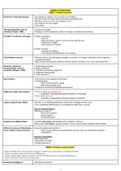
TERMS & DEFINITIONS
WEEK 1 Emotion theories
Emotions in folk psychology • You should be rational, not act upon your emotions
• My heart says one thing, but my head says something else…
• Emotions come over me, they happen to me…
• You need to vent your anger…
• Time heals…
The functionalistic view on • Concern is at stake
emotions (Frijda, 1986) • Changes in action readiness: aimed to change or maintain relationships
Function of sadness and anger Function of sadness
- I give up
- leave me alone, i have to come to terms with this loss
- I need time to digest
- Gain support or empathy
Function of anger
- I still want something
- I can still gain something from this situation
Physiological arousal • Primary function of physiological changes is provision of energy, mobilization of the organism
→ prepare for action
• Little evidence that specific patterns underlie specific emotions (e.g., heart rate, blood flow)
Emotions: based on 1. Physiological arousal
functionalisitic view on 2. Motor expression
emotions (Scherer, 2000) 3. Cognitive processing (appraisal)
4. Subjective feeling state
5. Action tendency
Deaf children • >90% grows up in hearing environment
• Consequences:
- fewer communication means
- little communication time
• Problems in social and emotional development
Difference anger and sadness • Sadness: focus on consequence
- Evaluation: reinstatement desired situation is impossible
• Anger: focus on cause
- Evaluation: reinstatement desired situation is possible
James-Lange theory (1884) • Emotion is our feeling (awareness) of the bodily changes as they occur
• Thus, subjective feeling state is a consequence rather than a cause.
Open to misinterpretation!
• Blushing is a sign of:
- Room is too warm?
- Upcoming flu?
- Embarrassment?
Emotions and Mood states • Emotion: direct link with specific event / situation / memory
• Mood state: not linked to specific situation cause unclear longer duration lower intensity
Different sources of information Everyone experiences emotions
teach children about emotions - When these emotions are experienced and how they are expressed is learned →
socialization
Sources of information
• Self observation
• Observation of others
• (Verbal) passing on
WEEK 2 Emotion communication
• When children show more positive emotions, mothers are more willing to do things for them.
• Sadness evokes stress and hormonal differences.
• Anger evokes anger itself or rejection, so often this gets ignored or reacted negatively on.
• Anger expression depends on relationship
Emotional Intelligence • Emotional recognition
1
, • Empathy
• Emotional awareness
• Moral emotions
• Emotional vocabulary
• Emotional regulation
Infants’ smiles (Messinger, • Neonates (<4w age) smile, also during sleep
2008) • From age 1m, two kinds of smiles, especially during positive interactions
1. Duchenne smiles (in half of the infants)
2. Open mouth smiles (one tenth of sample)
Function of smiling
• Smiling signals joy, but also ‘it’s okay’
• Powerful request for positive response
• Establish and maintain relationships
• With caregivers: stimulates attachment
• Smiling behavior in infancy is predictive of later development 10
Infants’ smiles, development
• Neonates smile; why & when unclear
- 1-2m, social smile: reaction to positive interaction caregiver (tickling, high pitched voice)
- 3m, social smile to unfamiliar people
- 6-12 m, laughter, smiling at mastery, referential smiling
Emotion Socialization; how • We all like positive emotions
does it work? - Expressing negative emotions less accepted requires better social skills
- Children need to learn social rules when / how strongly to express negative emotions
Mothers’ responses (Buss & When children show more positive emotions, mothers are more willing to do things for them. Sadness
Kiel, 2004) evokes stress and hormonal differences. Anger evokes anger itself or rejection, so often this gets
ignored or reacted negatively on.
• More warmth to child’s
- Positive emotions
- Sadness expressions
- But ignore anger / react negatively
Toddlers looking at their • Threat situation (stranger walks in)
mothers(Buss & Kiel, 2004) • Frustration (toy removal/in locked box)
• Looks to mother coded for
- anger, sadness, fear
- intensity
Results
Threat situations: more intense fear-looks at mother
Frustration situations: anger-looks no changes, more sad-looks at mother
Conclusion
- Anger doesn’t intensify in frustrating situation, but sadness intensifies
- So anger expression is not helpful if you want support from your caregiver, because
caregivers tend to reject anger or ignore this
- Sadness will get sympathy
Regulating emotion expression When emotion experience and expression can interfere with personal goals
Approaches in cross cultural • Ethnocentrism: own culture superior
psychology • Absolutism: equal
• Relativism: within each culture
• Universalism: universal, but culture affects development and display
Expressing sadness or fear • Threat reducing
according to Jenkins & Ball • Evokes more prosocial responses than anger
• Study showed that 6-12 year old children understand these functions
Expressing anger according to • Goal reinstatement; expression shows dominance / power.
Jenkins & Ball • In nonhuman primates: low status individuals rarely show aggression towards high status individuals.
• Anger responses often replied to with anger
Anger expression depends on • With good friend: to resolve conflict / restoration relationship
relationship (Saarni, 1999) • With rivaling sibling: instrumental repair, less remorse, unstable harmony
• Within hostile relationship: further escalation
Anger expression / • Chinese children:
2
WEEK 1 Emotion theories
Emotions in folk psychology • You should be rational, not act upon your emotions
• My heart says one thing, but my head says something else…
• Emotions come over me, they happen to me…
• You need to vent your anger…
• Time heals…
The functionalistic view on • Concern is at stake
emotions (Frijda, 1986) • Changes in action readiness: aimed to change or maintain relationships
Function of sadness and anger Function of sadness
- I give up
- leave me alone, i have to come to terms with this loss
- I need time to digest
- Gain support or empathy
Function of anger
- I still want something
- I can still gain something from this situation
Physiological arousal • Primary function of physiological changes is provision of energy, mobilization of the organism
→ prepare for action
• Little evidence that specific patterns underlie specific emotions (e.g., heart rate, blood flow)
Emotions: based on 1. Physiological arousal
functionalisitic view on 2. Motor expression
emotions (Scherer, 2000) 3. Cognitive processing (appraisal)
4. Subjective feeling state
5. Action tendency
Deaf children • >90% grows up in hearing environment
• Consequences:
- fewer communication means
- little communication time
• Problems in social and emotional development
Difference anger and sadness • Sadness: focus on consequence
- Evaluation: reinstatement desired situation is impossible
• Anger: focus on cause
- Evaluation: reinstatement desired situation is possible
James-Lange theory (1884) • Emotion is our feeling (awareness) of the bodily changes as they occur
• Thus, subjective feeling state is a consequence rather than a cause.
Open to misinterpretation!
• Blushing is a sign of:
- Room is too warm?
- Upcoming flu?
- Embarrassment?
Emotions and Mood states • Emotion: direct link with specific event / situation / memory
• Mood state: not linked to specific situation cause unclear longer duration lower intensity
Different sources of information Everyone experiences emotions
teach children about emotions - When these emotions are experienced and how they are expressed is learned →
socialization
Sources of information
• Self observation
• Observation of others
• (Verbal) passing on
WEEK 2 Emotion communication
• When children show more positive emotions, mothers are more willing to do things for them.
• Sadness evokes stress and hormonal differences.
• Anger evokes anger itself or rejection, so often this gets ignored or reacted negatively on.
• Anger expression depends on relationship
Emotional Intelligence • Emotional recognition
1
, • Empathy
• Emotional awareness
• Moral emotions
• Emotional vocabulary
• Emotional regulation
Infants’ smiles (Messinger, • Neonates (<4w age) smile, also during sleep
2008) • From age 1m, two kinds of smiles, especially during positive interactions
1. Duchenne smiles (in half of the infants)
2. Open mouth smiles (one tenth of sample)
Function of smiling
• Smiling signals joy, but also ‘it’s okay’
• Powerful request for positive response
• Establish and maintain relationships
• With caregivers: stimulates attachment
• Smiling behavior in infancy is predictive of later development 10
Infants’ smiles, development
• Neonates smile; why & when unclear
- 1-2m, social smile: reaction to positive interaction caregiver (tickling, high pitched voice)
- 3m, social smile to unfamiliar people
- 6-12 m, laughter, smiling at mastery, referential smiling
Emotion Socialization; how • We all like positive emotions
does it work? - Expressing negative emotions less accepted requires better social skills
- Children need to learn social rules when / how strongly to express negative emotions
Mothers’ responses (Buss & When children show more positive emotions, mothers are more willing to do things for them. Sadness
Kiel, 2004) evokes stress and hormonal differences. Anger evokes anger itself or rejection, so often this gets
ignored or reacted negatively on.
• More warmth to child’s
- Positive emotions
- Sadness expressions
- But ignore anger / react negatively
Toddlers looking at their • Threat situation (stranger walks in)
mothers(Buss & Kiel, 2004) • Frustration (toy removal/in locked box)
• Looks to mother coded for
- anger, sadness, fear
- intensity
Results
Threat situations: more intense fear-looks at mother
Frustration situations: anger-looks no changes, more sad-looks at mother
Conclusion
- Anger doesn’t intensify in frustrating situation, but sadness intensifies
- So anger expression is not helpful if you want support from your caregiver, because
caregivers tend to reject anger or ignore this
- Sadness will get sympathy
Regulating emotion expression When emotion experience and expression can interfere with personal goals
Approaches in cross cultural • Ethnocentrism: own culture superior
psychology • Absolutism: equal
• Relativism: within each culture
• Universalism: universal, but culture affects development and display
Expressing sadness or fear • Threat reducing
according to Jenkins & Ball • Evokes more prosocial responses than anger
• Study showed that 6-12 year old children understand these functions
Expressing anger according to • Goal reinstatement; expression shows dominance / power.
Jenkins & Ball • In nonhuman primates: low status individuals rarely show aggression towards high status individuals.
• Anger responses often replied to with anger
Anger expression depends on • With good friend: to resolve conflict / restoration relationship
relationship (Saarni, 1999) • With rivaling sibling: instrumental repair, less remorse, unstable harmony
• Within hostile relationship: further escalation
Anger expression / • Chinese children:
2