Lecture 1
Operations management = the activity of managing the resources that create and deliver
services and products. Everything you see/consumed has been produced by an operation.
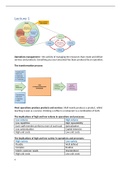
The transformation process:
Most operations produce products and services. Shell mainly produces a product, whilst
teaching is seen as a service. Drinking a coffee in a restaurant is a combination of both.
The implications of high and low volume in operations and processes:
Low volume High volume
Low repetition High repeatability
Each staff member performs more of each task Specialization
Less systemization Capital intensive
High unit costs Low unit costs
The implications of high and low variety in operations and processes:
High variety Low variety
Flexible Well defined
Complex Routine
Match customer needs Standardized
High unit costs Low unit costs
1
,The implications of high and low variation in operations and processes:
High variation Low variation
Changing capacity Stable
Anticipation Routine
Flexibility Predictable
In touch with demand High utilization
High unit costs Low unit costs
The implications of high and low visibility in operations and processes:
High visibility Low visibility
Short waiting tolerance Time lag between
production and
consumption
Satisfaction governed by customer perception Standardization
Customer contact skills needed Low contact skills
Received variety is high High staff utilization
High unit costs Low unit costs
It is important to understand how different operations are positioned on the 4 Vs.
Is their position where they want to be?
Do they understand the strategic implications of their position?
3 levels of operations performance:
- Societal level – operations sustainability.
o Planet, people, sustainability, profit.
- Strategic level – operations strategic impact.
o Learning, capital, risk, cost, revenue.
- Operational level – operations performance objectives.
o Quality, speed, dependability, flexibility, cost (1,2).
OM’s contribution to the ‘economic bottom line’:
- High efficiency, less waste lower operating costs (1).
- Enhanced service for customers higher revenue (2).
- Higher utilization of operations capacity less capital required to provide capacity.
- Opportunities for process learning and improvement.
- Less failure, reduced errors, better resilience lower risk of operations failure.
The 5 operations’ performance objectives (competitiveness):
1. Quality being right.
2. Speed being fast.
3. Dependability being reliable.
4. Flexibility being able to change.
5. Cost being productive.
Dependability is about the process’s ability to make or deliver the product or service.
Quality is about the product or service itself.
2
, 2 common meaning of quality:
- The specification of a product or service.
E.g. a farm produces organic meat raised exclusively on its own farm.
- The conformance with which the product or service is produced.
E.g. McDonalds’s may buy less expensive meat, but its conformance must be high.
Quality (externally) = enhances the product or service in the market, or at least avoids
customer complaints.
Quality (internally) = prevents errors slowing down throughput speed, causing internal
unreliability, low dependability, and causing wasted time and effort, therefore saving cost.
Speed (externally) = the elapsed time between a customer asking for a product or service
and getting it. It often enhances the value of the product or service to customers.
Speed (internally) = it helps to overcome internal problems by maintaining dependability,
and it reduces the need to manage transformed resources as they pass through the
operation, therefore saving cost.
Dependability (externally) = enhances the product or service in the market, or at least
avoids customer complaints.
Dependability (internally) = prevents late delivery slowing down throughput speed and it
prevents lateness causing disruption, wasted time and effort, therefore saving cost.
Flexibility is always associated with an operation’s ability to change. Change what?
- The products and services it brings to the market (product/service flexibility).
- The mix of products and services it produces at any one time (mix flexibility).
- The volume of products and services it produces (volume flexibility).
- The delivery time of its products and services (delivery flexibility).
Polar diagrams are used to indicate the relative importance of each performance objective
to an operation or process. They can also be used to indicate the difference between
different products and services produced by an operation or process.
A strategy concerns the decisions which are widespread in their effect on the organization to
which the strategy refers, define the position of the organization relative to its environment
and more the organization closer to its long-term goals.
Operations = the resources that create products and services.
Operational = the opposite of strategic, meaning day-to-day and detailed.
3
Operations management = the activity of managing the resources that create and deliver
services and products. Everything you see/consumed has been produced by an operation.
The transformation process:
Most operations produce products and services. Shell mainly produces a product, whilst
teaching is seen as a service. Drinking a coffee in a restaurant is a combination of both.
The implications of high and low volume in operations and processes:
Low volume High volume
Low repetition High repeatability
Each staff member performs more of each task Specialization
Less systemization Capital intensive
High unit costs Low unit costs
The implications of high and low variety in operations and processes:
High variety Low variety
Flexible Well defined
Complex Routine
Match customer needs Standardized
High unit costs Low unit costs
1
,The implications of high and low variation in operations and processes:
High variation Low variation
Changing capacity Stable
Anticipation Routine
Flexibility Predictable
In touch with demand High utilization
High unit costs Low unit costs
The implications of high and low visibility in operations and processes:
High visibility Low visibility
Short waiting tolerance Time lag between
production and
consumption
Satisfaction governed by customer perception Standardization
Customer contact skills needed Low contact skills
Received variety is high High staff utilization
High unit costs Low unit costs
It is important to understand how different operations are positioned on the 4 Vs.
Is their position where they want to be?
Do they understand the strategic implications of their position?
3 levels of operations performance:
- Societal level – operations sustainability.
o Planet, people, sustainability, profit.
- Strategic level – operations strategic impact.
o Learning, capital, risk, cost, revenue.
- Operational level – operations performance objectives.
o Quality, speed, dependability, flexibility, cost (1,2).
OM’s contribution to the ‘economic bottom line’:
- High efficiency, less waste lower operating costs (1).
- Enhanced service for customers higher revenue (2).
- Higher utilization of operations capacity less capital required to provide capacity.
- Opportunities for process learning and improvement.
- Less failure, reduced errors, better resilience lower risk of operations failure.
The 5 operations’ performance objectives (competitiveness):
1. Quality being right.
2. Speed being fast.
3. Dependability being reliable.
4. Flexibility being able to change.
5. Cost being productive.
Dependability is about the process’s ability to make or deliver the product or service.
Quality is about the product or service itself.
2
, 2 common meaning of quality:
- The specification of a product or service.
E.g. a farm produces organic meat raised exclusively on its own farm.
- The conformance with which the product or service is produced.
E.g. McDonalds’s may buy less expensive meat, but its conformance must be high.
Quality (externally) = enhances the product or service in the market, or at least avoids
customer complaints.
Quality (internally) = prevents errors slowing down throughput speed, causing internal
unreliability, low dependability, and causing wasted time and effort, therefore saving cost.
Speed (externally) = the elapsed time between a customer asking for a product or service
and getting it. It often enhances the value of the product or service to customers.
Speed (internally) = it helps to overcome internal problems by maintaining dependability,
and it reduces the need to manage transformed resources as they pass through the
operation, therefore saving cost.
Dependability (externally) = enhances the product or service in the market, or at least
avoids customer complaints.
Dependability (internally) = prevents late delivery slowing down throughput speed and it
prevents lateness causing disruption, wasted time and effort, therefore saving cost.
Flexibility is always associated with an operation’s ability to change. Change what?
- The products and services it brings to the market (product/service flexibility).
- The mix of products and services it produces at any one time (mix flexibility).
- The volume of products and services it produces (volume flexibility).
- The delivery time of its products and services (delivery flexibility).
Polar diagrams are used to indicate the relative importance of each performance objective
to an operation or process. They can also be used to indicate the difference between
different products and services produced by an operation or process.
A strategy concerns the decisions which are widespread in their effect on the organization to
which the strategy refers, define the position of the organization relative to its environment
and more the organization closer to its long-term goals.
Operations = the resources that create products and services.
Operational = the opposite of strategic, meaning day-to-day and detailed.
3