

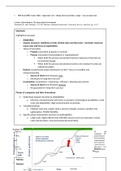
DOI from 2000. Codes: thick = important, red = change between articles, orange = seen on mock tests
Lecture 2 Introduction: The Innovation Environment
Abernathy,W. and Utterback, J. (1978), Patterns of industrial innovation, Technology Review, June/July, pp. 41-47.
Utterback
Highlighted concepts
- Adaptation
- Organic structure: redefinion of task, limited rules and hierarchy / mechanic structure:
many rules and focus on exploitation.
- Types of innovaties
o Product (consistent of goods or services)
o Process innovations (technological or organizational)
When both the process and product/services improves it becomes an
incremental change
When both the process and products/service are renewed it comes an
radical innovation
- Radical: revolutionary jumps (destructive of old) + focus on creatifity and
entrepreneurship.
o Source of short-term financial costs
o Necessary for long-term survival
- Incremental: evolutionary + improving + efficient + planning and control.
o Source of short-term financial revenue
o No guarantee for long-term survival
Phases of companies and their innovations
1. Fluid phase (organic structure & adaptability)
a. Informal, entrepreneurial with focus on product, technological possibilities, small
scale and adaptability. High environmental uncertainty.
2. Transitional phase
a. Medium-scale size, project teams, process changes, product variation and
optimisation. Middle flexibility.
3. Specific phase (mechanistic structure & predictability)
a. Large-scale, highly efficient but inflexible, process and cost reduction, formal,
rules and structures. Low environmental uncertainty.
Tushman, M. and
Anderson, Ph.
(1986), Technological
discontinuities
and organizational
environments,
Administrative
Science Quarterly, Vol.
31-3, pp. 439-465.
Tushman and Anderson
Technological discontinuities: competence enhancing or competence destroying
- Competence Enhancing building on top of the old knowledge & new
,Lecture 3 Organizing for Radical Innovation
Hargadon, A. (2003), Recombinant innovation and the sources of invention. In A. Hargadon, How breakthroughs happen:
the surprising truth about how companies innovate (pp. 31-52). Boston: Harvard Business School Press. ISBN:
1578519047, 9781578519040
Hargadon
- Technologies are: combination of people, ideas and objects.
- Innovation are: recombination of poeple, ideas and objects (especially radical)
Recombinant innovation and the sources of invention
General
- Innovations are fundamentally: people, ideas and objects and these can be reconfigured
in new combinations for new innovations: recombination/recombinant innovation.
- Interchangeability: mass production and product can be changed by a product alike.
- Standardized: process become standard.
- Mass production: producing is of a high capacity.
- Continues flow production: make it lean, make the process better, logistics. (less
inventory and continues flow of inputs and outputs.
o Assembly line production: make it lean by simple tasks for workers.
- Matured: an organisation has reached the point of being matured when they can start
focussing on process and have a rather big capacity.
- Interchangeability: one thing can be produced the same, multipool times of mass
produced. So that one product or part can directly replace another.
- Steal: “Picasso: “good artists borrow, great artist steal”.
o The more an innovation is built from scratch, the more effort is required to
develop and market it.
- Technology brokering strategies: structure innovation process to build on existing ideas
rather than making new ones.
, Schoenmakers, W. and Duysters, G. (2010), The Technological Origins of Radical Inventions. Research Policy, Vol. 39-8,
pp. 1051-1059. ISSN: 0048-7333
Schoenmakers
Inventions: creation of product or process for first time (novel)
Innovation: significant contribution.
- Radical inventions are made of:
o Based on more recombination of existing knowledge.
o Recombination of Emergent and mature knowledge existing knowledge, from
multiple knowledge domains.
o Emergent: just arrived or experienced/used – Mature: already well used.
- Entrepreneurship: start new independent (small) company.
- Corporate venturing: Mature + Entrepreneurship alliance.
General info
- It is about the history/origin of radical inventions
- Radical inventions are based on a higher degree of data and combination with knowledge
from other domains that are usually not connected delivers more radical inventions.
- Search if open innovation or focus within the organization is better.
-------------------------------------------------------------------------------------------------------------------------
Conclusion
- Radical inventions are based on a higher degree of data and combination with knowledge
from other domains that are usually not connected delivers more radical inventions.
- Radical inventions are based on a higher degree of emergent technologies.
o Emergent technologies might be more difficult because of the newness of
technology.
- Alliances and open innovations might increase the chances of recombing mature and new
emergent knowledge combination.
o The faster you can combine the better you probably are at radical inventions.
- Management focus on the need for more coordination and internal openness (with
innovations).
Lecture 2 Introduction: The Innovation Environment
Abernathy,W. and Utterback, J. (1978), Patterns of industrial innovation, Technology Review, June/July, pp. 41-47.
Utterback
Highlighted concepts
- Adaptation
- Organic structure: redefinion of task, limited rules and hierarchy / mechanic structure:
many rules and focus on exploitation.
- Types of innovaties
o Product (consistent of goods or services)
o Process innovations (technological or organizational)
When both the process and product/services improves it becomes an
incremental change
When both the process and products/service are renewed it comes an
radical innovation
- Radical: revolutionary jumps (destructive of old) + focus on creatifity and
entrepreneurship.
o Source of short-term financial costs
o Necessary for long-term survival
- Incremental: evolutionary + improving + efficient + planning and control.
o Source of short-term financial revenue
o No guarantee for long-term survival
Phases of companies and their innovations
1. Fluid phase (organic structure & adaptability)
a. Informal, entrepreneurial with focus on product, technological possibilities, small
scale and adaptability. High environmental uncertainty.
2. Transitional phase
a. Medium-scale size, project teams, process changes, product variation and
optimisation. Middle flexibility.
3. Specific phase (mechanistic structure & predictability)
a. Large-scale, highly efficient but inflexible, process and cost reduction, formal,
rules and structures. Low environmental uncertainty.
Tushman, M. and
Anderson, Ph.
(1986), Technological
discontinuities
and organizational
environments,
Administrative
Science Quarterly, Vol.
31-3, pp. 439-465.
Tushman and Anderson
Technological discontinuities: competence enhancing or competence destroying
- Competence Enhancing building on top of the old knowledge & new
,Lecture 3 Organizing for Radical Innovation
Hargadon, A. (2003), Recombinant innovation and the sources of invention. In A. Hargadon, How breakthroughs happen:
the surprising truth about how companies innovate (pp. 31-52). Boston: Harvard Business School Press. ISBN:
1578519047, 9781578519040
Hargadon
- Technologies are: combination of people, ideas and objects.
- Innovation are: recombination of poeple, ideas and objects (especially radical)
Recombinant innovation and the sources of invention
General
- Innovations are fundamentally: people, ideas and objects and these can be reconfigured
in new combinations for new innovations: recombination/recombinant innovation.
- Interchangeability: mass production and product can be changed by a product alike.
- Standardized: process become standard.
- Mass production: producing is of a high capacity.
- Continues flow production: make it lean, make the process better, logistics. (less
inventory and continues flow of inputs and outputs.
o Assembly line production: make it lean by simple tasks for workers.
- Matured: an organisation has reached the point of being matured when they can start
focussing on process and have a rather big capacity.
- Interchangeability: one thing can be produced the same, multipool times of mass
produced. So that one product or part can directly replace another.
- Steal: “Picasso: “good artists borrow, great artist steal”.
o The more an innovation is built from scratch, the more effort is required to
develop and market it.
- Technology brokering strategies: structure innovation process to build on existing ideas
rather than making new ones.
, Schoenmakers, W. and Duysters, G. (2010), The Technological Origins of Radical Inventions. Research Policy, Vol. 39-8,
pp. 1051-1059. ISSN: 0048-7333
Schoenmakers
Inventions: creation of product or process for first time (novel)
Innovation: significant contribution.
- Radical inventions are made of:
o Based on more recombination of existing knowledge.
o Recombination of Emergent and mature knowledge existing knowledge, from
multiple knowledge domains.
o Emergent: just arrived or experienced/used – Mature: already well used.
- Entrepreneurship: start new independent (small) company.
- Corporate venturing: Mature + Entrepreneurship alliance.
General info
- It is about the history/origin of radical inventions
- Radical inventions are based on a higher degree of data and combination with knowledge
from other domains that are usually not connected delivers more radical inventions.
- Search if open innovation or focus within the organization is better.
-------------------------------------------------------------------------------------------------------------------------
Conclusion
- Radical inventions are based on a higher degree of data and combination with knowledge
from other domains that are usually not connected delivers more radical inventions.
- Radical inventions are based on a higher degree of emergent technologies.
o Emergent technologies might be more difficult because of the newness of
technology.
- Alliances and open innovations might increase the chances of recombing mature and new
emergent knowledge combination.
o The faster you can combine the better you probably are at radical inventions.
- Management focus on the need for more coordination and internal openness (with
innovations).


