Inhoudsopgave:
Hoorcollege 1: introductie stress en gezondheid .......................................................................................... 2
Voordelen en nadelen van stress: ........................................................................................................................ 3
Literatuur HC 1 ........................................................................................................................................... 7
Hoofdstuk 1: Why don’t zebras get ulcers? .......................................................................................................... 7
Hoofdstuk 2: klieren, kippenvel en hormonen...................................................................................................... 9
Artikel: The short-term stress response – Mother nature’s mechanism for enhancing protection and
performance under conditions of threat, challenge and opportunity ............................................................... 11
Hoorcollege 2: stress assessment .............................................................................................................. 13
Hoorcollege 3: stress assessment .............................................................................................................. 16
Literatuur HC 2 en HC3:............................................................................................................................. 20
Artikel 1: Autonomic nervous system activity and workplace stressors – A systematic review. Jarczok, M.N., et
al. ........................................................................................................................................................................ 20
Artikel 2: Human hypothalamus-pituitary-adrenal axis responses to acute stress in laboratory settings. Foley,
P., & Kirschbaum, C. ........................................................................................................................................... 20
Artikel 3: A meta-analysis of cortisol reactivity to the Trier Social Stress Test in virtual environments –
Helminen, E.C. et al. ........................................................................................................................................... 21
Artikel 4: The role of autonomic nervous system in susceptibility and resilience to stress – Pereira, V.H.,
Campos, I., & Sousa, N. ...................................................................................................................................... 22
Hoorcollege 4: stress en leefstijl ................................................................................................................ 23
Literatuur HC4 .......................................................................................................................................... 29
Hoofdstuk 4: stress, metabolisme, ..................................................................................................................... 29
Hoofdstuk 5: ulcers, the run and hot fudge sundaes ......................................................................................... 30
H11: Stress en slaap ........................................................................................................................................... 32
H16: verslaafden, adrenaline verslaafden en plezier ......................................................................................... 33
Hoorcollege 5: stress en gezondheid.......................................................................................................... 35
Literatuur HC 5: ........................................................................................................................................ 40
Hoofdstuk 3: beroerte, hartaanvallen en voodoo-dood..................................................................................... 40
Hoofdstuk 8: immuniteit, stress en ziekte .......................................................................................................... 43
Artikel: Schneiderman et al., 2015 – Stress & Health: psychological, behavioral and biological determinants 46
Hoorcollege 6: stress en mentale gezondheid ............................................................................................ 49
Literatuur HC 6: ........................................................................................................................................ 53
Hoofdstuk 13: waarom is psychologische stress stressvol? ............................................................................... 53
Hoofdstuk 14: Stress en depressie ...................................................................................................................... 53
,Hoorcollege 7: life stressors ...................................................................................................................... 54
Werk gerelateerde stress (occupational stress) als major life event ................................................................. 55
Sociale stressoren: .............................................................................................................................................. 57
Literatuur HC7: ......................................................................................................................................... 58
Artikel: Carey et al. ‘Increased risk of acute cardiovasculair events after partner bereavement: A matched
cohort study’’...................................................................................................................................................... 58
Hoorcollege 8: positieve psychologie en stress........................................................................................... 59
Literatuur HC 8: ........................................................................................................................................ 65
Artikel: Davidson et al. – Don’t worry be happy: positive affect reduced 10-year incident coronary heart
disease: The Canadian Nova Scotia Health Survey ............................................................................................ 65
Artikel Gander et al. – Strength Based Positive intervention: further evidence for their potential in enhancing
well-being and alleviating depression ................................................................................................................ 65
Hoorcollege 9: coping ............................................................................................................................... 67
Literatuur HC 9: ........................................................................................................................................ 73
Hoofdstuk 18:het managen van stress:.............................................................................................................. 73
Hoorcollege 10: mindfulness ..................................................................................................................... 74
Hoorcollege 11: technologie, stress en gezondheid .................................................................................... 78
Shared decision making (SDM)........................................................................................................................... 80
Effect van gebruik van technologie op ons lichaam: .......................................................................................... 81
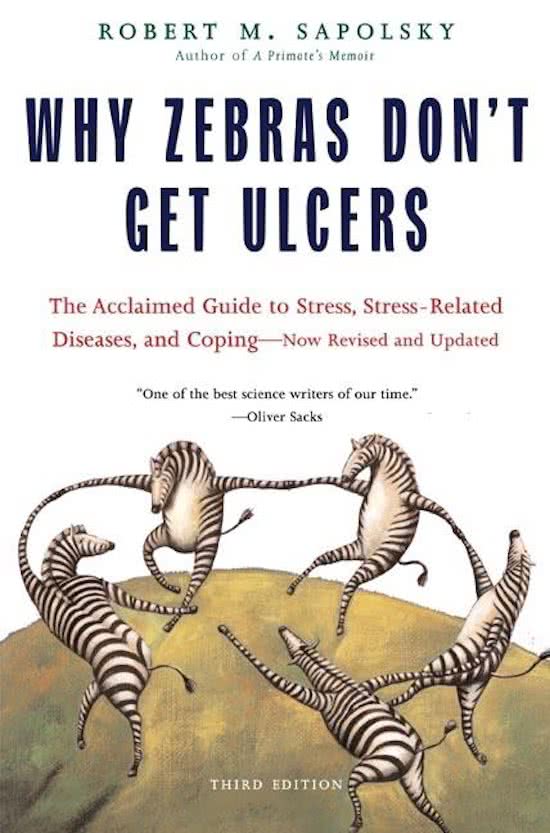
Stress en gezondheid - Why zebras don’t get ulcers: The acclaimed guide to stress, stress-
related diseases and coping.
Hoorcollege 1: introductie stress en gezondheid
Stress kan op verschillende manieren onze gezondheid beïnvloeden:
o Direct: stress → gezondheid (acuut)
o Indirect: stress → psychische problemen → gezondheid
stress → psychische problemen → gedragscomponenten → gezondheid
Stress in de klinische praktijk:
• Maakt mensen ziek
• Verhoogt de kans op het ontwikkelen van mentale of fysieke gezondheidsproblemen
• Negatief effect op herstel na ziekte of verwondingen
• Negatief effect op medische interventies’
• Negatief effect op communicatie tussen arts en patiënt
Mensen willen niet horen dat stress (en stressgerelateerde ziektes) de verklaring is van hun
problemen/klachten.
De definitie van stress:
Geen consensus over de definitie van stress, het ligt eraan vanuit welk oogpunt je kijkt
(psychologisch, biologisch).
Vanuit de psychologie: ‘a condition/feeling experienced when a person perceives that demands
exceed the personal and social resources the individual is able to mobilize.’
,Vanuit biologie: alles wat de homeostasis kan verstoren wordt gezien als stressor → stressreactie is
het proberen te herstellen van de homeostase.
Acuut en kortdurend
Snel van kunnen herstellen
Adaptief
Bereidt het lichaam voor op gevaar
Signaleert gevaar
Stress Chronisch
Langdurend
Langzaam herstel
Verstorend
Ontstaat veel eerder dan dat de stress plaatsvindt
Bereidt het lichaam voor op ..? Niets/geen echt gevaar
Signaleert voor ...?
Voordelen en nadelen van stress:
Voordelen Nadelen
Kortdurende/acute • Verhoogt immuunreactie • Emotioneel level: negatieve
stress • stemming
• Cognitief level: concentratie,
geheugen
• Gedragsmatig level: roken,
alcohol
• Biologisch level: immuun- en
endocriene systeem
, Chronische stress • Zou symptomen van Auto-immuunziektes, cardiovasculaire
auto-immuunziektes ziektes en kanker.
kunnen onderdrukken
Geschiedenis:
• Darwin: organisme dat in staat is zich aan te passen aan zijn omgeving zal overleven.
• Bernard: ‘environment’ in een organisme: innerlijke omgeving moet stabiel blijven, dan kan
je je goed aanpassen aan de omgeving.
• Cannon: fight and flight response.
Autonome zenuwstelsel bestaat uit het parasympatische en het sympatische zenuwstelsel.
Centraal zenuwstelsel (CNS) → m.n. neurotransmitters (primaire reactie op stress)
Endocrien systeem: ook aangestuurd door de hersenen maar net anders dan het CNS → m.n.
hormonen (secundaire reactie op stress)
CNS → Sympatisch AdrenoMedullair systeem (SAM) → hormonen
Hypothalamus → hypofyse → bijnier (HPA as) → hormonen
SAM en HPA-as interacteren met elkaar!
Stressreactie hormonen:
SAM HPA-as
• Epinephrine = adrenaline Glucocorticoïden:
• Norepinephrine = noradrenaline • Cortisol
• Steroïden
• Estrogenen
• Progestines
• Etc.
Additionle stresshormonen activatie:
Pancreas (alvleesklier) Hypofyse Hypofyse + hersenen
Glucagon Prolactine Endorfines
Vasopressin Enkepahilnes
Maar ook inhibitie van andere hormonen gedurende stressvolle periodes:
• Reproductieve hormonen: estrogenen, testosteron
• Groeihormonen zoals insuline
Hans Selye:
• Pionier op het gebied van stress: heeft glucocorticoïden toegevoegd aan het systeem van
Walter Canon.
• “Every stress leaves a indelible scar, and the organism pays for its survival after a stressful
situation by becoming a little older.”
• General adaptation syndrome (GAS):
Fase Processen in het lichaam Symptomen Hormonen
, Alarmfase ▪ Adrenaline-boost Energie Adrenaline ↑
▪ Energie ↑ (Takotsubo-
▪ Vechten of vluchten syndroom)
Overlevingsfase ▪ ‘Herstel’ maar het lichaam is Geïrriteerd Cortisol ↑
nog steeds aan het vechten Frustratie
▪ Dealen met stress als het niet Slechte
kan worden hersteld concentratie
▪ Kan eruitzien als coping met
stress (maar lichaam is dus
nog aan het vechten)
Uitputtingsfase ▪ Opgegeven Vermoeidheid Schade in het
▪ Nu ontstaan er ziektes Burn-out lichaam
Angst/depressie (immuunsysteem,
nieren etc.)
Selye:
• Stelde dat stress volledig fysiologisch is; je zou het volledig kunnen meten =
reactiviteitshypothese.
• Stress zou een non-specifieke reactie van het lichaam zijn op elke behoefte of bedreiging
• Reactiviteitshypothese:
o Tegenargumenten vanuit psychologisch perspectief op de reactiviteitshypothese:
▪ Mason: reacties op stress verschillen tussen én binnen individuen: dus het is niet
zo simpel zoals wordt geschetst door Selye
▪ Burchfield: het feit dat wij ons niet kunnen aanpassen aan chronische stress
heeft meer te maken met psychologische uitputting dan met fysiologie.
Daarom prolonged activation model:
Een stressor zal onze gezondheid beïnvloeden wanneer het fysiologische effect verlengd is (eerder en
langer doorwerkend) + voor te veel activatie wordt gezorgd.
Michigan stress model:
Effect van objectieve stressor op onze gezondheid hangt niet alleen af van de fysische reactie, maar
ook van persoonlijkheid
Dus:
• Stressreactie is niet een puur fysiologische reactie op een stressor, dan zou stress niet
schadelijk zijn en dat is wel het geval.
• Niet iedereen heeft dezelfde stressreactie
• De stressrespons en de duur van de van respons is verschillend tussen én in personen
Cycle of stress (Reznick): psycho-biologische reactie op stress
Reznick geeft aan dat de psychologische én fysiologische componenten in de 4 fases in kaart moeten
worden gebracht:
1. Rustfase
2. Spanningsfase
3. Reactiefase
4. Ontspanningsfase
Individuele verschillen in stressreactie → response stereotype:
• Stressperceptie
, • Verwerking
• Appraisal
• Coping
• Genetische ‘make-up’
Situationele verschillen (situational stereotype):
• Niet alle stressors produceren dezelfde stressrespons
• Hormonal signature
• Gevoeligheid van het lichaam voor stresshormonen
• Psychologische context
Man/vrouwverschillen in stressreactie:
Fight/flight reactie Tend-and-befriend reactie
• (Meer) mannelijke reactie • Meer vrouwelijke reactie
• Meer agressief • Zorggedrag; groepsgedrag
• SNS, glucocorticoïden • Zoeken naar sociale affiliatie
• Oxytocine
Wat kan er misgaan?
• Niet in staat om de stressreactie uit te zetten
• Niet in staat om de stressreactie aan te zetten
• Niet in staat om de stressreactie aan of uit te zetten op een adequate manier (te vroeg, te
laat)
Historische perspectieven over hoe om te gaan met stress:
• Gating mechanism: experiment Noorwegen → conclusie: vaker blootstellen werkt positief:
psychologische respons neemt na een aantal keer af en blijft redelijk stabiel:
• Dichotomy model: het gaat erom hoe jij de situatie waarneemt (jouw perceptie)
• Transactional model of stress (Lazarus & Falkman): perceptie van de situatie én de
mogelijkheden die jij hebt om ermee om te gaan. Als je bij de eerste appraisal dreiging
waarneemt dan bepaalt jouw idee of je met de dreiging om kan gaan (coping) bij de tweede
Hoorcollege 1: introductie stress en gezondheid .......................................................................................... 2
Voordelen en nadelen van stress: ........................................................................................................................ 3
Literatuur HC 1 ........................................................................................................................................... 7
Hoofdstuk 1: Why don’t zebras get ulcers? .......................................................................................................... 7
Hoofdstuk 2: klieren, kippenvel en hormonen...................................................................................................... 9
Artikel: The short-term stress response – Mother nature’s mechanism for enhancing protection and
performance under conditions of threat, challenge and opportunity ............................................................... 11
Hoorcollege 2: stress assessment .............................................................................................................. 13
Hoorcollege 3: stress assessment .............................................................................................................. 16
Literatuur HC 2 en HC3:............................................................................................................................. 20
Artikel 1: Autonomic nervous system activity and workplace stressors – A systematic review. Jarczok, M.N., et
al. ........................................................................................................................................................................ 20
Artikel 2: Human hypothalamus-pituitary-adrenal axis responses to acute stress in laboratory settings. Foley,
P., & Kirschbaum, C. ........................................................................................................................................... 20
Artikel 3: A meta-analysis of cortisol reactivity to the Trier Social Stress Test in virtual environments –
Helminen, E.C. et al. ........................................................................................................................................... 21
Artikel 4: The role of autonomic nervous system in susceptibility and resilience to stress – Pereira, V.H.,
Campos, I., & Sousa, N. ...................................................................................................................................... 22
Hoorcollege 4: stress en leefstijl ................................................................................................................ 23
Literatuur HC4 .......................................................................................................................................... 29
Hoofdstuk 4: stress, metabolisme, ..................................................................................................................... 29
Hoofdstuk 5: ulcers, the run and hot fudge sundaes ......................................................................................... 30
H11: Stress en slaap ........................................................................................................................................... 32
H16: verslaafden, adrenaline verslaafden en plezier ......................................................................................... 33
Hoorcollege 5: stress en gezondheid.......................................................................................................... 35
Literatuur HC 5: ........................................................................................................................................ 40
Hoofdstuk 3: beroerte, hartaanvallen en voodoo-dood..................................................................................... 40
Hoofdstuk 8: immuniteit, stress en ziekte .......................................................................................................... 43
Artikel: Schneiderman et al., 2015 – Stress & Health: psychological, behavioral and biological determinants 46
Hoorcollege 6: stress en mentale gezondheid ............................................................................................ 49
Literatuur HC 6: ........................................................................................................................................ 53
Hoofdstuk 13: waarom is psychologische stress stressvol? ............................................................................... 53
Hoofdstuk 14: Stress en depressie ...................................................................................................................... 53
,Hoorcollege 7: life stressors ...................................................................................................................... 54
Werk gerelateerde stress (occupational stress) als major life event ................................................................. 55
Sociale stressoren: .............................................................................................................................................. 57
Literatuur HC7: ......................................................................................................................................... 58
Artikel: Carey et al. ‘Increased risk of acute cardiovasculair events after partner bereavement: A matched
cohort study’’...................................................................................................................................................... 58
Hoorcollege 8: positieve psychologie en stress........................................................................................... 59
Literatuur HC 8: ........................................................................................................................................ 65
Artikel: Davidson et al. – Don’t worry be happy: positive affect reduced 10-year incident coronary heart
disease: The Canadian Nova Scotia Health Survey ............................................................................................ 65
Artikel Gander et al. – Strength Based Positive intervention: further evidence for their potential in enhancing
well-being and alleviating depression ................................................................................................................ 65
Hoorcollege 9: coping ............................................................................................................................... 67
Literatuur HC 9: ........................................................................................................................................ 73
Hoofdstuk 18:het managen van stress:.............................................................................................................. 73
Hoorcollege 10: mindfulness ..................................................................................................................... 74
Hoorcollege 11: technologie, stress en gezondheid .................................................................................... 78
Shared decision making (SDM)........................................................................................................................... 80
Effect van gebruik van technologie op ons lichaam: .......................................................................................... 81
Stress en gezondheid - Why zebras don’t get ulcers: The acclaimed guide to stress, stress-
related diseases and coping.
Hoorcollege 1: introductie stress en gezondheid
Stress kan op verschillende manieren onze gezondheid beïnvloeden:
o Direct: stress → gezondheid (acuut)
o Indirect: stress → psychische problemen → gezondheid
stress → psychische problemen → gedragscomponenten → gezondheid
Stress in de klinische praktijk:
• Maakt mensen ziek
• Verhoogt de kans op het ontwikkelen van mentale of fysieke gezondheidsproblemen
• Negatief effect op herstel na ziekte of verwondingen
• Negatief effect op medische interventies’
• Negatief effect op communicatie tussen arts en patiënt
Mensen willen niet horen dat stress (en stressgerelateerde ziektes) de verklaring is van hun
problemen/klachten.
De definitie van stress:
Geen consensus over de definitie van stress, het ligt eraan vanuit welk oogpunt je kijkt
(psychologisch, biologisch).
Vanuit de psychologie: ‘a condition/feeling experienced when a person perceives that demands
exceed the personal and social resources the individual is able to mobilize.’
,Vanuit biologie: alles wat de homeostasis kan verstoren wordt gezien als stressor → stressreactie is
het proberen te herstellen van de homeostase.
Acuut en kortdurend
Snel van kunnen herstellen
Adaptief
Bereidt het lichaam voor op gevaar
Signaleert gevaar
Stress Chronisch
Langdurend
Langzaam herstel
Verstorend
Ontstaat veel eerder dan dat de stress plaatsvindt
Bereidt het lichaam voor op ..? Niets/geen echt gevaar
Signaleert voor ...?
Voordelen en nadelen van stress:
Voordelen Nadelen
Kortdurende/acute • Verhoogt immuunreactie • Emotioneel level: negatieve
stress • stemming
• Cognitief level: concentratie,
geheugen
• Gedragsmatig level: roken,
alcohol
• Biologisch level: immuun- en
endocriene systeem
, Chronische stress • Zou symptomen van Auto-immuunziektes, cardiovasculaire
auto-immuunziektes ziektes en kanker.
kunnen onderdrukken
Geschiedenis:
• Darwin: organisme dat in staat is zich aan te passen aan zijn omgeving zal overleven.
• Bernard: ‘environment’ in een organisme: innerlijke omgeving moet stabiel blijven, dan kan
je je goed aanpassen aan de omgeving.
• Cannon: fight and flight response.
Autonome zenuwstelsel bestaat uit het parasympatische en het sympatische zenuwstelsel.
Centraal zenuwstelsel (CNS) → m.n. neurotransmitters (primaire reactie op stress)
Endocrien systeem: ook aangestuurd door de hersenen maar net anders dan het CNS → m.n.
hormonen (secundaire reactie op stress)
CNS → Sympatisch AdrenoMedullair systeem (SAM) → hormonen
Hypothalamus → hypofyse → bijnier (HPA as) → hormonen
SAM en HPA-as interacteren met elkaar!
Stressreactie hormonen:
SAM HPA-as
• Epinephrine = adrenaline Glucocorticoïden:
• Norepinephrine = noradrenaline • Cortisol
• Steroïden
• Estrogenen
• Progestines
• Etc.
Additionle stresshormonen activatie:
Pancreas (alvleesklier) Hypofyse Hypofyse + hersenen
Glucagon Prolactine Endorfines
Vasopressin Enkepahilnes
Maar ook inhibitie van andere hormonen gedurende stressvolle periodes:
• Reproductieve hormonen: estrogenen, testosteron
• Groeihormonen zoals insuline
Hans Selye:
• Pionier op het gebied van stress: heeft glucocorticoïden toegevoegd aan het systeem van
Walter Canon.
• “Every stress leaves a indelible scar, and the organism pays for its survival after a stressful
situation by becoming a little older.”
• General adaptation syndrome (GAS):
Fase Processen in het lichaam Symptomen Hormonen
, Alarmfase ▪ Adrenaline-boost Energie Adrenaline ↑
▪ Energie ↑ (Takotsubo-
▪ Vechten of vluchten syndroom)
Overlevingsfase ▪ ‘Herstel’ maar het lichaam is Geïrriteerd Cortisol ↑
nog steeds aan het vechten Frustratie
▪ Dealen met stress als het niet Slechte
kan worden hersteld concentratie
▪ Kan eruitzien als coping met
stress (maar lichaam is dus
nog aan het vechten)
Uitputtingsfase ▪ Opgegeven Vermoeidheid Schade in het
▪ Nu ontstaan er ziektes Burn-out lichaam
Angst/depressie (immuunsysteem,
nieren etc.)
Selye:
• Stelde dat stress volledig fysiologisch is; je zou het volledig kunnen meten =
reactiviteitshypothese.
• Stress zou een non-specifieke reactie van het lichaam zijn op elke behoefte of bedreiging
• Reactiviteitshypothese:
o Tegenargumenten vanuit psychologisch perspectief op de reactiviteitshypothese:
▪ Mason: reacties op stress verschillen tussen én binnen individuen: dus het is niet
zo simpel zoals wordt geschetst door Selye
▪ Burchfield: het feit dat wij ons niet kunnen aanpassen aan chronische stress
heeft meer te maken met psychologische uitputting dan met fysiologie.
Daarom prolonged activation model:
Een stressor zal onze gezondheid beïnvloeden wanneer het fysiologische effect verlengd is (eerder en
langer doorwerkend) + voor te veel activatie wordt gezorgd.
Michigan stress model:
Effect van objectieve stressor op onze gezondheid hangt niet alleen af van de fysische reactie, maar
ook van persoonlijkheid
Dus:
• Stressreactie is niet een puur fysiologische reactie op een stressor, dan zou stress niet
schadelijk zijn en dat is wel het geval.
• Niet iedereen heeft dezelfde stressreactie
• De stressrespons en de duur van de van respons is verschillend tussen én in personen
Cycle of stress (Reznick): psycho-biologische reactie op stress
Reznick geeft aan dat de psychologische én fysiologische componenten in de 4 fases in kaart moeten
worden gebracht:
1. Rustfase
2. Spanningsfase
3. Reactiefase
4. Ontspanningsfase
Individuele verschillen in stressreactie → response stereotype:
• Stressperceptie
, • Verwerking
• Appraisal
• Coping
• Genetische ‘make-up’
Situationele verschillen (situational stereotype):
• Niet alle stressors produceren dezelfde stressrespons
• Hormonal signature
• Gevoeligheid van het lichaam voor stresshormonen
• Psychologische context
Man/vrouwverschillen in stressreactie:
Fight/flight reactie Tend-and-befriend reactie
• (Meer) mannelijke reactie • Meer vrouwelijke reactie
• Meer agressief • Zorggedrag; groepsgedrag
• SNS, glucocorticoïden • Zoeken naar sociale affiliatie
• Oxytocine
Wat kan er misgaan?
• Niet in staat om de stressreactie uit te zetten
• Niet in staat om de stressreactie aan te zetten
• Niet in staat om de stressreactie aan of uit te zetten op een adequate manier (te vroeg, te
laat)
Historische perspectieven over hoe om te gaan met stress:
• Gating mechanism: experiment Noorwegen → conclusie: vaker blootstellen werkt positief:
psychologische respons neemt na een aantal keer af en blijft redelijk stabiel:
• Dichotomy model: het gaat erom hoe jij de situatie waarneemt (jouw perceptie)
• Transactional model of stress (Lazarus & Falkman): perceptie van de situatie én de
mogelijkheden die jij hebt om ermee om te gaan. Als je bij de eerste appraisal dreiging
waarneemt dan bepaalt jouw idee of je met de dreiging om kan gaan (coping) bij de tweede