Organization Development (441079-B-6)
Tilburg University Lectures, compulsory papers and a practice case.
+ Summary Experiential Approach to OD (8th edition)
Inhoud
Lecture 1: General introduction (Chapter 1, 2, 3) ................................................................................... 2
Lecture 2: Understanding the OD process, resistance to change and interventions (Chapter 4, 5, 6) ... 5
Lecture 3: Interviewing and AI ................................................................................................................ 8
Lecture 4: Improving excellence in individuals (Chapter 7, 8) .............................................................. 10
Lecture 5: Developing high performance in teams 1 (Chapter 9, 10, 11) ............................................. 14
Lecture 7: Developing high performance in teams 2 (Chapter 9, 10, 11) ............................................. 18
Lecture 6: Guest lecture: Adjusting to the pandemic ........................................................................... 22
Lecture 8: Building success in organizations (Chapter 12, 13, 14, 15) .................................................. 23
Compulsory paper: Harrison & Klein ..................................................................................................... 29
Compulsory paper: DiazGranados et al. ................................................................................................ 31
Preparation for the exam ...................................................................................................................... 32
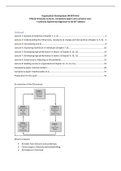
An overview of the OD process:
What to prepare:
• All slides from lectures and workshops.
• Canvas papers: Diversity and teambuilding.
• All chapters in the book.
,Lecture 1: General introduction (Chapter 1, 2, 3)
What is OD?
Organization development: The long-range effort to improve (1) an organization’s/system’s
problem-solving capabilities and (2) its abilities to cope with changes in the external environment
(with the help of external or internal behavioural-scientists consultants or change agents).
OD has 4 important characteristics: Planned, effectiveness, a scientific approach (e.g. team dynamics,
work design) and a systemic approach
E.g. Nokia was once extremely successful, but this declined completely. They did not switch quickly
enough to the most promising operating system. Therefore, Nokia was unable to develop.
Research process of an OD consultant (practical)
The practical process of doing research as an OD consultant looks as follows:
• Stage 1: Anticipate the need for change.
• Stage 2: Develop the practitioner-client relationship.
E.g. A practitioner and OD consultant meeting, establishing expectations and a contract.
• Stage 3: The diagnostic phase.
E.g. Gathering the data needed to diagnose the problem, combine these with theory.
• Stage 4: Action plans, strategies and techniques.
E.g. Choosing the right interventions to solve the problem.
• Stage 5: Self-renewal, monitor and stabilize.
E.g. Checking if the interventions have been successful.
The appreciative inquiry approach (philosophy)
The approach (philosophy) that we will use to look at organizations in the OD course: The
appreciative inquiry approach. This is a positive approach, based on expectation research; we
behave according to our expectations. This approach has 4 phases:
• Discovery (appreciating)
E.g. We have very good infrastructure, everyone should have a car.
• Dream (imagining)
E.g. An affordable car, that is easy to fix, and can be driven in the heat and in the cold.
• Design (innovating)
E.g. A cheap car with an air-cooled engine that can’t boil and freeze.
• Destiny (delivering)
E.g. Finding people that can deliver the car.
Relevance of OD
OD builds further on ‘introduction to psychology’ and ‘organizational behavior’, and prepares for
‘advice, intervention and evaluation’, ‘research in organizations’ and the bachelor’s thesis.
OD is relevant to understand changing organizations.
E.g. The ability of organizations to adapt to the COVID-19 measures.
There are many components/elements putting pressure on organizations, forcing them to change.
E.g. Competitors, customers, governments, stockholders, suppliers, society, employees and unions.
,Also, there are some major trends shaping change: Globalization and environment protection,
information technology and managerial innovation
This has resulted in many new forms of organizing. Organizations have become more boundaryless
and fluent, connecting multiple teams/tasks/organizations, and serving multiple purposes.
E.g. Uber, Airbnb, the worldwide fashion industry.
Systemic approach
Teams in organizations are connected and interdependent. Also, organizations continually interact
with their environments. Feed-back from the environment helps the system to adapt (open system).
Open systems have 4 characteristics:
Characteristic Example
Resource inputs Information, equipment, facilities, materials, money, people.
Transformation process Workplace actions, HR, physical resources.
Outputs Products, goods and services.
Feedback environment Employees, departments, managers, customers, regulations.
There are 4 forms or organizational adaptation/reactions to feedback:
Low adaptive orientation High adaptive orientation
Hyperturbulent Reactive management Renewing transformational
environment management
Stable environment Sluggish thermostat managements Satisficing management
These organizations consist of 2 dimensions: The social dimension and the technical dimension. They
can be divided into 4 subsystems:
• Technical subsystem: Functions, operations and equipment.
• Structural subsystem: Organizational structure.
• Psychological subsystem: Network of social relations.
• Goals van values subsystem: Mission and vision.
These are being unified by the managerial subsystem. Besides these subsystems, organizations also
consist of a culture.
Culture: System of shared values and beliefs that interact with an organization’s people, structure,
and systems to produce behavioural norms. It includes artifacts, norms and values and deep
assumptions.
Culture change is one of the hardest changes, there is often a lot of resistance.
Summary
Organizations have turbulent environments. Therefore, change is a must for the survival of
organizations. This is difficult, because people resist. OD looks at the complexity from a systemic
perspective, and aims at deep-level changes (with planned change).
, Chapter 1: OD and reinventing the organization
• Adaptation: Organizations operate in a dynamic and changing environment and consequently must
be adaptive.
• Challenge: One of the manager’s most difficult tasks is initiating change and renewal. You must be
sensitive to changes, products and competition, and be aware of the need for an adaptive and
flexible organization.
• OD: The discipline that applies behavioural science techniques to management problems.
• Change is constant: Change is unavoidable, and a moving target. Organizations will be able to
survive only if they effectively respond and anticipate.
• OD specialists: If OD specialists are members of the organization, they are internal practitioners. If
they come from outside, they are external practitioners.
• Culture: The set of characteristics of a specific group. Organizational culture is the shared language,
patterns of behaviour, value system, interactions and group norms of the members of an
organization.
• Socialization: The process that adapts employees to the culture. Employees may decide to rebel,
conform, or respond with creative individualism.
• Psychological contract: Brings underlying expectations out into the open, explains them en defines
the interdependence and shared responsibilities.
• OD-Model: The model that explains that organizational change involves improving the way people
work together and the way activities are integrated with goals.
Chapter 2: Organization renewal the challenge of change
• Change: Managers and organizations face rapid changes in three areas: technological advances,
environmental changes and social changes. Organizations must renew.
• Organizational renewal: Renewing management predicts future conditions and makes planned
changes before the conditions occur. For an organization to have this capacity, managers must
initiate and create a climate that encourages innovation.
• Adaptive: There are four different ways organizations may adapt to changes:
o Sluggish: No need to respond, no ability to adapt.
o Reactive: Need to respond, no ability to adapt.
o Satisficing: No need to respond, has the ability to adapt.
o Renewing: Need to respond, has the ability to adapt.
• Sociotechnical system: An organization can be viewed as an open system of coordinated human
and technical activities, consisting of five components; goals and values, technical, structural,
psychological and managerial.
• Future shock: Too much change in too short a time, occurs when there is a greatly accelerated rate
of change.
• Organization transformation: Significant change to the form and assumptions of an organization. It
is an unplanned response to crises.
• Planned change and OD: Planned change can be used to improve the effectiveness.
Chapter 3: Changing the culture
• Change: Changes can be initiated by employees, or as a reaction to external forces. A key aspect of
implementing change is the need to institutionalize the change into the value systems.
• Corporate culture: Whether anticipative or reactive, change is most successful when the
organization proceeds with a planned approach that takes the culture into account.
• Cultural resistance to change: An inappropriate culture is one of the biggest stumbling blocks on
the path to adaptation.
• Tools for change: Three tools are required in the adaptive organization; information, support and
resources.
• Goals and values of OD: OD programs aim to improve the basic organizational dimensions that
affect performance; managerial effectiveness, managerial efficiency and motivational climate.
Tilburg University Lectures, compulsory papers and a practice case.
+ Summary Experiential Approach to OD (8th edition)
Inhoud
Lecture 1: General introduction (Chapter 1, 2, 3) ................................................................................... 2
Lecture 2: Understanding the OD process, resistance to change and interventions (Chapter 4, 5, 6) ... 5
Lecture 3: Interviewing and AI ................................................................................................................ 8
Lecture 4: Improving excellence in individuals (Chapter 7, 8) .............................................................. 10
Lecture 5: Developing high performance in teams 1 (Chapter 9, 10, 11) ............................................. 14
Lecture 7: Developing high performance in teams 2 (Chapter 9, 10, 11) ............................................. 18
Lecture 6: Guest lecture: Adjusting to the pandemic ........................................................................... 22
Lecture 8: Building success in organizations (Chapter 12, 13, 14, 15) .................................................. 23
Compulsory paper: Harrison & Klein ..................................................................................................... 29
Compulsory paper: DiazGranados et al. ................................................................................................ 31
Preparation for the exam ...................................................................................................................... 32
An overview of the OD process:
What to prepare:
• All slides from lectures and workshops.
• Canvas papers: Diversity and teambuilding.
• All chapters in the book.
,Lecture 1: General introduction (Chapter 1, 2, 3)
What is OD?
Organization development: The long-range effort to improve (1) an organization’s/system’s
problem-solving capabilities and (2) its abilities to cope with changes in the external environment
(with the help of external or internal behavioural-scientists consultants or change agents).
OD has 4 important characteristics: Planned, effectiveness, a scientific approach (e.g. team dynamics,
work design) and a systemic approach
E.g. Nokia was once extremely successful, but this declined completely. They did not switch quickly
enough to the most promising operating system. Therefore, Nokia was unable to develop.
Research process of an OD consultant (practical)
The practical process of doing research as an OD consultant looks as follows:
• Stage 1: Anticipate the need for change.
• Stage 2: Develop the practitioner-client relationship.
E.g. A practitioner and OD consultant meeting, establishing expectations and a contract.
• Stage 3: The diagnostic phase.
E.g. Gathering the data needed to diagnose the problem, combine these with theory.
• Stage 4: Action plans, strategies and techniques.
E.g. Choosing the right interventions to solve the problem.
• Stage 5: Self-renewal, monitor and stabilize.
E.g. Checking if the interventions have been successful.
The appreciative inquiry approach (philosophy)
The approach (philosophy) that we will use to look at organizations in the OD course: The
appreciative inquiry approach. This is a positive approach, based on expectation research; we
behave according to our expectations. This approach has 4 phases:
• Discovery (appreciating)
E.g. We have very good infrastructure, everyone should have a car.
• Dream (imagining)
E.g. An affordable car, that is easy to fix, and can be driven in the heat and in the cold.
• Design (innovating)
E.g. A cheap car with an air-cooled engine that can’t boil and freeze.
• Destiny (delivering)
E.g. Finding people that can deliver the car.
Relevance of OD
OD builds further on ‘introduction to psychology’ and ‘organizational behavior’, and prepares for
‘advice, intervention and evaluation’, ‘research in organizations’ and the bachelor’s thesis.
OD is relevant to understand changing organizations.
E.g. The ability of organizations to adapt to the COVID-19 measures.
There are many components/elements putting pressure on organizations, forcing them to change.
E.g. Competitors, customers, governments, stockholders, suppliers, society, employees and unions.
,Also, there are some major trends shaping change: Globalization and environment protection,
information technology and managerial innovation
This has resulted in many new forms of organizing. Organizations have become more boundaryless
and fluent, connecting multiple teams/tasks/organizations, and serving multiple purposes.
E.g. Uber, Airbnb, the worldwide fashion industry.
Systemic approach
Teams in organizations are connected and interdependent. Also, organizations continually interact
with their environments. Feed-back from the environment helps the system to adapt (open system).
Open systems have 4 characteristics:
Characteristic Example
Resource inputs Information, equipment, facilities, materials, money, people.
Transformation process Workplace actions, HR, physical resources.
Outputs Products, goods and services.
Feedback environment Employees, departments, managers, customers, regulations.
There are 4 forms or organizational adaptation/reactions to feedback:
Low adaptive orientation High adaptive orientation
Hyperturbulent Reactive management Renewing transformational
environment management
Stable environment Sluggish thermostat managements Satisficing management
These organizations consist of 2 dimensions: The social dimension and the technical dimension. They
can be divided into 4 subsystems:
• Technical subsystem: Functions, operations and equipment.
• Structural subsystem: Organizational structure.
• Psychological subsystem: Network of social relations.
• Goals van values subsystem: Mission and vision.
These are being unified by the managerial subsystem. Besides these subsystems, organizations also
consist of a culture.
Culture: System of shared values and beliefs that interact with an organization’s people, structure,
and systems to produce behavioural norms. It includes artifacts, norms and values and deep
assumptions.
Culture change is one of the hardest changes, there is often a lot of resistance.
Summary
Organizations have turbulent environments. Therefore, change is a must for the survival of
organizations. This is difficult, because people resist. OD looks at the complexity from a systemic
perspective, and aims at deep-level changes (with planned change).
, Chapter 1: OD and reinventing the organization
• Adaptation: Organizations operate in a dynamic and changing environment and consequently must
be adaptive.
• Challenge: One of the manager’s most difficult tasks is initiating change and renewal. You must be
sensitive to changes, products and competition, and be aware of the need for an adaptive and
flexible organization.
• OD: The discipline that applies behavioural science techniques to management problems.
• Change is constant: Change is unavoidable, and a moving target. Organizations will be able to
survive only if they effectively respond and anticipate.
• OD specialists: If OD specialists are members of the organization, they are internal practitioners. If
they come from outside, they are external practitioners.
• Culture: The set of characteristics of a specific group. Organizational culture is the shared language,
patterns of behaviour, value system, interactions and group norms of the members of an
organization.
• Socialization: The process that adapts employees to the culture. Employees may decide to rebel,
conform, or respond with creative individualism.
• Psychological contract: Brings underlying expectations out into the open, explains them en defines
the interdependence and shared responsibilities.
• OD-Model: The model that explains that organizational change involves improving the way people
work together and the way activities are integrated with goals.
Chapter 2: Organization renewal the challenge of change
• Change: Managers and organizations face rapid changes in three areas: technological advances,
environmental changes and social changes. Organizations must renew.
• Organizational renewal: Renewing management predicts future conditions and makes planned
changes before the conditions occur. For an organization to have this capacity, managers must
initiate and create a climate that encourages innovation.
• Adaptive: There are four different ways organizations may adapt to changes:
o Sluggish: No need to respond, no ability to adapt.
o Reactive: Need to respond, no ability to adapt.
o Satisficing: No need to respond, has the ability to adapt.
o Renewing: Need to respond, has the ability to adapt.
• Sociotechnical system: An organization can be viewed as an open system of coordinated human
and technical activities, consisting of five components; goals and values, technical, structural,
psychological and managerial.
• Future shock: Too much change in too short a time, occurs when there is a greatly accelerated rate
of change.
• Organization transformation: Significant change to the form and assumptions of an organization. It
is an unplanned response to crises.
• Planned change and OD: Planned change can be used to improve the effectiveness.
Chapter 3: Changing the culture
• Change: Changes can be initiated by employees, or as a reaction to external forces. A key aspect of
implementing change is the need to institutionalize the change into the value systems.
• Corporate culture: Whether anticipative or reactive, change is most successful when the
organization proceeds with a planned approach that takes the culture into account.
• Cultural resistance to change: An inappropriate culture is one of the biggest stumbling blocks on
the path to adaptation.
• Tools for change: Three tools are required in the adaptive organization; information, support and
resources.
• Goals and values of OD: OD programs aim to improve the basic organizational dimensions that
affect performance; managerial effectiveness, managerial efficiency and motivational climate.