

Membrane potential
• knowing the difference between active and passive conduction
Passive signals → these signals do not reach the threshold and therefore do not lead to depolarization (no
action, passive conduction decays over distance)
Active signals → these signals do reach the threshold and lead to depolarization
- there is an action potential
- strength of stimuli determines the frequency of firing
- active conduction is constant over distance
Chain reaction → depolarization of previous neuron triggers depolarization of the subsequent neuron
• be able to explain what the equilibrium potential or reversal potential is
The point at which the direction of net current flow reverses is called the reversal potential and is the same as
the equilibrium potential
Equilibrium potential → electrical potential at electrochemical equilibrium
- at initial conditions, K+ diffuses from inside to outside
- at equilibrium, there is a balance between diffusion force and electrical force (no net movement of
K+ ions at a particular voltage)
- the number of ions that need to flow to generate this potential is very small (there is a small, almost
non-detectable, shift in ion concentrations)
Nernst equation to calculate the equilibrium potential
(𝑅 × 𝑇) [𝑥]𝑜𝑢𝑡 58~61 [𝑥]𝑜𝑢𝑡
𝐸𝑥 = × ln [𝑥]𝑖𝑛
→ 𝐸𝑥 = × ln [𝑥]𝑖𝑛
(𝑧 × 𝐹) 𝑧
- R = 8.31 J/K/mol
- z = valence (electrical charge) of the ion
- F = 96485 C/mol
Reverse potential → when there is a large negative charge on the inside of the cell, a net flux of K+ from
outside to inside is created
- net flux of K+ depends on membrane potential
- at -58 mV (= equilibrium potential), there is no net flux of K+
• understanding how the resting membrane potential is established
The resting membrane potential depends on the permeability of the membrane for K +, Na+, Cl-, and Ca2+
- The resting membrane potential is the combined electro chemical effect of different ions (Na, K, Cl,
Ca) at different concentrations inside and outside of the cell. For each ion, channels exist in the
membrane that selectively conduct that ion.
- K+ dominate the equation because their ion channels are always open at hyperpolarized levels
- however, since ion channels are voltage and ligand sensitive, the resting membrane potential can
change
, • knowing which ions are important for the resting membrane potential
K+, Na+, and Cl-
• knowing for which ions the permeability changes during the action
potential
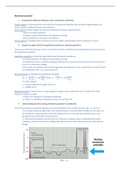
At resting potential
- PK >> PNa (the permeability for potassium ions is much larger
than the permeability for sodium ions), which results in an
outflux of potassium (repolarization)
- at around 0 mV, the permeability of sodium ions increases
- when the membrane potential is positive, PNa >> PK → results
in an influx of sodium ions (depolarization)
• knowing how to calculate the resting membrane potential when the membrane is permeable for 1
ion, or multiple ions
Ion channels and transporters
• be able to explain the differences between an ion pump and ion channel
Ion pump (aka ion transporter)
- active transporters (“pumping station”)
- ion binds and gets transported across the membrane
- actively moves selected ions against concentration gradient, creating an ion concentration gradient
Ion channel
- ions diffuse through channel
- allows ions to diffuse according to the concentration gradient (from high to low concentrations)
- ion channels are selectively permeable for certain ions
Na+/K+ pump (ATPase pump; ion transporter)
- K+ in, Na+ out using ATP
- when transporter faces inside the cell
→ high affinity for Na+, low affinity for K+
→ ATP phosphorylates the pump, which induces a conformational change to face outside the
cell (affinity changes as well)
- when transporter faces outside the cell
→ high affinity for K+, low affinity for Na+ so the Na that was bound is now released and K+
from outside the cell binds instead
→ pump is dephosphorylated; conformational change to face inside the cell again and
release K+
, • be able to explain the differences between current-clamp and voltage-clamp measurements
Voltage-clamp → measurements of (voltage-induced) currents
Current-clamp → measurements of (current-induced) changes in membrane potential
• be able to mention different types of ion channels and their role in neuronal signalling
Voltage gated ion channels
- are involved in action potential generation (K+, Na+, and Cl- channels)
- activity is induced by intracellular signalling
- opening/closing of these channels is determined by the changes in membrane potential
Ligand gated ion channels
- e.g. neurotransmitter receptors, calcium activated K+ channels
- ligand binds, (prevent) inducing conformational change (open/close)
Thermosensitive ion channels
Mechanosensitive ion channels
• knowing the difference between activation gates and
inactivation gates
Voltage gated Na+ channels have two separate gates, the activation
gate and inactivation gate. At a normal resting potential of -70 to -80
mV, the activation gate is closed and the inactivation gate is open.
This is called the resting Na+ channel.
• knowing the difference between active and passive conduction
Passive signals → these signals do not reach the threshold and therefore do not lead to depolarization (no
action, passive conduction decays over distance)
Active signals → these signals do reach the threshold and lead to depolarization
- there is an action potential
- strength of stimuli determines the frequency of firing
- active conduction is constant over distance
Chain reaction → depolarization of previous neuron triggers depolarization of the subsequent neuron
• be able to explain what the equilibrium potential or reversal potential is
The point at which the direction of net current flow reverses is called the reversal potential and is the same as
the equilibrium potential
Equilibrium potential → electrical potential at electrochemical equilibrium
- at initial conditions, K+ diffuses from inside to outside
- at equilibrium, there is a balance between diffusion force and electrical force (no net movement of
K+ ions at a particular voltage)
- the number of ions that need to flow to generate this potential is very small (there is a small, almost
non-detectable, shift in ion concentrations)
Nernst equation to calculate the equilibrium potential
(𝑅 × 𝑇) [𝑥]𝑜𝑢𝑡 58~61 [𝑥]𝑜𝑢𝑡
𝐸𝑥 = × ln [𝑥]𝑖𝑛
→ 𝐸𝑥 = × ln [𝑥]𝑖𝑛
(𝑧 × 𝐹) 𝑧
- R = 8.31 J/K/mol
- z = valence (electrical charge) of the ion
- F = 96485 C/mol
Reverse potential → when there is a large negative charge on the inside of the cell, a net flux of K+ from
outside to inside is created
- net flux of K+ depends on membrane potential
- at -58 mV (= equilibrium potential), there is no net flux of K+
• understanding how the resting membrane potential is established
The resting membrane potential depends on the permeability of the membrane for K +, Na+, Cl-, and Ca2+
- The resting membrane potential is the combined electro chemical effect of different ions (Na, K, Cl,
Ca) at different concentrations inside and outside of the cell. For each ion, channels exist in the
membrane that selectively conduct that ion.
- K+ dominate the equation because their ion channels are always open at hyperpolarized levels
- however, since ion channels are voltage and ligand sensitive, the resting membrane potential can
change
, • knowing which ions are important for the resting membrane potential
K+, Na+, and Cl-
• knowing for which ions the permeability changes during the action
potential
At resting potential
- PK >> PNa (the permeability for potassium ions is much larger
than the permeability for sodium ions), which results in an
outflux of potassium (repolarization)
- at around 0 mV, the permeability of sodium ions increases
- when the membrane potential is positive, PNa >> PK → results
in an influx of sodium ions (depolarization)
• knowing how to calculate the resting membrane potential when the membrane is permeable for 1
ion, or multiple ions
Ion channels and transporters
• be able to explain the differences between an ion pump and ion channel
Ion pump (aka ion transporter)
- active transporters (“pumping station”)
- ion binds and gets transported across the membrane
- actively moves selected ions against concentration gradient, creating an ion concentration gradient
Ion channel
- ions diffuse through channel
- allows ions to diffuse according to the concentration gradient (from high to low concentrations)
- ion channels are selectively permeable for certain ions
Na+/K+ pump (ATPase pump; ion transporter)
- K+ in, Na+ out using ATP
- when transporter faces inside the cell
→ high affinity for Na+, low affinity for K+
→ ATP phosphorylates the pump, which induces a conformational change to face outside the
cell (affinity changes as well)
- when transporter faces outside the cell
→ high affinity for K+, low affinity for Na+ so the Na that was bound is now released and K+
from outside the cell binds instead
→ pump is dephosphorylated; conformational change to face inside the cell again and
release K+
, • be able to explain the differences between current-clamp and voltage-clamp measurements
Voltage-clamp → measurements of (voltage-induced) currents
Current-clamp → measurements of (current-induced) changes in membrane potential
• be able to mention different types of ion channels and their role in neuronal signalling
Voltage gated ion channels
- are involved in action potential generation (K+, Na+, and Cl- channels)
- activity is induced by intracellular signalling
- opening/closing of these channels is determined by the changes in membrane potential
Ligand gated ion channels
- e.g. neurotransmitter receptors, calcium activated K+ channels
- ligand binds, (prevent) inducing conformational change (open/close)
Thermosensitive ion channels
Mechanosensitive ion channels
• knowing the difference between activation gates and
inactivation gates
Voltage gated Na+ channels have two separate gates, the activation
gate and inactivation gate. At a normal resting potential of -70 to -80
mV, the activation gate is closed and the inactivation gate is open.
This is called the resting Na+ channel.


