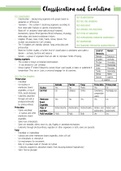
Classification and Evolution
10.1 Classification
10.1 Classification
- Classification – placing living organisms into groups based on
similarities or differences. 10.2 The five kingdoms
- Taxonomy – the system if classifying organisms according to 10.3 phylogeny
their observable features or genetic characteristics.
- Based off of anatomy (observable physical features), 10.4 evidence for evolution
biochemistry (genes/DNA/genetics/RNA), behaviour, physiology, 10.5 types of variation
embryology, and shared evolutionary history. 10.6 representing variation graphically
- Kingdom, Phylum, Class, Order, Family, Genus, Species. This
system was proposed by Carl Linnaeus. 10.7 Adaptations
- The 5 kingdoms are animalia, plantae, fungi, protoctista and 10.8 Changing population characteristics
prokaryotae.
- Based on further studies, a further level of classification is sometimes used called a Level of Human
domain – archaea, bacteria and eukarya. Hierarchy
- Species – a group of organisms that are able to reproduce fertile offspring. Domain Eukarya
Naming organisms: Kingdom Animalia
- This system is known as binomial nomenclature. Phylum Chordata
- It was devised by Carl Linnaeus. Class Mammalia
- Genus (capital 1st letter) followed by species (lower case) usually in italics or underlined if Order Primates
handwritten. They are in Latin, a universal language for all countries. Family Hominidae
Genus Homo
10.2 The Five Kingdoms Species sapiens
Prokaryotae: H. sapiens
- Unicellular
- No nucleus or Animalia Plantae Fungi Protoctista Prokaryotae
membrane bound Nucleus Yes Yes Many Yes No
organelles, a ring of Cell Wall No Cellulose Chitin Sometimes, Peptidoglycan
DNA, small ribosomes composition
- Nutrients absorbed caries
through cell wall or Membrane Yes Yes Yes Yes No
produced internally Bound
by photosynthesis Organelles
Protoctista: Mode of Heterotrophic Autotrophic Heterotrophic Hetero and Hetero and
- Mainly unicellular Nutrition autotrophic autotrophic
- A nucleus and other Multi/unicellular Multi Multi Both Uni Uni
membrane bound
organelles
- Some have chloroplasts
- Some are immobile, others move by cilia, flagella, or amoeboid mechanisms
- Nutrients through photosynthesis, ingestion of other organisms or both, some are parasitic.
Fungi:
- Unicellular or multicellular
- Nucleus and other membrane-bound organelles, chitin cell wall
- No chloroplasts or chlorophyll
- No mechanisms for movement
- Body of mycelium made of threads to hyphae
- Nutrients acquired by absorption mainly from decaying material (saprophytic)
- Store food as glycogen
, Plantae:
- Multicellular
- Nucleus and membrane-bound organelles, chloroplasts containing chlorophyll
- Cellulose cell wall
- Most don’t move
- Nutrients via photosynthesis (autotrophic).
- Store food as starch
Animalia:
- Multicellular
- Nucleus and membrane-bound organelles
- No cell wall or chloroplasts
- Move with cilia, flagella, or muscular organs.
- Nutrients acquired by ingestion (heterotrophic)
- Food stored as glycogen.
3 domain system:
- Proposed by Carl Woese.
- Group’s organism using differences in sequencing in the rRNA, cell membrane lipid structure and
sensitivity to antibiotics.
- Eukarya
o 80s ribosomes
o RNA polymerase contains 12 proteins
- Archaea (archaebacteria)
o 70s ribosomes
o RNA poly merse between 8 and 10 proteins, very similar to eukaryotic ribosome
o Can live in extreme environments e.g., hot thermal vents, anaerobic or highly acidic
environments
- Bacteria (eubacteria)
o 70s ribosomes
o RNA polymerase contains 5 proteins
o Found in most environments
10.3 Phylogeny
- Phylogeny – the evolutionary relationships between organisms.
- Phylogeny shows how closely related organisms are, the earliest species is
at the base, the most recent species are at the tip, every time there is a
join/branch there is a common ancestor.
- Phylogeny produces a continuous tree; scientists are not forced to put
organisms into a specific group.
- Classification can be misleading as it suggests that groups within the same rank are equivalent, however
they are not, some may be much bigger groups or be much older than others or have different degrees
of biological differentiation.
10.4 Evidence for Evolution
- Charles Darwin observed finches in the Galapagos Islands, and notices the different islands had
different finches. The birds were similar and must be closely related but had different size and shape
beaks and claws.
- He spent many years developing his ideas. At the same time Alfred Wallace was also working on a
theory of evolution, he sent his ideas to Darwin for peer review.
10.1 Classification
10.1 Classification
- Classification – placing living organisms into groups based on
similarities or differences. 10.2 The five kingdoms
- Taxonomy – the system if classifying organisms according to 10.3 phylogeny
their observable features or genetic characteristics.
- Based off of anatomy (observable physical features), 10.4 evidence for evolution
biochemistry (genes/DNA/genetics/RNA), behaviour, physiology, 10.5 types of variation
embryology, and shared evolutionary history. 10.6 representing variation graphically
- Kingdom, Phylum, Class, Order, Family, Genus, Species. This
system was proposed by Carl Linnaeus. 10.7 Adaptations
- The 5 kingdoms are animalia, plantae, fungi, protoctista and 10.8 Changing population characteristics
prokaryotae.
- Based on further studies, a further level of classification is sometimes used called a Level of Human
domain – archaea, bacteria and eukarya. Hierarchy
- Species – a group of organisms that are able to reproduce fertile offspring. Domain Eukarya
Naming organisms: Kingdom Animalia
- This system is known as binomial nomenclature. Phylum Chordata
- It was devised by Carl Linnaeus. Class Mammalia
- Genus (capital 1st letter) followed by species (lower case) usually in italics or underlined if Order Primates
handwritten. They are in Latin, a universal language for all countries. Family Hominidae
Genus Homo
10.2 The Five Kingdoms Species sapiens
Prokaryotae: H. sapiens
- Unicellular
- No nucleus or Animalia Plantae Fungi Protoctista Prokaryotae
membrane bound Nucleus Yes Yes Many Yes No
organelles, a ring of Cell Wall No Cellulose Chitin Sometimes, Peptidoglycan
DNA, small ribosomes composition
- Nutrients absorbed caries
through cell wall or Membrane Yes Yes Yes Yes No
produced internally Bound
by photosynthesis Organelles
Protoctista: Mode of Heterotrophic Autotrophic Heterotrophic Hetero and Hetero and
- Mainly unicellular Nutrition autotrophic autotrophic
- A nucleus and other Multi/unicellular Multi Multi Both Uni Uni
membrane bound
organelles
- Some have chloroplasts
- Some are immobile, others move by cilia, flagella, or amoeboid mechanisms
- Nutrients through photosynthesis, ingestion of other organisms or both, some are parasitic.
Fungi:
- Unicellular or multicellular
- Nucleus and other membrane-bound organelles, chitin cell wall
- No chloroplasts or chlorophyll
- No mechanisms for movement
- Body of mycelium made of threads to hyphae
- Nutrients acquired by absorption mainly from decaying material (saprophytic)
- Store food as glycogen
, Plantae:
- Multicellular
- Nucleus and membrane-bound organelles, chloroplasts containing chlorophyll
- Cellulose cell wall
- Most don’t move
- Nutrients via photosynthesis (autotrophic).
- Store food as starch
Animalia:
- Multicellular
- Nucleus and membrane-bound organelles
- No cell wall or chloroplasts
- Move with cilia, flagella, or muscular organs.
- Nutrients acquired by ingestion (heterotrophic)
- Food stored as glycogen.
3 domain system:
- Proposed by Carl Woese.
- Group’s organism using differences in sequencing in the rRNA, cell membrane lipid structure and
sensitivity to antibiotics.
- Eukarya
o 80s ribosomes
o RNA polymerase contains 12 proteins
- Archaea (archaebacteria)
o 70s ribosomes
o RNA poly merse between 8 and 10 proteins, very similar to eukaryotic ribosome
o Can live in extreme environments e.g., hot thermal vents, anaerobic or highly acidic
environments
- Bacteria (eubacteria)
o 70s ribosomes
o RNA polymerase contains 5 proteins
o Found in most environments
10.3 Phylogeny
- Phylogeny – the evolutionary relationships between organisms.
- Phylogeny shows how closely related organisms are, the earliest species is
at the base, the most recent species are at the tip, every time there is a
join/branch there is a common ancestor.
- Phylogeny produces a continuous tree; scientists are not forced to put
organisms into a specific group.
- Classification can be misleading as it suggests that groups within the same rank are equivalent, however
they are not, some may be much bigger groups or be much older than others or have different degrees
of biological differentiation.
10.4 Evidence for Evolution
- Charles Darwin observed finches in the Galapagos Islands, and notices the different islands had
different finches. The birds were similar and must be closely related but had different size and shape
beaks and claws.
- He spent many years developing his ideas. At the same time Alfred Wallace was also working on a
theory of evolution, he sent his ideas to Darwin for peer review.