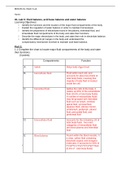
BIOS 256 Week 5 OL Lab 5; Fluid balance, acid base balance and water balance
Learning Objectives: • Identify the functions and the location of the major fluid compartments of thebody • Explain the regulation of water balance in order to maintainhomeostasis • Identify the proportions of electrolytes found in the plasma, interstitial fluid,and intracellular fluid compartments of the body and state theirfunctions. • Describe the major electrolytes in the body, and state their role in electrolytebalance. • Identify the different pH ranges in the body and understand thecompensatory mechanism involved to maintain acid-basebalance. Part 1: 1.1 Complete the chart to locate major fluid compartments of the body and statetheir functions. (3 points) 1.2 Identify the physiological stimulus and responses that regulate water balance inthe body. (5points) 1.3 Identify the fluid compartments and the major electrolytes in the body tocomplete thechart. (5 points) 1.4 Use the chart provided to complete the table below: (4points) 1.5 Identify the changes in the pH and the H+, HCO3- and CO2 concentrationsto complete the table below: (5 points) a. In respiratory acidosis, what is the stimulus to initiate the respiratorycompensation? b. What are the effectors involved in the compensation duringrespiratory acidosis? Part 2: Read the case study and answer the questions in your own words and completesentences: (8 points) Sam, a 70-year-old man with chronic renal failure, was in for a routine visit at the hospital. Progressive destruction of nephrons leads to chronic renal failure. Sam’s blood work indicated low blood pH taken and potassium levels were outside of the normal range. Sam’s estimated glomerular filtration rate (GFR) was 15 mL/min with a high respiratory rate of 20 breaths per minute. 1. What is the normal range for blood potassiumconcentration? 2. From which part of the nephron is the majority of excess potassiumnormally excreted? 3. Based on your observations, will Sam’s potassium levels be high, normal, orlow? 4. What are the pH buffers found in theurine? 5. How are H+ ions transported into the tubular fluid of thekidney? 6. In what form are H+ ions excreted in theurine? 7. Why could be the reason for Sam’s lowpH? 8. Why would Sam have an increase in respiratory rate? How does the increasein respiratory ratehelp?
Written for
- Institution
-
Chamberlain College Of Nursing
- Course
-
BIOS 256 (BIOS256)
Document information
- Uploaded on
- March 10, 2022
- Number of pages
- 8
- Written in
- 2022/2023
- Type
- OTHER
- Person
- Unknown

Also available in package deal