Burns NCLEX Question and Burn Injury Nursing Management Exam Pack Part 5 Updated 2022
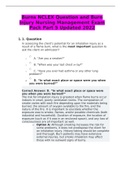
1. 1. Question In assessing the client’s potential for an inhalation injury as a result of a flame burn, what is the most important question to ask the client on admission? o A. “Are you a smoker?” o B. “When was your last chest x-ray?” o C. “Have you ever had asthma or any other lung problem?” o D. “In what exact place or space were you when you were burned?” Correct Answer: D. “In what exact place or space were you when you were burned?” The risk for inhalation injury is greatest when flame burns occur indoors in small, poorly ventilated rooms. The composition of smoke varies with each fire depending upon the materials being burned, the amount of oxygen available to the fire, and the nature of the fire. It is important to elucidate whether the exposure was to smoke, flames, and/or possible chemicals (both industrial and household). Duration of exposure, the location of exposure (such as if it was in an enclosed space), and any loss of consciousness are all important as well. • Option A: Although smoking increases the risk for some problems, it does not predispose the client for an inhalation injury. History-taking should be complete and thorough. Burn patients may have extensive external injuries, but smoke inhalation may affect those with no outward signs of burns. • Option B: Workup of smoke inhalation injury may include serial chest radiographs (often negative early in smoke inhalation injury) and computed tomography (CT) chest. A delay in the onset of symptoms is not uncommon, and clinicians should educate patients on the possibility of delayed symptom onset post-exposure. The delayed symptoms occur in the lower respiratory airways as it is caused by chemical toxin exposure, which may bypass the upper airways. • Option C: Short-term complications are seen in more severe injuries within 4 to 5 days, and the most common issue is pneumonia. Acute respiratory distress syndrome and pulmonary edema are also seen in the short term. 2. 2. Question Which information obtained by assessment ensures that the client’s respiratory efforts are currently adequate? • A. The client is able to talk. • B. The client is alert and oriented. • C. The client’s oxygen saturation is 97%. • D. The client’s chest movements are uninhibited. Correct Answer: C. The client’s oxygen saturation is 97%. Clients may have ineffective respiratory efforts and gas exchange even though they are able to talk, have good respiratory movement, and are alert. The best indicator for respiratory effectiveness is the maintenance of oxygen saturation within the normal range. • Option A: A thorough respiratory assessment consists of inspection, palpation, percussion, and auscultation in conjunction with a comprehensive health history. Use a systematic approach and compare findings between left and right so the patient serves as his own control. • Option B: Respirations should be even, unlabored, and regular at a rate of 12 to 20 breaths per minute. Normally, inspiration is half as long as expiration, and chest expansion is symmetrical. If the client appears anxious or exhibits nasal flaring, cyanosis of the lips and mouth, intercostal retraction, or use of accessory muscles of respiration, he may be in respiratory distress. • Option D: Normally, the thorax is symmetrical and the anterior-posterior diameter is less than the transverse diameter. (Equal diameters may signal chronic obstructive pulmonary disease in an adult.) Note any structural deformity such as a pigeon chest (pectus carinatum) or funnel chest (pectus excavatum).
Document information
- Uploaded on
- March 9, 2022
- Number of pages
- 22
- Written in
- 2021/2022
- Type
- Exam (elaborations)
- Contains
- Questions & answers