Law Lecture 4
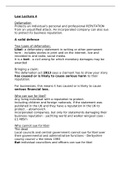
Defamation
Protects an individual’s personal and professional REPUTATION
from an unjustified attack. An incorporated company can also sue
to protect its business reputation.
A valid defence
Two types of defamation;
Libel- a defamatory statement in writing or other permanent
form - includes stories in print and on the internet, live and
recorded tv and radio, social media.
It is a tort - a civil wrong for which monetary damages may be
awarded
Bringing a claim;
The defamation act 2013 says a claimant has to show your story
has caused or is likely to cause serious harm to their
reputation.
For businesses, this means it has caused or is likely to cause
serious financial loss.
Who can sue for libel?
Any living individual with a reputation to protect.
Including children and foreign nationals, if the statement was
published in the UK and they have a reputation in the UK to
protect. - abramovich
Incorporated companies, but only for statements damaging their
business reputation - yachting world and walker wingsail case -
£1.485m
Who cannot sue for libel
The dead
Local councils and central government cannot sue for libel over
their governmental and administrative functions - Derbyshire
county council v the times 1993
But individual councillors and officers can sue for libel
, eg, the twibel case
Who can be sued?
Anyone responsible for defamatory publication; source, writer,
sub editor, editor, proprietor, distributor.
What does a claimant have to prove?
Defamation
Identification
Publication the DIP test
The claimant doesn’t have to prove the words are untrue or
unfair, it is the publisher who has to prove they have a defence.
Defamation act 1952
Does your story tend to ;
• cause the claimant to be shunned or avoided
• Lower the claimant in the eyes of right thinking people
• Expose the claimant to hatred, ridicule or contempt
• Disparage the claimant in their trade, office or profession
Tend to?
The claimant doesn’t have to prove their reputation has been
damaged - only that it could be. Meaning of the words must be
tested.
Who does what?
The judge decided if the words are capable of having defamatory
meaning.
Important change - defamation a 2013 removes the
presumption of jury in libel cases- judges will normally hear these
cases.
Defamation
Protects an individual’s personal and professional REPUTATION
from an unjustified attack. An incorporated company can also sue
to protect its business reputation.
A valid defence
Two types of defamation;
Libel- a defamatory statement in writing or other permanent
form - includes stories in print and on the internet, live and
recorded tv and radio, social media.
It is a tort - a civil wrong for which monetary damages may be
awarded
Bringing a claim;
The defamation act 2013 says a claimant has to show your story
has caused or is likely to cause serious harm to their
reputation.
For businesses, this means it has caused or is likely to cause
serious financial loss.
Who can sue for libel?
Any living individual with a reputation to protect.
Including children and foreign nationals, if the statement was
published in the UK and they have a reputation in the UK to
protect. - abramovich
Incorporated companies, but only for statements damaging their
business reputation - yachting world and walker wingsail case -
£1.485m
Who cannot sue for libel
The dead
Local councils and central government cannot sue for libel over
their governmental and administrative functions - Derbyshire
county council v the times 1993
But individual councillors and officers can sue for libel
, eg, the twibel case
Who can be sued?
Anyone responsible for defamatory publication; source, writer,
sub editor, editor, proprietor, distributor.
What does a claimant have to prove?
Defamation
Identification
Publication the DIP test
The claimant doesn’t have to prove the words are untrue or
unfair, it is the publisher who has to prove they have a defence.
Defamation act 1952
Does your story tend to ;
• cause the claimant to be shunned or avoided
• Lower the claimant in the eyes of right thinking people
• Expose the claimant to hatred, ridicule or contempt
• Disparage the claimant in their trade, office or profession
Tend to?
The claimant doesn’t have to prove their reputation has been
damaged - only that it could be. Meaning of the words must be
tested.
Who does what?
The judge decided if the words are capable of having defamatory
meaning.
Important change - defamation a 2013 removes the
presumption of jury in libel cases- judges will normally hear these
cases.