

Strength and Conditioning - Endurance Training: Applied principles
Session overview/outcome
1) Adaptations to endurance exercise
2) VO2Max / Assessment methods
3) Lactate Threshold
4) Maximal lactate steady state
5) Hierarchy of training needs
6) Case Study – XC Skiing Olympic Gold medallist
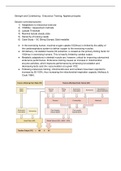
● In the exercising human, maximal oxygen uptake (VO2max) is limited by the ability of
the cardiorespiratory system to deliver oxygen to the exercising muscles.
● O2 delivery, not skeletal muscle O2 extraction, is viewed as the primary limiting factor for
VO2max in exercising humans. This is heavily limited by cardiac output.
● Metabolic adaptations in skeletal muscle are, however, critical for improving submaximal
endurance performance. Endurance training causes an increase in mitochondrial
enzyme activities, which improves performance by enhancing fat oxidation and
decreasing lactic acid (H+) accumulation at a given VO2.
● Following endurance training, mitochondria size and numbers have been reported to
increase by 50-100%, thus increasing the mitochondrial respiration capacity (Holloszy &
Coyle 1984).
,Maximal aerobic speed/VO2 max
● VO2 max is described as the greatest amount of oxygen that can be used at the cellular
level for the entire body, and is related primarily to the ability of the heart and circulatory
system to transport oxygen and the ability of body tissues to use it
● The speed and/or power associated with the body’s maximal oxygen uptake is reffered
to as maximal aerobic speed. v/pVO2max is theoretically the lowest speed/power
needed to elicit VO2max, this makes it an ideal reference for training
● The v/pVO2max can be determined, or estimated, using a number of different ways.
Some of these include the following:
1) Direct measurement: Pulmonary gas exchange during ramp-like incremental running or
cycling tests to exhaustion is used, either on a track or treadmill or by using an
ergometer
2) Constant: A 5 min exhaustive run or 4 minute cycle are common, since the average time
to exhaustion at VO2max has been reported to range from 4 to 8 min. The VO2max
calculated from this test has been shown to be largely correlated with the incremental
laboratory tests
3) Incremental / intermittent: 30-15 / Bleep tests are commonly used in team sports with
high correlation to laboratory measures.
,
Session overview/outcome
1) Adaptations to endurance exercise
2) VO2Max / Assessment methods
3) Lactate Threshold
4) Maximal lactate steady state
5) Hierarchy of training needs
6) Case Study – XC Skiing Olympic Gold medallist
● In the exercising human, maximal oxygen uptake (VO2max) is limited by the ability of
the cardiorespiratory system to deliver oxygen to the exercising muscles.
● O2 delivery, not skeletal muscle O2 extraction, is viewed as the primary limiting factor for
VO2max in exercising humans. This is heavily limited by cardiac output.
● Metabolic adaptations in skeletal muscle are, however, critical for improving submaximal
endurance performance. Endurance training causes an increase in mitochondrial
enzyme activities, which improves performance by enhancing fat oxidation and
decreasing lactic acid (H+) accumulation at a given VO2.
● Following endurance training, mitochondria size and numbers have been reported to
increase by 50-100%, thus increasing the mitochondrial respiration capacity (Holloszy &
Coyle 1984).
,Maximal aerobic speed/VO2 max
● VO2 max is described as the greatest amount of oxygen that can be used at the cellular
level for the entire body, and is related primarily to the ability of the heart and circulatory
system to transport oxygen and the ability of body tissues to use it
● The speed and/or power associated with the body’s maximal oxygen uptake is reffered
to as maximal aerobic speed. v/pVO2max is theoretically the lowest speed/power
needed to elicit VO2max, this makes it an ideal reference for training
● The v/pVO2max can be determined, or estimated, using a number of different ways.
Some of these include the following:
1) Direct measurement: Pulmonary gas exchange during ramp-like incremental running or
cycling tests to exhaustion is used, either on a track or treadmill or by using an
ergometer
2) Constant: A 5 min exhaustive run or 4 minute cycle are common, since the average time
to exhaustion at VO2max has been reported to range from 4 to 8 min. The VO2max
calculated from this test has been shown to be largely correlated with the incremental
laboratory tests
3) Incremental / intermittent: 30-15 / Bleep tests are commonly used in team sports with
high correlation to laboratory measures.
,


