

Exam (elaborations) GIZMOS Student Exploration Mouse Genetics (One Trait)
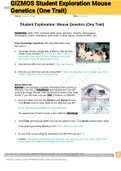
Exam (elaborations) GIZMOS Student Exploration Mouse Genetics (One Trait) Vocabulary: allele, DNA, dominant allele, gene, genotype, heredity, heterozygous, homozygous, hybrid, inheritance, phenotype, Punnett square, recessive allele, trait Prior Knowledge Questions (Do these BEFORE using the Gizmo.) 1. The image shows a single litter of kittens. How are they similar to one another? All of them are kittens, have a white belly, have spots of color throughout their body, and seem to have no missing body parts. 2. How do they differ from one another? They each have a different skin color and body mass. 3. What do you think their parents looked like? I think one was black and the other was some shade of spotted brown or entirely white. Gizmo Warm-up Heredity is the passage of genetic information from parents to offspring. The rules of inheritance were discovered in the 19th century by Gregor Mendel. With the Mouse Genetics (One Trait) Gizmo™, you will study how one trait, or feature, is inherited. 1. Drag two black mice into the Parent 1 and Parent 2 boxes. Click Breed several times. What do the offspring look like? All the offspring that resulted from this were black. The appearance of each mouse is also called its phenotype. 2. Click Clear and drag two white mice into the parent boxes. Click Breed several times. What is the phenotype of the offspring now? All the offspring were white. 3. Do you think mouse offspring will always look like their parents? No Explain: Phenotype is determined by genotype, and offspring can have hidden alleles that would cause for a different phenotype than their parents. This study source was downloaded by from CourseH on :58:31 GMT -05:00 This study resource was shared via CourseH GIZMOS Student Exploration Mouse Genetics (One Trait) Activity A: Patterns of inheritance Get the Gizmo ready: Click Clear. Drag a black mouse and a white mouse into the parent boxes, but don’t click Breed yet. Question: What patterns are shown by offspring traits? 1. Predict: What do you think the offspring of a black mouse and a white mouse will look like? Either entirely black, entirely white, entirely gray, or black and white at the same time. 2. Observe: Click Breed several times. What do you see? All the offspring were black. 3. Observe: Drag two offspring into the Holding Cages. These mice are called hybrids because their parents had different traits. Click Clear, and then breed the two hybrids. What do you see now? Around 25% of the offspring were white and the rest were black. 4. Experiment: Turn on Show statistics. Click Breed until there are 100 offspring. How many offspring were black? 76 How many were white? 24 5. Explore: Try other combinations of mouse parents. Write the results of each experiment in your notes. When you have finished, answer the following questions. (Note: You can refer to the parents as “pure black,” “pure white,” or “hybrid.”) A. Which parent combination(s) yield only white offspring? Only two pure white parents. B. Which parent combination(s) yield only black offspring? A pure black with any other parent type. C. Which parent combination(s) yield a mixture of black and white offspring? A hybrid with another hybrid or a hybrid with a pure white. 6. Challenge: Based on experiments similar to these, Gregor Mendel devised a theory of inheritance. Use your own observations to come up with your own explanation of how a trait such as fur color is passed down from parents to offspring. In this case, the trait of skin color is expressed through only one set of genes and it exhibits the basic Mendelian genetics principles of dominant and recessive genes (without any codominance or incomplete dominance). This study source was downloaded by from CourseH on :58:31 GMT -05:00 This study resource was shared via CourseH Activity B: Genetics basics Get the Gizmo ready: Click Clear. Drag a black mouse and a white mouse into the parent boxes. Introduction: Inherited traits are encoded on a molecule called DNA (deoxyribonucleic acid). Genes are segments of DNA that control a particular trait. Most genes have several different versions, or alleles. The genotype is the allele combination an organism has. Question: How do alleles determine fur color? 1. Observe: Turn on Show genotype. Move your cursor over a mouse to see its genotype. A. What is the genotype of the black parent? FF White parent? ff These mice are homozygous for fur color, meaning both alleles are the same. B. Click Breed. What is the genotype of the offspring mice? Ff These mice are heterozygous for fur color, meaning the alleles are different. 2. Analyze: Dominant alleles are always expressed when present. Recessive alleles are not expressed when the dominant allele is also present. Look at the two alleles for fur color. A. Which allele is dominant, and which fur color does it produce? F, produces black B. Which allele is recessive, and which fur color does it produce? f, produces white 3. Predict: Place two of the Ff offspring into the Holding Cages. Click Clear, and then place them into the parent boxes. A. Which allele(s) could the offspring inherit from parent 1? Dominant F for black or a recessive f for white. B. Which allele(s) could the offspring inherit from parent 2? The same as parent 1, dominant F for black or recessive f for white. C. What are the possible genotypes of the offspring? FF (25% probability), Ff (50% probability), and ff (25% probability). 4. Experiment: Click Breed several times and look at the genotypes of the offspring. Did you find all the predicted genotypes? Explain. Yes, all three predicted genotypes were prevalent, however they were only shown in one of two phenotypes: all black fur or all white fur. This study source was downloaded by from CourseH on :58:31 GMT -05:00 This study resource was shared via CourseH F F f f F f f f Activity C: Modeling inheritance Get the Gizmo ready: Click Clear. Drag a black mouse and a white mouse into the parent boxes. Question: How do scientists predict the genotypes of offspring? 1. Model: Scientists use a Punnett square to model the different possible offspring genotypes from a parent pair. The parent genotypes are written across the top and side of the square, as shown. The four possible offspring genotypes are then filled in. The first square is filled in for you. Fill in the remaining squares. A. What are the genotypes of the offspring? All of the offspring were heterozygous. B. What percentage of the offspring will have black fur? 100% C. What percentage of the offspring will have white fur? 0 2. Experiment: Click Breed several times. Were your predictions correct? Yes 3. Model: Use the Punnett squares below to model each parent combination. After filling in each Punnett square, predict the percentages of black and white offspring. Parent 1: Heterozygous black (Ff) Parent 2: Heterozygous black (Ff) Predicted % black offspring: 75% Predicted % white offspring: 25% Parent 1: Heterozygous black (Ff) Parent 2: Homozygous white (ff) Predicted % black offspring: 50% Predicted % white offspring: 50% Ff Ff Ff Ff Ff FF ff Ff Ff ff ff This study source was downloaded by from CourseH on :58:31 GMT -05:00 This study resource was shared via CourseH (Activity C continued next page) This study source was downloaded by from CourseH on :58:31 GMT -05:00 This study resource was shared via CourseH Activity C (continued from previous page) 4. Experiment: Turn on Show statistics and Show as approximate percentage. For each combination, breed approximately 500 offspring. Record the results in the table below. (Hint: To obtain an Ff mouse, breed an FF mouse to an ff mouse. Place two Ff offspring into the holding cages, click Clear, and then drag the Ff mice into the parent boxes.) Parent 1 Genotype Parent 2 Genotype % Black offspring % White offspring Ff Ff 74% 26% Ff ff 50% 50% 5. Draw conclusions: How well did the Punnett squares predict the offspring percentages for each parent pair? The Punnett squares were reliable and were able to predict the percentages considerably accurately for each parent pair. 6. Summarize: In your own words, describe what heredity is and how it works in mice. Heredity is the something that occurs as a result of a trait or feature being passed on to an offspring. With this type of mice, it worked purely simply as either dominant or recessive for the fur type, but in real life there are multiple alleles/genes that code for each individual trait in an organism. These alleles/genes cause the genetic variation we see and can even mutate causing new unknown variations that were not prevalent in the parents or ancestral line of the offspring. 7. Think and discuss: Do you think most traits are inherited the way mouse fur color is? No Why do you think this is? If only one gene coded for each trait in a body, mutations could severe and extremely fatal affects. Additionally, since each trait is a result of multiple biological macromolecules coming together it would make sense for it to require more than one section of DNA to code for it. For each individual trait, there are usually tons of proteins that result in the expression of such trait so there would be a lot of DNA that codes for all of these proteins and a lot of variable and distinct genes. This study source was downloaded by from CourseH on :58:31 GMT -05:00 This stud
Document information
- Uploaded on
- January 10, 2022
- Number of pages
- 6
- Written in
- 2021/2022
- Type
- Exam (elaborations)
- Contains
- Questions & answers


