

Exam (elaborations) GIZMOS Pierra Flack Gizmo Equilibrium and Pressure
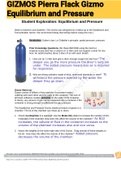
Exam (elaborations) GIZMOS Pierra Flack Gizmo Equilibrium and Pressure [Note to teachers and students: This Gizmo was designed as a follow-up to the Equilibrium and Concentration Gizmo. We recommend doing that activity before trying this one.] Vocabulary: Dalton’s law, Le Châtelier’s principle, partial pressure, pressure Prior Knowledge Questions (Do these BEFORE using the Gizmo.) A typical scuba tank has a volume of 11 liters and can support a diver for one hour. An adult breathes about 3 liters of air with each breath. 1. How can an 11-liter tank give a diver enough oxygen for one hour? The deeper you go the more pressure the diver’s lung are under. The added pressure means less air is required for respiration. 2. Why are diving cylinders made of thick, reinforced aluminum or steel? To withstand the pressure exerted by the water the deeper they go down. Gizmo Warm-up Gases consist of billions of tiny particles in constant motion, colliding with each other and the walls of the container. The sum of all these collisions creates pressure on the walls of the container. In theory, any amount of gas can be squeezed into a container if the container is strong enough to withstand the gas pressure. The Equilibrium and Pressure Gizmo shows a mixture of gases in a chamber. The lid of the chamber can move up or down. 1. Check that Reaction 1 is selected. Use the Moles NO2 slider to increase the number of NO2 molecules in the chamber. How does this affect the volume of the chamber? As NO2 increases, the volume of fluid in the container increases so the volume of the chamber increases also and vice versa. 2. Notice the weights on the lower right side of the Gizmo. Drag several of these weights to the lid. How does this affect the volume of the chamber? Added pressure decreases the volume of the chamber. This study source was downloaded by from CourseH on :03:15 GMT -05:00 This study resource was shared via CourseH GIZMOS Pierra Flack Gizmo Equilibrium and Pressure 2019 Activity A: Dalton’s law Get the Gizmo ready: Remove all weights from the lid. Set Moles NO2 and Moles N2O4 to 0. Introduction: In a mixture of gases, each gas contributes a partial pressure to the total pressure in the chamber. Because the chamber has a moveable piston, the pressure inside is equal to the pressure on the lid. In this Gizmo, the units of pressure are megapascals (MPa). Question: How do individual gases contribute to the total pressure in a chamber? 1. Observe: Set Moles NO2 to 2 to add 2 moles of NO2 gas to the chamber. A. The total pressure (P) on the chamber is shown next to the weights, at bottom right. What is the total pressure in the chamber? 54 MPa B. Select the BAR CHART tab and select Pressure. Turn on Show data values. What is the pressure of NO2? PNO2 = 54.00 MPa 2. Observe: Set Moles N2O4 to 2 to add 2 moles of N2O4 gas to the chamber. A. What is the total pressure on the chamber? 54 MPa B. What are the partial pressures of NO2 and N2O4? PNO2 = 27 MPa PN2O4 = 27 MPa C. What is the sum of the partial pressures of NO2 and N2O4? 54 MPa Dalton’s law states that the total pressure in a container is equal to the sum of the partial pressures: P = P1 + P2 + …. + Pn 3. Explain: Why doesn’t the total pressure increase when more gas is added to the chamber? (Hint: What would you see if the volume of the chamber was fixed?) As more gas is added to the chamber and the chamber is at a fixed volume, the gas molecules would be closer together, exerting more pressure upon each other and the chamber. 4. Analyze: A molecule of N2O4 has twice the mass as a molecule of NO2. What do you notice about the partial pressure exerted by 2 moles of NO2 compared to the partial pressure exerted by 2 moles of N2O4? They are equal. At a given temperature, the partial pressure exerted by a gas depends only on the quantity of the gas, not on its mass. Thus a mole of a light gas such as hydrogen (H2) exerts the same pressure as a mole of a heavier gas such as dinitrogen tetroxide (N2O4). This study source was downloaded by from CourseH on :03:15 GMT -05:00 This study resource was shared via CourseH 2019 Activity B: Partial pressure and equilibrium Get the Gizmo ready: Select Reaction 2. Move the Sim. speed slider all the way to the right. Introduction: In the Equilibrium and Concentration Gizmo, you found that reversible reactions eventually result in chemical equilibrium. Chemical equilibrium is reached when the rates of the forward and reverse reactions are the same. The constant Kc describes the ratio of products to reactants at equilibrium. A similar equilibrium can be calculated based on partial pressure. Question: How can partial pressure be used to measure equilibrium? 1. Review: What is the formula of Kc for reaction 2? Assume [NO] is the equilibrium concentration of NO, [NO2] is the equilibrium concentration of NO2, and [N2O3] is the equilibrium concentration of N2O3. Kc = [ N2O3 ] [NO][NO2 ] 2. Gather data: Experiment with a variety of initial partial pressures of NO, NO2, and N2O3. For each set of initial partial pressures, use the Gizmo to determine the equilibrium partial pressures of each gas. Run three trials for each set of initial conditions. Use the data you collect to fill in the first four columns of the table. (Note that some NO2 molecules combine to form N2O4, so there may be less free NO2 than NO.) Init. PNO (MPa) Init. PNO2 (MPa) Init. PN2O3 (MPa) Eq. PNO (MPa) Eq. PNO2 (MPa) Eq. PN2O3 (MPa) PN2O3 PNO·PNO2 .61 14.70 13.70 0.40 = 2/5 .25 11.76 12.68 0.37 = 3/8 .25 15.30 8.26 0.21 = 1/5 13.71 6.08 27.43 17.62 11.61 18.77 0.64 = 2/3 13.71 6.08 27.43 20.45 14.93 12.62 0.36 = 1/3 13.71 6.08 27.43 19.76 14.12 14.12 0.42 = 3/7 .73 16.65 9.53 0.25 = ¼ 16 16 16 18.90 14.39 13.08 0.39 = 2/5 .78 17.71 8.49 0.22 = This study source was downloaded by from CourseH on :03:15 GMT -05:00 This study resource was shared via CourseH 2019 2/9 3. Calculate: In the last column of the table, calculate the ratio of equilibrium partial pressures as shown. What do you notice about the values in the last column? They are really close together and all less than
Document information
- Uploaded on
- January 4, 2022
- Number of pages
- 9
- Written in
- 2021/2022
- Type
- Exam (elaborations)
- Contains
- Questions & answers


