

Instrumentele analyse: Facet scheidingsmethoden
HPLC principe en instrument:
HPLC = high performance liquid chromatografie
DLC = dunnelaagchromatografie
LC = vloeistofchromatografie
GC = gaschromatografie
LC kan op een breder terrein w toegepast
Niet beperkt door vluchtigheid of thermische
stabiliteit vd te analyseren componenten
Methanol = ideaal voor GC, heeft laag kookpunt
Ontbreekt een UV of fluorescentie activiteit
Riboflavine = geen kookpunt,
kan niet verdampen
UV actieve molecule
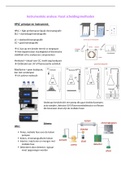
Onderaan bevindt zich een pomp die gaat vloeistof pompen,
auto sampler, detector (UV) fluorescentiedetector en flessen
die bovenaan staan zijn de mobiele fasen
Schema
HPLC:
Pomp, mobiele fase over de kolom
pompen
Kolom, chromatografische kolom
Injector, injecteren en mengen met
mobiele fase
Detecteren door detector, signaal
moet opgevangen worden
, Scheidingsprincipe:
Componenten in mengsel gescheiden obv hun verschil in affiniteit voor de stationaire en
mobiele fase
Kolom = stationaire fase
Eluens = mobiele fase
Op polariteit scheiden
- Polair houdt van polair
- Apolair houdt van apolair
Verdelingschromatografie:
Moleculen lossen op in de stationaire fase, evenwicht
tussen conc van de moleculen in de stationaire fase en
die in de mobiele fase
Component gaat zich verdelen over de stationaire en mobiele fase
Als ze bij de mobiele fase graag zitten dan komen ze er snel uit
Grootste deel bevindt zich in de stationaire fase (blauw)
Cs = stationaire fase
Cm = mobiele fase
K = evenwichtsconstante
K = (Cs/Cm)
Mobiele fase:
Moet goed gekozen worden voor chromatogram met
voldoende resolutie
Polariteit van het eluens heeft dus een grote invloed op de
scheiding
Potentiële mobiele fases (organische oplossingen)
Water is het meest polair
Cyclohexaan minst polair
Altijd samen met water (het is relatief goedkoop)
Isocratische elutie (= constante elutiesterkte)
Voorbeeld 80/20 MeOH/H2O
- De laatste component heeft veel tijdverschil voor deze eruit komt
Gradiënt elutie
- Samenstelling van mobiele fase wijzigen in functie vd tijd wordt minder polair, elutiesterkte
gaat veranderen) gaat van 75 min naar 30 min
HPLC principe en instrument:
HPLC = high performance liquid chromatografie
DLC = dunnelaagchromatografie
LC = vloeistofchromatografie
GC = gaschromatografie
LC kan op een breder terrein w toegepast
Niet beperkt door vluchtigheid of thermische
stabiliteit vd te analyseren componenten
Methanol = ideaal voor GC, heeft laag kookpunt
Ontbreekt een UV of fluorescentie activiteit
Riboflavine = geen kookpunt,
kan niet verdampen
UV actieve molecule
Onderaan bevindt zich een pomp die gaat vloeistof pompen,
auto sampler, detector (UV) fluorescentiedetector en flessen
die bovenaan staan zijn de mobiele fasen
Schema
HPLC:
Pomp, mobiele fase over de kolom
pompen
Kolom, chromatografische kolom
Injector, injecteren en mengen met
mobiele fase
Detecteren door detector, signaal
moet opgevangen worden
, Scheidingsprincipe:
Componenten in mengsel gescheiden obv hun verschil in affiniteit voor de stationaire en
mobiele fase
Kolom = stationaire fase
Eluens = mobiele fase
Op polariteit scheiden
- Polair houdt van polair
- Apolair houdt van apolair
Verdelingschromatografie:
Moleculen lossen op in de stationaire fase, evenwicht
tussen conc van de moleculen in de stationaire fase en
die in de mobiele fase
Component gaat zich verdelen over de stationaire en mobiele fase
Als ze bij de mobiele fase graag zitten dan komen ze er snel uit
Grootste deel bevindt zich in de stationaire fase (blauw)
Cs = stationaire fase
Cm = mobiele fase
K = evenwichtsconstante
K = (Cs/Cm)
Mobiele fase:
Moet goed gekozen worden voor chromatogram met
voldoende resolutie
Polariteit van het eluens heeft dus een grote invloed op de
scheiding
Potentiële mobiele fases (organische oplossingen)
Water is het meest polair
Cyclohexaan minst polair
Altijd samen met water (het is relatief goedkoop)
Isocratische elutie (= constante elutiesterkte)
Voorbeeld 80/20 MeOH/H2O
- De laatste component heeft veel tijdverschil voor deze eruit komt
Gradiënt elutie
- Samenstelling van mobiele fase wijzigen in functie vd tijd wordt minder polair, elutiesterkte
gaat veranderen) gaat van 75 min naar 30 min


