Oral Medications Dosage Calculations Practice Quiz (Part 2: 40 Items)| 21/2022 UPDATE
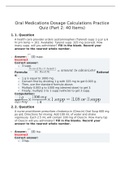
Oral Medications Dosage Calculations Practice Quiz (Part 2: 40 Items) 1. 1. Question A health care provider orders acetaminophen (Tylenol) supp 1 g pr q 6 hr prn temp > 101. Available: Tylenol supp. 325 mg (scored). How many supp. will you administer? Fill in the blank. Record your answer to the nearest whole number. o Answer: (3) supp. Incorrect Correct answer: • 3 supp. Formula: Rationale: • 1 g is equal to 1000 mg. • Convert first by dividing 1 g with 325 mg to get 0.003 g. • Then, use the standard formula above. • Multiply 0.003 g to 1000 mg (desired dose) to get 3. • Finally, multiply 3 to 1 supp (vehicle) to get 3 supp. Computation: 2. 2. Question A nurse practitioner prescribes clindamycin (Cleocin) Oral Susp 600 mg po qid; Directions for mixing: Add 100 mL of water and shake vigorously. Each 2.5 mL will contain 100 mg of Cleocin. How many tsp of Cleocin will you administer? Fill in the blanks. Record your answer to the nearest whole number. • Answer: (3) tsp. Incorrect Correct answer: • 3 tsp. Formula: Rationale: • Use the standard formula above. • Divide 600 mg (desired dose) by 100 mg (drug on hand) to get 6 mg. • Then, multiply 6 mg to 2.5 mL (vehicle) to get 15 mL. • Convert mL to teaspoon; 1 tsp is equal to 5 mL. • Multiply 15 mL to 1 tsp, then divide it by 5 mL to get 3 tsp. Computation: 3. 3. Question A health care provider ordered sulfasalazine (Azulfidine) Oral Susp 500 mg q 6 hr; Directions for mixing: Add 125 mL of water and shake well. Each tbsp will yield 1.5 g of sulfasalazine. How many mL will you give? Fill in the blanks. • Answer: (5) ml. Incorrect Correct answer: • 5 ml. Formula: Rationale: • Use the standard formula above. • Divide 500 mg (desired dose) with 1.5 g (drug on hand) to get 333.3. • Multiply 333.3 to 1 g and divide it by 1000 mg to get 0.3 tbsp. • 1 tbsp is equal to 15 mL. • Multiply 0.3 to 15 mL to get 4.9 mL. • Finally, round it off to a whole number to get 5 mL. Computation: 1 tbsp = 15 ml 4. 4. Question A health care provider prescribes potassium chloride (Klotrix) 0.35 mEq/ lb po dissolved in 6 oz of oj at 8 am; Available: Klotrix 8 mEq/mL. How many mL of Klotrix will you add to the oj for a 20.5 Kg patient? Fill in the blanks. • Answer: (2) ml. Incorrect Correct answer: • 2 ml. Formula: Rationale: • 1 kg is equal to 2.2 lbs. • Convert kg to lbs first; multiply 20.5 kg to 2.2 lbs to get 45.1 lbs. • Since 0.35 mEq is recommended for 1 lb, multiply 45.1 lbs to 0.35 mEq to get 15.8 mEq/lb. • Then, use the standard formula above. • Divide 15.8 meq/lb (desired dose) by 8 mEq/lb (drug on hand) then multiply it by 1 mL (vehicle) to get 1.9 mL. • Finally, round off to a whole number to get 2 mL. Computation: 20.5 kg x 2.2 lbs = 45.1 lbs. 45.1 lbs. x 0.35 0.35 mEq/lb = 15.8 mEq/lb 5. 5. Question A health care provider orders megestrol (Megace) Oral Suspension 160 mg po bid; Directions for mixing: Add 100 mL of water and shake vigorously. Each 0.5 mL will contain 10.7 mg of megestrol. How many tbsp of megestrol will you administer? Fill in the blanks. Record your answer using one decimal place. • Answer: (0.5) tbsp Incorrect Correct answer: • 0.5 tbsp. Formula: Rationale: • Use the standard formula above. • Divide 160 mg (desired dose) with 10.7 mg (drug on hand) to get 14.9 mg. • Then, multiply 14.9 mg to 0.5 mL (vehicle) to get 7.5 mL. • 1 tbsp is equal to 15 mL. • Convert by multiplying 7.5 mL to 1 tbsp, then divide it by 15 mL to get the final answer of 0.5 tbsp or ½ tbsp. Computation: 6. 6. Question A health care provider prescribes hydroxyzine (Vistaril) Oral Susp 10 mg q 4 hr prn anxiety; Directions for mixing: Add 125 mL of water and shake well. Each tsp will yield 15 mg of Vistaril. How many mL will you give? Fill in the blanks. Record your answer using one decimal place. • Answer: (3.3) ml Incorrect Correct answer: • 3.3 ml Formula: Rationale: • Use the standard formula above. • Divide 10 mg (desired dose) by 15 mg (drug on hand) to get 0.67 mg. • Multiply 0.67 mg to 1 tsp to get 0.67 tsp. • 1 tsp is equal to 5 mL. • Convert by multiplying 0.67 tsp to 5 mL and dividing it by 1 tsp to get 3.35 mL. • Finally, round it off to one decimal place to get 3.3 mL. Computation: 7. 7. Question A health care provider prescribes ondansetron (Zofran) 8 mg p.o. t.i.d.; Available: Zofran in a 100 ml bottle labeled 4 mg/tsp.; How many ml will the nurse administer for each dose? Fill in the blanks. • Answer: (10) ml Incorrect Correct answer: • 10 ml Formula: Rationale: • Use the standard formula above. • Divide 8 mg (desired dose) with 4 mg (drug on hand) to get 2 mg. • 1 tsp is equal to 5 mL. • Multiply 2 mg to 5 mL (vehicle) to get 10 mL. Computation: Formula: Solution: 8. 8. Question A health care provider orders cefaclor (Ceclor) 45 mg/kg/day p.o. in 3 divided doses for a patient who weighs 66 pounds. A 75 ml stock medication is labeled Ceclor 125 mg/ml. How many ml would the nurse administer per dose? Fill in the blanks. Record your answer using one decimal place. • Answer: (3.6) ml Incorrect Correct answer: • 3.6 ml Formula: Rationale: • 1 kg is equal to 2.2 lbs. • Convert by dividing 66 lbs by 2.2 lbs then multiply by 1 kg to get 30 kgs. • Multiply 45 mg/kg/day (desired dose) to 30 kgs to get 1,350 then divide it by 1000 to get 1.350 mg/day. • Divide 1.350 mg/day into 3 doses then multiply it by 1000 to get 450 mg/dose. • Divide 450 mg by 125 mg (drug on hand) then multiply it by 1 mL (vehicle) to get 3.6 mL. Computation: Formula: Solution: 45 mg/kg/day x 30 kg = 1.350 mg/day ÷ 3 doses = 450 mg per dose 9. 9. Question You are providing home care for a patient who needs 15 mL of magnesium hydroxide/aluminum hydroxide (Maalox) PO. She has only standard measuring spoons in the house. How many tablespoon(s) do you instruct her to take her dose? Fill in the blanks. Record your answer to the nearest whole number. • Answer: (1) tablespoon(s) Incorrect Correct answer: • 1 Tablespoon Rationale: • 1 tbsp is equal to 15 mL. • Convert by multiplying 15 mL to 1 tbsp, then divide it by 15 ml to get 1 tbsp. Computation: 10. 10. Question You have on hand ergocalciferol (Calciferol) liquid 8000 units/2 mL. Your order reads ergocalciferol 225,000 units PO daily. How many ml should you prepare the correct dose? Fill in the blanks. Record your answer to the nearest whole number. • Answer: (56) ml Incorrect Correct answer: 56 ml Computation: 11. 11. Question Amoxil (amoxicillin) suspension 180 mg PO bid is ordered for a patient who cannot swallow pills. It is supplied as 125 mg/5 mL. How many milliliters should you administer? Fill in the blanks. Record your answer using one decimal place. • Answer: (7.2) mL. Incorrect Correct answer: • 7.2 mL. Formula: Rationale: • Use the standard formula above. • Multiply 180 mg (desired dose) to 5 mL (vehicle) to get 900 ml. • Divide 900 ml with 125 mg (drug on hand) to get 7.2 ml. Computation: 12. 12. Question You have an order for phenobarbital (Luminal) 50 mg PO at bedtime. It is supplied as phenobarbital elixir 20 mg/5 mL. How much in mL will you administer? Fill in the blanks. Record your answer using one decimal place. • Answer: (12.5) mL. Incorrect Correct answer: • 12.5 mL. Formula: Rationale: • Use the standard formula above. • Multiply 50 mg (desired dose) to 5 mL (vehicle) to get 250 ml. • Divide 250 ml with 20 mg (drug on hand) to get 12.5 ml. Computation: 13. 13. Question You are caring for your ill grandmother at home. She has an order for magnesium hydroxide/aluminum hydroxide (Maalox) 10 mL PO prn stomach upset. How do you instruct her to measure her dose in tsp using household measuring spoons? Fill in the blanks. • Answer: (2) tsp. Incorrect Correct answer: • 2 tsp. Rationale: • 1 tsp is equal to 5 ml. • Convert by multiplying 10 ml to 1 tsp, then divide it by 5 ml to get 2 tsp. Computation: 14. 14. Question You need to administer 400 mg of erythromycin (Erythrocin) PO. You have on hand a suspension of 125 mg/5 mL. How many ml will you prepare? Fill in the blanks. • Answer: (16) mL. Incorrect Correct answer: • 16 mL. Formula: Rationale: • Use the standard formula above. • Multiply 400 mg (desired dose) to 5 ml (vehicle) to get 2,000 ml. • Divide 2,000 ml with 125 mg (drug on hand) to get 16 ml. Computation: 15. 15. Question Your patient has a headache but has difficulty swallowing pills. The physician orders acetaminophen (Tylenol) 1000 mg PO every 4 to 6 hours prn. You have acetaminophen elixir 160 mg in 5 mL. How much will you administer? Fill in the blanks. Record your answer using two decimal place. • Answer: (31.25) mL. Incorrect Correct answer: • 31.25 mL. Formula: Rationale: • Use the standard formula above. • Multiply 1000 mg (desired dose) to 5 ml to get 5,000 ml. • Divide 5,000 ml with 160 mg to get 31.25 ml. Computation: 16. 16. Question A patient is instructed to take acetaminophen (Tylenol) liquid (elixir) 650 mg qid. The elixir is 160 mg/5 mL. How many milliliters per dose should the patient take? Fill in the blanks. • Answer: (20) mL. Incorrect Correct answer: • 20 mL. Formula: Rationale: • Use the standard formula above. • Multiply 650 mg (desired dose) to 5 ml (vehicle) to get 3,250 ml. • Divide 3,250 ml with 160 mg (drug on hand) to get 20.3 ml. • Finally, round it off to a whole number to get 20 ml. Computation: 17. 17. Question A patient is placed on methadone (Methadose) maintenance therapy of 15 mg/day PO. It is supplied as 10 mg in 5 mL oral solution. How many milliliters should you instruct the patient to take? Fill in the blanks. Record your answer using one decimal place. • Answer: (7.5) mL. Incorrect Correct answer: • 7.5 mL. Formula: Rationale: • Use the standard formula above. • Multiply 15 mg (desired dose) to 5 ml (vehicle) to get 75 ml. • Divide 75 ml with 10 mg (drug on hand) to get 7.5 ml. Computation: 18. 18. Question A homebound patient must take 400,000 units of nystatin PO every 4 hours, to swish in the mouth, and then swallow. It is available as 100,000 units/5 mL. The patient has only household measuring spoons. How should the patient be instructed to take the dose? Fill in the blanks. • Answer: (4) teaspoon Incorrect Correct answer: • 4 teaspoon Formula: Rationale: • Use the standard formula above, then convert to tsp. • Multiply 400,000 units (desired dose) to 5 ml (vehicle) to get 2,000,000 ml. • Divide 2,000,000 ml with 100,000 units (drug on hand) to get 20 ml. • 1 tsp is equal to 5 ml. • Convert by dividing 20 ml with 5 ml then multiply it with 1 tsp to get 4 teaspoons. Computation: 19. 19. Question A health care provider prescribes ceftazidime (Fortaz) mg/kg/day p.o. 50 mg/kg p.o. t.i.d. to a child who weighs 25.5 kg. Fortaz is available in an oral suspension labeled 100 mg/ml. How many ml would the nurse administer per dose? Fill in the blanks. Record your answer using one decimal place. • Answer: (12.8) mL. Incorrect Correct answer: • 12.8 mL. Formula: Rationale: • Use the standard formula above. • Multiply 50mg/kg (desired dose) to 25.5 kg (weight of patient) to get 1,275 mg. • Divide 1,275 mg with 100 mg (drug on hand) to get 12.75 ml. • Finally, round it off to one decimal place to get 12.8 ml. Computation: Formula: Solution: 20. 20. Question A nurse was instructed by a physician to give clarithromycin (Biaxin) for a child whose BSA is 0.55 m2. The usual adult dose is 500 mg. Biaxin is available in an oral suspension. The 100ml bottle is labeled 50 mg/ml. How many ml would the nurse give per dose? Fill in the blanks. Record your answer using one decimal place. • Answer: (3.2) mL. Incorrect Correct answer: • 3.2 mL. Formula: BSA Formula: BSA Formula: Rationale: • Use the BSA formula first then the standard formula as shown above. • To get the child’s dose, multiply 0.55m2(child’s BSA) to 500 mg (usual adult dose) to get 275. • Divide 275 with 1.7 m2to get 161.76 mg. • Use the standard formula above. • Divide 161.76 mg (desired pedia dose) with 50 mg (drug on hand) and multiply by 1 ml (vehicle) to get 3.2 ml. Computation: 21. 21. Question A health care provider prescribes nafcillin (Nafcil) 500 mg po pc; Available on hand is nafcillin 1 g tab (scored). How many tab(s) will you administer per day? Fill in the blank. Record your answer using one decimal place. • Answer: (1.5) tab(s). Incorrect Correct answer: • 1.5 tabs Rationale: • 1 g is equal to 1000 mg. • Convert by dividing 500 mg with 1000 mg to get 0.5. • Multiply 0.5 to 3 meals, then multiply by 1 tab to get 1.5 tabs. Computation: 1 g = 1,000 mg 22. 22. Question A health care provider prescribes Synthroid 75 mcg PO daily; Available: Synthroid 0.15 mg tab (scored). How many tab(s) will you administer? Fill in the blanks. Record your answer using one decimal place. • Answer: (0.5) tab(s) Incorrect Correct Answer: • 0.5 tab Formula: Rationale: • 1 mg is equal to 1,000 mcg. • Convert by dividing 75 mcg (desired dose) with 0.15 mg (drug on hand) to get 500 mg. • Then, use the standard formula. • Multiply 500 mg by 1 mg, then divide it by 1,000 mcg to get 0.5. • Finally, multiply 0.5 to 1 tab (vehicle) to get 0.5 tab. Computation: 1 mg = 1,000 mcg 23. 23. Question A health care provider prescribes Diuril 1.8 mg/kg PO tid; Available: Diuril 12.5 mg caps. How many cap(s) will you administer for each dose to a 31 lb child? Fill in the blanks. • Answer: (2) cap(s) Incorrect Correct answer: • 2 caps Formula: Rationale: • 1 kg is equal to 2.2 lbs. • Convert by dividing 31 lbs with 2.2 lbs to get 14 kgs. • Multiply 1.8 mg/kg to 14 kg to get 25.2 mg or 25 mg (per dose). • Use the standard formula above. • Divide 25 mg (desired dose) with 12.5 mg (drug on hand) then multiply by 1 cap (vehicle) to get 2 caps. Computation: 31 lbs = 14 kg 1.8 mg/kg x 14 kg = 25.2 mg or 25 mg (per dose) 24. 24. Question A health care provider orders prazosin HCl (Minipress) 3000 micrograms PO (per orem) ac (before meals); Available: Minipress tabs 2 mg (scored). How many tab(s) will you administer in 24 hr? Fill in the blanks. Record your answer using one decimal place. • Answer: (4.5) tab(s) Incorrect Correct answer: • 4.5 tabs Formula: Rationale: • Use the standard formula above. • Divide 3,000 mcg (desired dose) with 2 mg (drug on hand) to get 1,500. • Multiply 1,500 by 1 mg, then divide by 1,000 mg to get 1.5 tab. • Multiply 1.5 tabs to 3 meals per day to get 4.5 tabs. Computation: 25. 25. Question A health care provider prescribes phenytoin (Dilantin) 0.75 g PO stat; Available: Dilantin 250 mg cap. How many cap(s) will you administer? Fill in the blanks. • Answer: (3) caps. Incorrect Correct answer: • 3 caps. Formula: Rationale: • Use the standard formula above. • 1 g is equal to 1000 mg. • Divide 0.75 g (desired dose) with 250 mg (drug on hand) to get 0.003. • Multiply 0.003 to 1000 mg then divide by 1 g (vehicle) to get 3 caps. Computation: 26. 26. Question A health care provider orders digoxin (Lanoxin) 0.25 mg po daily; Available: Digoxin 125 mcg tabs (scored). How many tab(s) will you administer for this dose? Fill in the blanks. • Answer: (2) tabs. Incorrect Correct answer: • 2 tabs Rationale: • 1,000 mcg is equal to 1 mg. • Divide 0.25 mg with 125 mcg to get 0.002. • Multiply 0.002 to 1,000mcg then divide by 1 mg to get 2 tabs. Computation: 27. 27. Question A health care provider orders amoxicillin (Amoxil) 0.25 g p.o. every 8 hours; Available: Amoxicillin 125 mg tablets. How many tablet(s) will the nurse give per dose? Fill in the blanks. • Answer: (2) tabs. Incorrect Correct answer: • 2 tabs. Formula: Rationale: • Use the standard formula above. • 1000 mg is equal to 1 g. • Convert by multiplying 0.25 g to 1000 mg to get 250 mg. • Divide 250 mg (desired dose) by 125 mg (drug on hand) to get 2 mg. • Multiply 2 mg to 1 tab (vehicle) to get 2 tabs. Computation: Formula: Solution: 28. 28. Question A patient with acute coronary syndrome is about to take Aspirin gr. X. The bottle contains Aspirin 300 mg tablets. How many tablet (s) should he take? Fill in the blanks. • Answer: (2) tablet(s) Incorrect Correct answer: • 2 tablets Rationale: • 1 grain is equal to 60 mg. • Multiply 10 grains by 60 mg to get 600 mg. • Divide 600 mg by 300 mg to get 2 tabs. Computation: • 1 grain = 60 mg • 10 grains = 600 mg • 300 mg : 1 tab = 600 mg: x tabs 29. 29. Question Your patient is to receive metoprolol tartrate (Lopressor) 25 mg/day PO. The pharmacist dispenses 50 mg scored tablets. How many tablet(s) should your patient take each day? • A. 2 tabs • B. 1 1/2 tabs • C. 1 tab • D. 1/2 tab Incorrect Correct answer: • D. 1/2 tab Formula: Rationale: • Use the standard formula above. • Multiply 25 mg (desired dose) to 1 tab (vehicle) to get 25. • Divide 25 by 50 mg (drug on hand) to get 0.5 tab or ½ tab. Computation: 30. 30. Question Your order reads ergocalciferol (Calciferol) 225,000 units PO daily. You have on hand ergocalciferol in 50,000 unit tablets. How many tablet(s) will you administer? Fill in the blanks. • Answer: (4.5) tablet(s) Incorrect Correct answer: • 4.5 tablets Formula: Rationale: • Use the standard formula above. • Multiply 225,000 units (desired dose) to 1 tablet (vehicle) then divide by 50,000 units (drug on hand) to get 4.5 tablets. Computation: 31. 31. Question Your order reads cortisone (Cortone Acetate) 15 mg PO every morning. You have on hand cortisone 10 mg tablets. How many tablet(s) will you administer? Fill in the blanks. Record your answer using one decimal place. • Answer: (1.5) tablet(s) Incorrect Correct answer: • 1.5 tablets Formula: Rationale: • Use the standard formula above. • Multiply 15 mg (desired dose) to 1 tablet (vehicle), then divide by 10 mg (drug on hand) to get 1.5 tablets. Computation: 32. 32. Question Your order reads levothyroxine (Synthroid) 100 mcg PO every morning. You have levothyroxine 0.05 mg tablets. How many tablet(s) will you administer? Fill in the blanks. • Answer: (2) tablet(s) Incorrect Correct answer: • 2 tablets Formula: Rationale: • Convert mcg to mg first by dividing 100 mcg with 1000 mcg to get 0.1 mg. • Then, use the standard formula above. • Multiply 0.1 mg (desired dose) to 1 tablet (vehicle) then divide by 0.05 mg (drug on hand) to get 2 tablets. Computation: 33. 33. Question Diltiazem (Cardizem) 90 mg PO tid is ordered for a patient with hypertension. It is supplied in 60 mg scored tablets. How many tablet (s) should you administer? Fill in the blanks. Record your answer using one decimal place. • Answer: (1.5) tablet(s) Incorrect Correct answer: • 1.5 tablets Formula: Rationale: • Use the standard formula above. • Multiply 90 mg (desired dose) by 1 tablet (vehicle), then divide by 60 mg (drug on hand) to get 1.5 tablets. Computation: 34. 34. Question Each acetaminophen (Tylenol) #3 tablet has 325 mg of acetaminophen and 30 mg codeine. A patient is told to take 2 tablets PO every 4 hours for pain. The maximum safe dose of acetaminophen is 4 g/day. The safe dose of codeine varies with tolerance. Is the dose safe? • A. 3.25 grams per day. Safe! • B. 3.9 grams per day. Safe! • C. 8.25 grams per day. Not safe! • D. 8.9 grams per day. Not safe! Incorrect Correct Answer: • B. 3.9 grams per day. Safe! Rationale: • Multiply 325 mg/tablet by 2 tablets/dose to get 650 mg. • Then , multiply 650 mg by 6 doses/day to get 3,900. • Divide 3,900 by 1,000 mg to get 3.9 grams per day. *3.9 grams per day is less than the maximum safe dose of 4 grams, so it is safe. 35. 35. Question Levothyroxine (Synthroid) 150 mcg PO per day is ordered for a patient with hypothyroidism. It is supplied as 0.075 mg tablets. How many tablets should the patient take daily? A safe dose of Synthroid is 1.5 mcg/kg/day. The patient weighs 196 pounds. Is the dose safe? • A. 2 tablets. The patient is receiving 1.5 mcg/kg. Safe! • B. 1.5 tablets. The patient is receiving 1.5 mcg/kg. Safe! • C. 2 tablets. The patient is receiving 1.7 mcg/kg. Not safe! • D. 1.5 tablets. The patient is receiving 1.7 mcg/kg. Not safe! Incorrect Correct answer: • C. 2 tablets. The patient is receiving 1.7 mcg/kg. Not safe! Formula: Rationale: • First, convert mcg to mg by dividing 150 mcg by 1000 mcg to get 0.15 mg. • Then, multiply 0.15 mg (desired dose) by 1 tablet (vehicle) and divide by 0.075 mg (drug on hand) to get 2 tablets. *Not safe, the dose of 1.7 mg/kg is greater than 1.5 mg/kg, so the dose is too high 36. 36. Question A patient is taking acetaminophen (Tylenol) 325 mg, 2 tablets PO every 6 hours. How many gram(s) is the patient receiving in 24 hours? Fill in the blanks. Record your answer using one decimal place. • Answer: (2.6) gram(s) Incorrect Correct answer: • 2.6 grams Formula: Rationale: • Multiply 325 mg with 2 tablets to get 650 mg. • Multiply 650 mg to 4 doses (number of doses per day) to get 2,600 mg. • Convert 2,600 mg to grams by dividing 2,600 mg by 1,000 mg to get 2.6 g. Computation: 37. 37. Question You have digoxin (Lanoxin) 0.25 mg tablets, and you need to administer 0.375 mg PO. How many tablet(s) should you administer? Fill in the blanks. Record your answer using one decimal place. • Answer: (1.5) tablet Incorrect Correct answer: • 1.5 tablet Formula: Rationale: • Use the standard formula above. • Multiply 0.375 mg (desired dose) to 1 tablet (vehicle), then divide by 0.25 mg (drug on hand) to get 1.5 tablets. Computation: 38. 38. Question You need to administer 40 mg of furosemide (Lasix) PO. You have on hand Lasix 20 mg tablets. How many tablet(s) should you give? Fill in the blanks. • Answer: (2) tablet(s) Incorrect Correct answer: • 2 tablets Formula: Rationale: • Use the standard formula above. • Multiply 40 mg (desired dose) to 1 tablet (vehicle), then divide by 20 mg (drug on hand) to get 2 tablets. Computation: 39. 39. Question You have an order for levothyroxine (Synthroid) 0.05 mg PO. You have on hand Synthroid 100 mcg tablets. How should you prepare the correct dose? Fill in the blanks. Record your answer using one decimal place. • Answer: (1/2,0.5) tablet(s) Incorrect Correct answer: • 0.5 tablet or 1/2 tablet Formula: Rationale: • 1 mg is equal to 1,000 mcg. • Convert first by multiplying 0.05 mg to 1,000 mcg to get 50 mg. • Use the standard formula above. • Multiply 50 mg (desired dose) to 1 tablet (vehicle), then divide by 100 mg (drug on hand) to get 0.5 tablet or ½ tablet. Computation: 40. 40. Question A patient is sent home on captopril (Capoten), 6.25 mg PO bid. Her pharmacist dispenses 25 mg scored tablets. How many tablet(s) should the patient take for each dose? • A. 1/4 tablet • B. 1/2 tablet • C. 1 tablet • D. 2 tablets Incorrect Correct answer: • A. 1/4 tablet Formula: Rationale: • Use the standard formula above. • Multiply 6.25 mg (desired dose) to 1 tablet (vehicle), then divide by 25 mg (drug on hand) to get 0.25 mg or ¼ tablet. Computation:
Written for
Document information
- Uploaded on
- December 23, 2021
- Number of pages
- 23
- Written in
- 2021/2022
- Type
- Exam (elaborations)
- Contains
- Questions & answers
Subjects
-
oral medications dosage calculations practice quiz part 2 40 items 1 1 question a health care provider orders acetaminophen tylenol supp 1 g pr q 6 hr prn temp gt 101 available tylenol supp
Also available in package deal