study_guide_NR503_week4
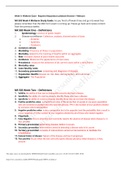
Week 4: Midterm Exam - Requires Respondus Lockdown Browser + Webcam NR 503 Week 4 Midterm Study Guide: As you finish off week three and go into week four please remember that the Mid-Term exam is coming up. Please go back and review content from the previous weeks: NR 503 Week One – Definitions 1. Epidemiology- science of public health 2. Disease surveillance- Collection, analysis, dissemination of data o – Endemic o – Epidemic o – Pandemic 2. Common vehicle 3. Morbidity- Presence of illness in population 4. Mortality-related to the tracking of deaths within an aggregate 5. Risk- increase chance of poor health outcome 6. Incidence- Measures the appearance of new cases 7. Prevalence- measure the existence of all current cases within a time frame 8. Mortality rates 9. Case-fatality rates 10. Secondary prevention- screening and diagnosis of disease 11. Population Health-Focuses on risk .data, demographics, and outcomes 12. Aggregate- The Population NR 503 Week Two – Definitions 1. Validity-the ability of that test to distinguish correctly who has a disease. 2. Sensitivity-the ability of a test to correctly identify those who have a disease 3. Specificity-he ability of a test to correctly identify those who do not have the disease 4. Positive predictive value- a proportional value of the proportion of people in any given population who are screened as positive and who have the disease. PPV is the number of true positives divided by everyone who tested positive 5. Negative predictive value- is also a proportion but is the opposite (and the probability that a result is a true negative). It is the number of true negatives divided by all of those who tested negative. 6. Magnitude 7. False Negative- Occurs when the test incorrectly reports the absence of disease when disease is, in fact, present 8. Primary prevention-preventing disease before it occurs 9. Secondary prevention- Interventions aimed at detecting a disease early in its course 10. Tertiary prevention-consists of interventions aimed at interventions to facilitate the rehabilitation 11. Natural history of disease- Nature of the disease and how it progresses 12. True positive Occurs when the test correctly reports disease presence when disease is, in fact, present -
Document information
- Uploaded on
- November 25, 2021
- Number of pages
- 2
- Written in
- 2022/2023
- Type
- Exam (elaborations)
- Contains
- Questions & answers