

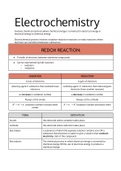
Electrochemistry
Involves chemical reactions where chemical energy is converted to electrical energy or
electrical energy to chemical energy
Electrochemical process involves oxidation-reduction reactions or redox reactions where
electrons are transferred between substances.
REDOX REACTION:
● Transfer of electrons between elements/compounds
● Can be represented by half-reactions
○ oxidation
○ reduction
OXIDATION REDUCTION
A loss of electrons A gain of electrons
reducing agent⇒ substance that oxidized/loses oxidizing agent ⇒ substance that reduced/gains
electrons electrons (from another reactant)
an increase in oxidation number a decrease in oxidation number
Always at the anode Always at the cathode
A0 → A+ + e– oxidation number increase when A+ + e– → A0 oxidation number decreases when
oxides
TERM DEFINITION
Anode: the electrode where oxidation takes place.
Cathode: the electrode where reduction takes place
Electrolyte: a substance of which the aqueous solution contains ions OR a
substance that dissolves in water to give a solution that conducts
electricity. Salt of the compound.
Electrolysis: The chemical process in which electrical energy is converted to
chemical energy OR the use of electrical energy to produce a
chemical change.
, HOW TO BALANCE REDOX REACTION USING REDOX TABLE:
1. Identify the reactants
Zn(s) and H+(aq)
2. Underline reactants on the redox table
3. Draw arrows in direction of reaction
4. Write the oxidation and reduction half-reactions
Oxidation half-reaction: Zn → Zn2+ + 2e-
+ -
Red half-reaction: 2H + 2e → H2
5. Balance electrons if necessary
6. Write overall reaction (leave out spectators)
Overall: Zn + 2H+ → Zn2+ + H2
ELECTROLYTIC VOLTAIC / GALVANIC
cathode anode cathode Anode
Reduction happens Oxidation happens Reduction happens Oxidation happens
here here here here
Connects to the Connects to the Connects to the Connects to the
negative pole of the positive pole of positive pole of the negative pole of the
energy source energy source cell cell
Electrons of Electrons are Electrons of Electrons are
external circuit flow released to the external circuit flow released to the
towards it external circuit towards it external circuit
Is negative Is positive positive negative
GALVANIC CELL ELECTROLYTIC CELL
● a cell, chemical energy is converted into A cell, electrical energy is converted into chemical
electrical energy. energy.
● has self-sustaining electrode reactions.
- Spontaneous and Exothermic Non-spontaneous and Endothermic
- Chemical energy converted to electrical energy - Electrical energy converted to chemical energy
- Electrons ⇒ from the negative anode through the Requires a battery ⇒ a DC power source (one stays
external circuit to the positive cathode positive one stays negative)
Involves chemical reactions where chemical energy is converted to electrical energy or
electrical energy to chemical energy
Electrochemical process involves oxidation-reduction reactions or redox reactions where
electrons are transferred between substances.
REDOX REACTION:
● Transfer of electrons between elements/compounds
● Can be represented by half-reactions
○ oxidation
○ reduction
OXIDATION REDUCTION
A loss of electrons A gain of electrons
reducing agent⇒ substance that oxidized/loses oxidizing agent ⇒ substance that reduced/gains
electrons electrons (from another reactant)
an increase in oxidation number a decrease in oxidation number
Always at the anode Always at the cathode
A0 → A+ + e– oxidation number increase when A+ + e– → A0 oxidation number decreases when
oxides
TERM DEFINITION
Anode: the electrode where oxidation takes place.
Cathode: the electrode where reduction takes place
Electrolyte: a substance of which the aqueous solution contains ions OR a
substance that dissolves in water to give a solution that conducts
electricity. Salt of the compound.
Electrolysis: The chemical process in which electrical energy is converted to
chemical energy OR the use of electrical energy to produce a
chemical change.
, HOW TO BALANCE REDOX REACTION USING REDOX TABLE:
1. Identify the reactants
Zn(s) and H+(aq)
2. Underline reactants on the redox table
3. Draw arrows in direction of reaction
4. Write the oxidation and reduction half-reactions
Oxidation half-reaction: Zn → Zn2+ + 2e-
+ -
Red half-reaction: 2H + 2e → H2
5. Balance electrons if necessary
6. Write overall reaction (leave out spectators)
Overall: Zn + 2H+ → Zn2+ + H2
ELECTROLYTIC VOLTAIC / GALVANIC
cathode anode cathode Anode
Reduction happens Oxidation happens Reduction happens Oxidation happens
here here here here
Connects to the Connects to the Connects to the Connects to the
negative pole of the positive pole of positive pole of the negative pole of the
energy source energy source cell cell
Electrons of Electrons are Electrons of Electrons are
external circuit flow released to the external circuit flow released to the
towards it external circuit towards it external circuit
Is negative Is positive positive negative
GALVANIC CELL ELECTROLYTIC CELL
● a cell, chemical energy is converted into A cell, electrical energy is converted into chemical
electrical energy. energy.
● has self-sustaining electrode reactions.
- Spontaneous and Exothermic Non-spontaneous and Endothermic
- Chemical energy converted to electrical energy - Electrical energy converted to chemical energy
- Electrons ⇒ from the negative anode through the Requires a battery ⇒ a DC power source (one stays
external circuit to the positive cathode positive one stays negative)


