NURS 6512 FINAL EXAM Prep |200+ Q&A 100% Effective
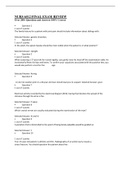
NURS 6512 FINAL EXAM Latest prep Over 200+ Questions and Answers 100% Correct Question 2 1 out of 1 points The family history for a patient with joint pain should include information about siblings with: Selected Answer: genetic disorders. • Question 4 1 out of 1 points In the adult, the apical impulse should be most visible when the patient is in what position? Selected Answer: Upright • Question 5 1 out of 1 points When assessing a 17-year-old for nuchal rigidity, you gently raise his head off the examination table. He involuntarily flexes his hips and knees. To confirm your suspicions associated with this positive test, you would also perform a test for the sign. Selected Answer: Kernig • Question 6 A red, hot swollen joint in a 40-year-old man should lead you to suspect: Selected Answer: gout. • Question 7 1 out of 1 points Electrical activity recorded by the electrocardiogram (ECG) tracing that denotes the spread of the stimulus through the atria is the: Selected Answer: P wave. • Question 8 1 out of 1 points Which cranial nerves are usually evaluated during the examination of the eyes? Selected Answer: III and VI • Question 9 1 out of 1 points A pulsation that is diminished to the point of being barely palpable would be graded as: Selected Answer: 1 • Question 10 1 out of 1 points Your 15-year-old patient is athletic and thin. Radiography of an ankle injury reveals a stress fracture. You should question this patient about her: Selected Answer: menstrual cycles. • Question 11 A positive straight leg raise test usually indicates: Selected Answer: lumbar nerve root irritation. • Question 12 A common finding in markedly obese and pregnant women is: Selected Answer: lordosis. • Question 13 1 out of 1 points A patient you are seeing in the emergency department for chest pain is suspected of having a myocardial infarction. During the health history interview of his family history, he relates that his father had died of "heart trouble." The most important follow-up question you should pose is which of the following? Selected Answer: "What age was your father at the time of his death?" • Question 14 1 out of 1 points A patient in the deepest coma would be scored a on the Glasgow Coma Scale. Selected Answer: 3 • Question 15 Cranial nerve XII may be assessed in an infant by: Selected Answer: observing the infant suck and swallow. • Question 16 1 out of 1 points A 23-year-old white woman has come to the clinic because she has missed two menstrual periods. She states that her breasts have enlarged and that her nipples have turned a darker color. Your further response to this finding is to: Selected Answer: suggest pregnancy testing. • Question 17 1 out of 1 points One of the most important aspects to consider in the orthopedic screening examination is: Selected Answer: symmetry. • Question 18 1 out of 1 points To spread the breast tissue evenly over the chest wall, you should ask the woman to lie supine with: Selected Answer: one arm overhead and a pillow under her shoulder. • Question 19 An idiopathic spasm of arterioles in the digits is termed: Selected Answer: Raynaud disease. • Question 20 If pitting edema is unilateral, you would suspect occlusion of a: Selected Answer: major vein. • Question 21 Tarry black stool should make you suspect: Selected Answer: upper intestinal bleeding. • Question 22 A parent is advised to restrict contact or collision sports participation for their child. An example of a sport in which this child could participate is: Selected Answer: riflery. • Question 23 1 out of 1 points When is the mental status portion of the neurologic system examination performed? Selected Answer: Constantly, throughout the entire interaction with a patient • Question 24 The adnexa of the uterus are composed of the: Selected Answer: fallopian tubes and ovaries. 1 out of 1 points • Question 25 1 out of 1 points Which portion of the physical examination is best done with the patient standing? Selected Answer: Spinal • Question 26 1 out of 1 points You are examining a patient in the emergency department who has recently sustained head trauma. In order to initially assess this patient's neurologic status, you would: Selected Answer: test the six cardinal points of gaze. • Question 27 A finding that is indicative of osteoarthritis is: Selected Answer: Heberden nodes. • Question 28 Bimanual examination of the uterus includes: Selected Answer: grasping the cervix between the examining fingers. • Question 29 At your first meeting with a patient, it is usually best to say: Selected Answer: "Tell me about yourself." • Question 30 Throughout the history and physical examination, the clinician should: Selected Answer: evaluate the whole patient. • Question 31 1 out of 1 points You are inspecting the genitalia of an uncircumcised adult male. The foreskin is tight and cannot be easily retracted. You should: Selected Answer: inquire about previous penile infections. • Question 32 When palpating breast tissue, the examiner should use the at each site. Selected Answer: finger pads, gliding • Question 33 A grade IV mitral regurgitation murmur would: Selected Answer: radiate to the axilla. • Question 34 1 out of 1 points Which of the following statements is true regarding the examination of peripheral arteries? Selected Answer: The pulses are most readily felt over bony prominences. • Question 35 1 out of 1 points You are examining Mr. S., a 79-year-old diabetic man complaining of claudication. Which of the following physical findings is consistent with the diagnosis of arterial occlusion? Selected Answer: Loss of hair over the extremity • Question 36 1 out of 1 points You are interviewing a 20-year-old patient with a new-onset psychotic disorder. The patient is apathetic and has disturbed thoughts and language patterns. The nurse recognizes this behavior pattern as consistent with a diagnosis of: Selected Answer: schizophrenia. • Question 37 Which medical condition would exclude a person from sports participation? Selected Answer: Fever • Question 38 The Mini-Mental State Examination: Selected Answer: may be used to quantitatively estimate cognitive changes. • Question 39 1 out of 1 points You are conducting a clinical breast examination for your 30-year-old patient. Her breasts are symmetrical with bilateral, multiple tender masses that are freely moveable with well-defined borders. You recognize that these symptoms and assessment findings are consistent with: Selected Answer: fibrocystic changes. • Question 40 The presence of cervical motion tenderness may indicate: Selected Answer: pelvic inflammatory disease. • Question 41
Written for
- Institution
- NURS 6512 FINAL EXAM REVIEW
- Course
- NURS 6512 FINAL EXAM REVIEW
Document information
- Uploaded on
- November 7, 2021
- Number of pages
- 51
- Written in
- 2022/2023
- Type
- Exam (elaborations)
- Contains
- Questions & answers
Subjects
-
nurs 6512 final exam review
-
question 2 1 out of 1 points the family history for a patient with joint pain should include information about siblings with selected answer genetic disorders • questio

Also available in package deal