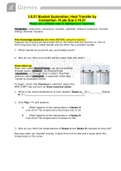
Student Exploration Heat Transfer by Conduction Gizmo Lab Jaylene Williams.
Vocabulary: conduction, convection, insulate, radiation, thermal conductor, thermal energy, thermal insulator Prior Knowledge Questions (Do these BEFORE using the Gizmo.) Suppose two frying pans have been left on the stove with the burners on. One of the frying pans has a metal handle and the other has a wooden handle. 1. Which handle do you think you could safely touch? 2. Why do you think one handle will be cooler than the other? Gizmo Warm-up Heat, also called thermal energy, can be transmitted through space (radiation), by moving fluids (convection), or through direct contact. This final method, called conduction, is explored in the Heat Transfer by Conduction Gizmo. To begin, check that Aluminum is selected. Select the BAR CHART tab and turn on Show numerical values. 1. What is the initial temperature of each beaker? Beaker A 95 c Beaker B _5 c 2. Click Play ( ) and observe. A. What happens to the temperature of Beaker A over time? The temperature decreases fast to 50. B. What happens to the temperature of Beaker B over time? The temperature increases to 50c 3. Why do you think the temperatures of Beaker A and Beaker B changed as they did? Because when you transfer energy, it goes from hot to cold and it stops when the temperature is the same Activity A: Measuring heat transfer Get the Gizmo ready: • Click Reset ( ). • Check that Aluminum is selected. Question: How does the temperature difference between two containers relate to the rate of temperature change? 1. Observe: Select the GRAPH tab and press Play. Wait until the temperatures of the two beakers are both close to 50 °C, and use the zoom out button (–) to see the whole graph. Snip and paste the graph below What does the graph show about the rate of temperature change over time? it is very rapid at the beginning, then it gets closer and closer and slows down. 2. Form hypothesis: How do you think the temperature difference between the beakers relates to the rate of heat transfer? The temperature difference made the temperature go very fast to make the cold temp catch up to the warm temp. 3. Gather data: Select the TABLE tab. Click Reset, and then click Play. Click Pause ( ) every 100 seconds (does not have to be exact). Each time you click Pause, record the temperature of each beaker and their temperature difference in the table below. (To find the temperature difference, subtract the temperature of beaker B from that of beaker A.) Time (s) Beaker A temp. (°C) Beaker B temp. (°C) Temp. difference (°C) 0 s 95 5 90 100 s 77.3 22.7 54.6 200 s 66.6 33.4 33.2 300 s 60 40 20 400 s 56.1 43.9 12.2 500 s 53.7 47.8 7.4
Document information
- Uploaded on
- November 1, 2021
- Number of pages
- 9
- Written in
- 2021/2022
- Type
- Exam (elaborations)
- Contains
- Questions & answers