PVL3701 Summary of Property law (2021 new pack)
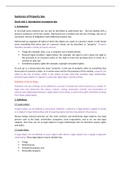
Summary of Property law Study Unit 1: Introduction to property law 1. Introduction In its broad sense property law can also be described as patrimonial law – the law dealing with a person’s patrimony (all his/her assets). Patrimonial law is divided into the law of things, the law of succession, the law of obligations and intellectual property law. Patrimonial law regulates all rights of which the objects are assets in a person’s estate. In this broad sense everything that forms part of a person’s estate can be described as ‘‘property’’. Property therefore includes a variety of assets, such as: Things (for example, land, a car, a computer and a mobile phone), Personal rights (creditor’s rights/claims) (for example, the right to one’s salary, the right to the proceeds of an insurance policy or the right to claim the purchase price in terms of a contract of sale) and Immaterial property rights (for example, copyright and patent rights). To sum up: in a broad sense the word ‘‘property’’ in the law of property refers to everything that forms part of a person’s estate. In a narrow sense and for the purposes of this module, property law refers to the law of things, which is the system of legal rules that regulates legal relationships between legal subjects in regard to a particular legal object, namely a thing. Definition of law of things: Therefore, the law of things can be defined as a branch of private law which consists of a number of legal rules that determine the nature, content, vesting, protection, transfer and termination of various real relationships between a legal subject and a thing, as well as the rights and duties ensuing from these relationships. 2. Definitions 2.1 Legal subject A legal subject can be defined as any person (whether a natural or a legal person) capable of acting as a subject in legal relationships and of acquiring rights and incurring duties in the process. Human beings (natural persons) are the most common and best-known legal subjects, but legal persons such as the State, universities, companies, close corporations, and so on, are also legal subjects, since they can act as legal subjects in legal relationships and can therefore acquire rights and duties. 2.2 Legal object A legal object can be defined as every object with which a legal subject has a legally recognised relationship. These legal objects may be divided into: Things, Performances, Immaterial property and ....................
Written for
- Institution
- PVL3701 Summary of Property law.
- Course
- PVL3701 Summary of Property law.
Document information
- Uploaded on
- October 29, 2021
- Number of pages
- 138
- Written in
- 2021/2022
- Type
- Other
- Person
- Unknown
Subjects
-
summary of property law study unit 1 introduction to property law 1 introduction in its broad sense property law can also be described as patrimonial law – the law dealing with a person’s patrimony

Also available in package deal