100% satisfaction guarantee Immediately available after payment Both online and in PDF No strings attached 4.2 TrustPilot
logo-home
Exam (elaborations)

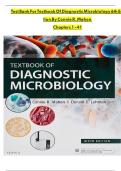
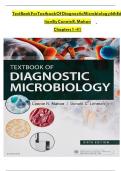
Exam (elaborations) TEST BANK FOR TEXTBOOK OF DIAGNOSTIC MICROBIOLOGY 4TH EDITION

Rating
-
Sold
-
Pages
61
Grade
A+
Uploaded on
27-10-2021
Written in
2021/2022

TEST BANK with Complete Questions and Solutions. To clarify, this is the TEST BANK, not the textbook. You get immediate access to download your test bank. You will receive a complete test bank; in other words, all chapters will be there. Test banks come in PDF format; therefore, you do not need specialized software to open them. Exam (elaborations) TEST BANK FOR TEXTBOOK OF DIAGNOSTIC MICROBIOLOGY 4TH EDITION Chapter 04: Control of Microorganisms Test Bank MULTIPLE CHOICE 1. The chemical or physical method that destroys all forms of life is called: a. Sterilization Textbook of Diagnostic Microbiology 4th Edition Test Bank b. Disinfection c. Bacteriostatic d. Bactericidal ANS: A Sterilization is the destruction of all forms of life, including bacterial spores. Disinfection is a process that eliminates a defined scope of microorganisms, including, in some cases, spores. Bacteriostatic inhibits the growth of microorganisms. Bactericidal kills bacteria. REF: page 62 OBJ: Level 1 – Recall 2. Organisms that are the most resistant to heat, chemicals, and radiation are: a. Parasites b. Prions c. Bacteria d. Viruses ANS: B Prions are naked pieces of protein, so they are harder to kill than any other organism. Viruses usually contain a nucleic acid, and all the mentioned forms of killing can effectively disrupt their nucleic acid. Bacteria and parasites are complete organisms that are killed by disinfection and sterilization, even in the spore and cyst stages. REF: page 63 OBJ: Level 1 – Recall 3. After using the phone, the laboratory tech sprayed the receiver with a chemical spray. This process will kill a defined scope of microorganisms. What is this process called? a. Sterilization b. Bacteriostatic c. Disinfection d. Bactericidal ANS: C Sterilization kills all organisms and spores at a site. Bacteriostatic and bactericidal are adjectives that describe the particular action of chemical agents: to inhibit bacterial growth or kill bacteria. Disinfection kills a defined scope of microorganisms. REF: page 62 OBJ: Level 2 – Interpretation 4. Before performing a phlebotomy, the phlebotomist will clean the area on a patient’s arm with a substance before inserting the needle. This substance is called a(n): a. Disinfectant b. Sterilizer c. Antiseptic d. Bactericidal ANS: C A disinfectant is a chemical agent used to kill microorganisms on an inanimate object. To sterilize is to kill all life; skin will still have organisms growing after wiping. Bactericidal is the process of killing bacteria. An antiseptic is a substance applied to the skin for the purpose of eliminating or reducing the number of bacteria present. REF: page 62 OBJ: Level 2 – Interpretation 5. All the following factors play a significant role in the selection and implementation of the appropriate method of disinfection EXCEPT: a. Temperature b. Contact time c. Biofilms d. Humidity ANS: D Temperature, contact time, and biofilms all play a role in selection and implementation of the appropriate method of disinfection. Humidity is not important when attempting to disinfect or kill organisms. REF: pages 62-63 OBJ: Level 1 – Recall 6. When eliminating organisms from inanimate objects, higher numbers of organisms require longer exposure times because: a. All disinfecting agents are not alike and some require shorter times. b. The chemical composition of the disinfecting agent varies. c. Disinfecting agents containing carbon tetrachloride require longer times to act. d. It takes longer to eliminate 99% of microorganisms. ANS: D When there are higher numbers of microorganisms, it takes longer to kill 99% of microorganisms present. Although disinfectants are different, it still takes longer to kill more organisms. The chemical composition of a disinfecting agent may affect the time required to kill microorganisms, but microbial load is a determining factor. REF: page 63 OBJ: Level 1 – Recall 7. When using disinfectants, it is important to follow the manufacturer’s instructions for diluting the product because if it is not diluted properly: a. There may not be enough free chemicals to kill the organisms. b. You would be wasting money by using too much disinfectant. c. The resulting solution would not kill mycobacteria. d. The resulting solution would not kill parasites. ANS: A The manufacturer tests disinfectants at a particular dilution, and this is the dilution needed for optimum performance of the disinfectant. If the manufacturer’s instructions are not followed, optimum effectiveness cannot be guaranteed. REF: page 63 OBJ: Level 1 – Recall 8. If this is present on a surface to be disinfected, it can shield microorganisms from the disinfectant or inactivate the disinfectant. What is this substance? a. Bleach (sodium hypochlorite) b. Organic material c. Hydrochloric acid d. Water ANS: B Bleach, hydrochloric acid, and water can counteract another disinfectant, but they cannot shield microorganisms from a disinfectant. Organic matter (e.g., blood, pus) can keep the disinfectant from reaching and killing the microorganism. REF: page 64 OBJ: Level 1 – Recall 9. When killing microorganisms, you must take all the following into consideration EXCEPT: a. A type of microorganism b. Temperature c. Humidity d. Bioburden ANS: C The type of microorganism (bacteria, mycobacteria, parasite, etc.), the temperature, and the bioburden (the number of bacteria) must be taken into consideration when decided how to best kill microorganisms. The humidity plays no role in the killing of microorganisms. REF: page 64 OBJ: Level 1 – Recall 10. Disinfectants are usually used at this temperature. a. 50° to 100° C b. 0° to 10° C c. 25° to 50° C d. 20° to 22° C ANS:

Show more Read less


Whoops! We can’t load your doc right now. Try again or contact support.

Document information

Uploaded on
October 27, 2021
Number of pages
61
Written in
2021/2022
Type
Exam (elaborations)
Contains
Questions & answers

Subjects

Content preview

,Textbook of Diagnostic
Microbiology 4th Microbiology
Textbook of Diagnostic Edition Test
4th
Edition Test Bank
Bank
To Purchase this Complete Test Bank with Answers Click the
link Below

https://tbzuiqe.com/product/textbook-of-diagnostic-microbiology-4th-edition-test-bank/


If face any problem or Further information contact us At


Sample Test


Mahon: Textbook of Diagnostic Microbiology, 4th Edition


Chapter 04: Control of Microorganisms


Test Bank


MULTIPLE CHOICE


1. The chemical or physical method that destroys all forms of life is called:

a. Sterilization

, b. Disinfection


c. Bacteriostatic


d. Bactericidal


ANS: A

Sterilization is the destruction of all forms of life, including bacterial spores. Disinfection is a process
that eliminates a defined scope of microorganisms, including, in some cases, spores. Bacteriostatic
inhibits the growth of microorganisms. Bactericidal kills bacteria.


REF: page 62 OBJ: Level 1 – Recall


2. Organisms that are the most resistant to heat, chemicals, and radiation are:

a. Parasites


b. Prions


c. Bacteria


d. Viruses


ANS: B

Prions are naked pieces of protein, so they are harder to kill than any other organism. Viruses
usually contain a nucleic acid, and all the mentioned forms of killing can effectively disrupt their

, nucleic acid. Bacteria and parasites are complete organisms that are killed by disinfection and
sterilization, even in the spore and cyst stages.


REF: page 63 OBJ: Level 1 – Recall


3. After using the phone, the laboratory tech sprayed the receiver with a chemical spray. This
process will kill a defined scope of microorganisms. What is this process called?

a. Sterilization


b. Bacteriostatic


c. Disinfection


d. Bactericidal


ANS: C

Sterilization kills all organisms and spores at a site. Bacteriostatic and bactericidal are adjectives that
describe the particular action of chemical agents: to inhibit bacterial growth or kill bacteria.
Disinfection kills a defined scope of microorganisms.


REF: page 62 OBJ: Level 2 – Interpretation


4. Before performing a phlebotomy, the phlebotomist will clean the area on a patient’s arm with
a substance before inserting the needle. This substance is called a(n):

a. Disinfectant


b. Sterilizer
Get to know the seller

Seller avatar
Reputation scores are based on the amount of documents a seller has sold for a fee and the reviews they have received for those documents. There are three levels: Bronze, Silver and Gold. The better the reputation, the more your can rely on the quality of the sellers work.
Expert001 Chamberlain School Of Nursing
View profile
Follow You need to be logged in order to follow users or courses
Sold
797
Member since
4 year
Number of followers
566
Documents
1190
Last sold
3 days ago
Expert001

High quality, well written Test Banks, Guides, Solution Manuals and Exams to enhance your learning potential and take your grades to new heights. Kindly leave a review and suggestions. We do take pride in our high-quality services and we are always ready to support all clients.

4.2

159 reviews

5
104
4
18
3
14
2
7
1
16

Recently viewed by you

Why students choose Stuvia

Created by fellow students, verified by reviews

Quality you can trust: written by students who passed their tests and reviewed by others who've used these notes.

Didn't get what you expected? Choose another document

No worries! You can instantly pick a different document that better fits what you're looking for.

Pay as you like, start learning right away

No subscription, no commitments. Pay the way you're used to via credit card and download your PDF document instantly.

Student with book image

“Bought, downloaded, and aced it. It really can be that simple.”

Alisha Student

Frequently asked questions