Bios 256 Lab Assignment: Urinalysis
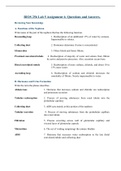
Urinalysis explained A. Functions of the Nephron Write name of the part of the nephron that has the following function. Descending loop Collecting duct Glomerulus Proximal convoluted tubule Distal convoluted tubule Ascending loop B. Hormones and Urine Formation Aldosterone Tubular reabsorption Collecting duct Tubular secretion Filtration Micturition ADH C. Urinalysis Answer the following questions with a short answer. 1. What is the normal volume of urine output per day in an adult 2. What is the normal color of urine? 3. What could make urine cloudy? 4. What is the normal specific gravity of urine? 5. What makes urine have a higher specific gravity than distilled water? 6. Name five normal solutes found in urine. 7. Normal urine contains _____ % water and _____ % solutes. 8. Is normal daytime urine output dilute or concentrated 9. What is the normal pH of urine 10. What is pyuria? 11. What is ketonuria? 12. What is hematuria? 13. What is glucosuria? 14. True or false. Normal urine has some bacteria in it even if the urine sample was taken properly. Using Your Knowledge A. Urine Formation 1. Explain how a kidney stone blocking urine flow through the ureter eventually may decrease filtrate formation in the glomerular capsule. (Hint: hydrostatic pressure.) 2. Explain how inflammation of the glomerular capsule causes hematuria. 3. Compare the contents of the filtrate in the glomerular capsule and the contents of urine in the renal pelvis. (Yes, you can answer this question without research.) B. Urinalysis
Document information
- Uploaded on
- October 26, 2021
- Number of pages
- 5
- Written in
- 2021/2022
- Type
- Exam (elaborations)
- Contains
- Questions & answers