

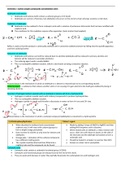
Chemistry – Carbon oxygen compounds Consolidation notes
Aldehydes and ketones
• Aldehydes and ketones both contain a carbonyl group (a C=O bond)
• Aldehydes are isomers of ketones, but aldehydes only occur on the end of a chain whereas a ketone is mid chain.
Oxidation of aldehydes
è Aldehydes can be oxidised to form carboxylic acids with a solution of potassium dichromate that has been acidified with
sulphuric acid.
è The conditions for this oxidation require reflux apparatus. (And constant heat applied)
Reflux is used so that the product is continually oxidised until it cannot be oxidised anymore by falling into the quickfit apparatus
and then oxidising further.
Reduction of aldehydes
• Aldehydes and ketones can both be reduced back to alcohols (aldehydes will be reduced to primary alcohols and
ketones will be reduces to secondary alcohols.)
• The reducing agent used is usually NaBH4
• This is a nucleophilic addition reaction, which is also known as being a reduction reaction.
Pictured above is the mechanism in which an aldehyde or a ketone is reduced back to its corresponding alcohol.
Reducing agent = a substance that reduces another atom or ion causing it to gain electrons but itself gets oxidised by losing or
donating electrons.
Reaction of hydrogen/sodium cyanide with an aldehyde or ketone will form a hydroxynitrile
• Hydrogen or sodium cyanide reacts with carbonyl compounds to produce hydroxynitriles.
• This Is a nucleophilic addition reaction.
• Hydrogen cyanide is a weak acid therefor e dissociates in water to form H+ ions and CN- ions.
Pictured above is the mechanism in which a carbonyl compound (aldehyde) is converted to a hydroxynitrile.
2,4-Dinitrophenylhydrazine Tollens’ regent
• When dissolved in methanol and concentrated • Made by adding 2 drops of NaOH to AgNO3 and then
sulphuric acid, it will react with carbonyl groups to adding NH3 dropwise until it dissolves.
form a bright orange precipitate. • When heated with an aldehyde, a redox reaction will
• Does not test for COOHs so only tests for ketones and occur, silver ions will reduce to atoms on the side of
aldehydes. the test tube and the aldehyde will oxidise to form a
• Orange ppte. = derivative of the carbonyl compound, carboxylic acid.
has a different melting point. • Should be heated in a beaker no warmer than 60’C.
• The crystals could be dried and then fitted into a • Known as a silver mirror precipitate.
capillary tube and the compound can be found.
Carboxylic acids
• Carboxylic acids contain a carboxylic functional group (-COOH).
• Carboxylic acid functional groups are always found at the end of the chain/.
• They are weak acids because in water they partially dissociate into carboxylate ions and hydrogen ions.
Aldehydes and ketones
• Aldehydes and ketones both contain a carbonyl group (a C=O bond)
• Aldehydes are isomers of ketones, but aldehydes only occur on the end of a chain whereas a ketone is mid chain.
Oxidation of aldehydes
è Aldehydes can be oxidised to form carboxylic acids with a solution of potassium dichromate that has been acidified with
sulphuric acid.
è The conditions for this oxidation require reflux apparatus. (And constant heat applied)
Reflux is used so that the product is continually oxidised until it cannot be oxidised anymore by falling into the quickfit apparatus
and then oxidising further.
Reduction of aldehydes
• Aldehydes and ketones can both be reduced back to alcohols (aldehydes will be reduced to primary alcohols and
ketones will be reduces to secondary alcohols.)
• The reducing agent used is usually NaBH4
• This is a nucleophilic addition reaction, which is also known as being a reduction reaction.
Pictured above is the mechanism in which an aldehyde or a ketone is reduced back to its corresponding alcohol.
Reducing agent = a substance that reduces another atom or ion causing it to gain electrons but itself gets oxidised by losing or
donating electrons.
Reaction of hydrogen/sodium cyanide with an aldehyde or ketone will form a hydroxynitrile
• Hydrogen or sodium cyanide reacts with carbonyl compounds to produce hydroxynitriles.
• This Is a nucleophilic addition reaction.
• Hydrogen cyanide is a weak acid therefor e dissociates in water to form H+ ions and CN- ions.
Pictured above is the mechanism in which a carbonyl compound (aldehyde) is converted to a hydroxynitrile.
2,4-Dinitrophenylhydrazine Tollens’ regent
• When dissolved in methanol and concentrated • Made by adding 2 drops of NaOH to AgNO3 and then
sulphuric acid, it will react with carbonyl groups to adding NH3 dropwise until it dissolves.
form a bright orange precipitate. • When heated with an aldehyde, a redox reaction will
• Does not test for COOHs so only tests for ketones and occur, silver ions will reduce to atoms on the side of
aldehydes. the test tube and the aldehyde will oxidise to form a
• Orange ppte. = derivative of the carbonyl compound, carboxylic acid.
has a different melting point. • Should be heated in a beaker no warmer than 60’C.
• The crystals could be dried and then fitted into a • Known as a silver mirror precipitate.
capillary tube and the compound can be found.
Carboxylic acids
• Carboxylic acids contain a carboxylic functional group (-COOH).
• Carboxylic acid functional groups are always found at the end of the chain/.
• They are weak acids because in water they partially dissociate into carboxylate ions and hydrogen ions.


