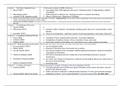
Lecture 1 – The Policy Making Process Positionality (related to WPR reflexivity)
Bacchi (2009)* Foucauldian vibes; WPR-approach; discourseD ; dividing practices1 & stigmatization; political
rationalities2
Diez-Ripolles (2019) Rational decision-making in law - ideological counter to symbolic lawmaking;
Xanthaki (2018): legislative quality Efficacy, Effectiveness, Subjectivity & Flexibility;
1) problem representations often set groups of people in opposition to each other - 'dividing practices' (Foucault, 1982, p.208). The stigmatization of the minority group serves a governmental
purpose: encouraging desired behaviour among the majority.
2) Governmental or political rationalities form patterns of thinking about problems; a currently popular style of problematization is making individuals themselves primarily responsible for
their lives.
Lecture 2 – Criminalization Processes
Jenness (2004):
Wilenmann (2019): Symbolic conflict/ Symbolic criminalization (political goals); discourse D; shared identity vs alien
identity;
Auerhahn (1999)* Theory of criminalization - Split labor market; US anti-drug legislation; moral panic; discourse D;
Lecture 3 – Lawmaking Globalized World
Perez (2006): Translation of laws; empowerment executive – less power legislative;
Zamboni (2007): Globalization of (politics of/policy of) law; translation of laws; discretion
Halliday (2009): Recursivity/ cyclicity of lawmaking. Law in the books/ Law in action; global normmaking
Lecture 4/5 – Risk, precaution & prevention Precaution, pre-crime, risk society, preventive/actuarial justice, governmentality
De Sousa Santos (1987): Law as imagined reality;
Weber (2003): Reasons for Discretion (law in the books/ law in action);
Van der Woude (2020): lack of harmonization of intra-Schengen mobility explained by Zamboni’s notion of translation;
interlegality and discretion;
Mythen & Walklate (2005): Risk Society (manufactured risks; modernity) & Governmentality (discourse, actuarial
assessment);
McCulloch & Pickering (2009): pre-crimeD; the framing of criminal law as national security problem (discourse); relates back to
the war of crime and drugs.
Zedner & Ashworth (2019): preventive state;
Lecture 6 – A Culture of Control Enemy penologyD; strategies of dealing with crime (adaptation/ denial)
Crawford (2009): Governing through anti-social behavior (governmentality; social control; discretion; actuarial
justiceD); discretionary power
Culture of Control; modernityD; institutionalized experience of crime; governmental strategies
Garland (2000): High Crime Society (adaptation & denial – HC 6); responsibilizationD; preventive partnerships; the alien other
Bacchi (2009)* Foucauldian vibes; WPR-approach; discourseD ; dividing practices1 & stigmatization; political
rationalities2
Diez-Ripolles (2019) Rational decision-making in law - ideological counter to symbolic lawmaking;
Xanthaki (2018): legislative quality Efficacy, Effectiveness, Subjectivity & Flexibility;
1) problem representations often set groups of people in opposition to each other - 'dividing practices' (Foucault, 1982, p.208). The stigmatization of the minority group serves a governmental
purpose: encouraging desired behaviour among the majority.
2) Governmental or political rationalities form patterns of thinking about problems; a currently popular style of problematization is making individuals themselves primarily responsible for
their lives.
Lecture 2 – Criminalization Processes
Jenness (2004):
Wilenmann (2019): Symbolic conflict/ Symbolic criminalization (political goals); discourse D; shared identity vs alien
identity;
Auerhahn (1999)* Theory of criminalization - Split labor market; US anti-drug legislation; moral panic; discourse D;
Lecture 3 – Lawmaking Globalized World
Perez (2006): Translation of laws; empowerment executive – less power legislative;
Zamboni (2007): Globalization of (politics of/policy of) law; translation of laws; discretion
Halliday (2009): Recursivity/ cyclicity of lawmaking. Law in the books/ Law in action; global normmaking
Lecture 4/5 – Risk, precaution & prevention Precaution, pre-crime, risk society, preventive/actuarial justice, governmentality
De Sousa Santos (1987): Law as imagined reality;
Weber (2003): Reasons for Discretion (law in the books/ law in action);
Van der Woude (2020): lack of harmonization of intra-Schengen mobility explained by Zamboni’s notion of translation;
interlegality and discretion;
Mythen & Walklate (2005): Risk Society (manufactured risks; modernity) & Governmentality (discourse, actuarial
assessment);
McCulloch & Pickering (2009): pre-crimeD; the framing of criminal law as national security problem (discourse); relates back to
the war of crime and drugs.
Zedner & Ashworth (2019): preventive state;
Lecture 6 – A Culture of Control Enemy penologyD; strategies of dealing with crime (adaptation/ denial)
Crawford (2009): Governing through anti-social behavior (governmentality; social control; discretion; actuarial
justiceD); discretionary power
Culture of Control; modernityD; institutionalized experience of crime; governmental strategies
Garland (2000): High Crime Society (adaptation & denial – HC 6); responsibilizationD; preventive partnerships; the alien other