

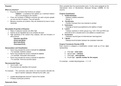
Enzymes More complete than the recommended name. It is the name assigned by the
International Union of Biochemistry Molecular Biology (IUBMB) for the
What are enzymes? enzyme.
Enzymes are proteins that functions as catalyst
Catalyst – a substance that speeds up a chemical reaction Enzyme Classification
and is not changes by the reaction 1. Oxidoreductases
There are hundreds of different enzymes but each enzyme speeds - Catalyze oxidation-reduction
up only one kind of reaction. They are specific. - (Group 1)
Because enzymes are proteins, they are denatured by heat or some 2. Transferases
chemicals - Transfer of groups from one molecule to another
3. Hydrolases
- Cleavage of bonds accomplished by the addition of water
Remarkable Properties of Enzymes 4. Lyases
1. Rates of catalyzed reaction are often high - Catalyze reactions in which groups (e.g. H2O, CO2 and NH3) are
2. Activity can be regulated due to its complex structure removed to form a double bond or are added to a double bond
3. High specificity to the reaction they catalyze, with rare formation of 5. Isomerases
side products - Catalyzes several types of intramolecular rearrangement
- Absolute specificity 6. Ligases
- Group specificity - Catalyze bond formation between two substrate molecules
- Bond specificity
- Stereospecificity Enzyme Commission Number (EC#)
Each enzyme is assigned a classification number made up of four digits
Nomenclature and Classification representing:
Some may precede the name to indicate the substrate
- For example: Xanthine oxidase a. First digit – class name
Some may precede the name to indicate the source b. Second digit – subclass
- For example: Pancreatic ribonuclease c. Third digit – sub-subclass
Some may precede the name to indicate its regulation d. Fourth digit – specific number for the enzyme
- For example: Hormone-sensitive lipase
For example – Lactate dehydrogenase – 1.1.1.27
Recommended Name
Use of suffix “-ase”
The enzymes are classifies into 6 groups
For example: The commonly used names for most enzymes describe the
type of reaction catalyzed, followed by the suffix –ase
Lactate dehydrogenase (remove H atoms from lactate
Protease (hydrolyzes proteins)
Systematic Name
, Different structural forms and origin, but with similar enzymatic activities
Type Composition Location
LDH1 HHHH Myocardium and RBC
LDH2 HHHM Myocardium and RBC
LDH3 HHMM Lungs, lymphocytes, spleen,
pancreas
LDH4 HMMM Liver, skeletal muscles
LDH5 MMMM Liver, skeletal muscles
How do enzymes work?
S+ E ↔ ES complex ↔ E+ P
Enzymes lower the activation energy or free energy of the activation
Enzymes do not alter the eq. (Keq) of the reaction, but they can
increase the rate toward equilibrium
Isoenzymes
International Union of Biochemistry Molecular Biology (IUBMB) for the
What are enzymes? enzyme.
Enzymes are proteins that functions as catalyst
Catalyst – a substance that speeds up a chemical reaction Enzyme Classification
and is not changes by the reaction 1. Oxidoreductases
There are hundreds of different enzymes but each enzyme speeds - Catalyze oxidation-reduction
up only one kind of reaction. They are specific. - (Group 1)
Because enzymes are proteins, they are denatured by heat or some 2. Transferases
chemicals - Transfer of groups from one molecule to another
3. Hydrolases
- Cleavage of bonds accomplished by the addition of water
Remarkable Properties of Enzymes 4. Lyases
1. Rates of catalyzed reaction are often high - Catalyze reactions in which groups (e.g. H2O, CO2 and NH3) are
2. Activity can be regulated due to its complex structure removed to form a double bond or are added to a double bond
3. High specificity to the reaction they catalyze, with rare formation of 5. Isomerases
side products - Catalyzes several types of intramolecular rearrangement
- Absolute specificity 6. Ligases
- Group specificity - Catalyze bond formation between two substrate molecules
- Bond specificity
- Stereospecificity Enzyme Commission Number (EC#)
Each enzyme is assigned a classification number made up of four digits
Nomenclature and Classification representing:
Some may precede the name to indicate the substrate
- For example: Xanthine oxidase a. First digit – class name
Some may precede the name to indicate the source b. Second digit – subclass
- For example: Pancreatic ribonuclease c. Third digit – sub-subclass
Some may precede the name to indicate its regulation d. Fourth digit – specific number for the enzyme
- For example: Hormone-sensitive lipase
For example – Lactate dehydrogenase – 1.1.1.27
Recommended Name
Use of suffix “-ase”
The enzymes are classifies into 6 groups
For example: The commonly used names for most enzymes describe the
type of reaction catalyzed, followed by the suffix –ase
Lactate dehydrogenase (remove H atoms from lactate
Protease (hydrolyzes proteins)
Systematic Name
, Different structural forms and origin, but with similar enzymatic activities
Type Composition Location
LDH1 HHHH Myocardium and RBC
LDH2 HHHM Myocardium and RBC
LDH3 HHMM Lungs, lymphocytes, spleen,
pancreas
LDH4 HMMM Liver, skeletal muscles
LDH5 MMMM Liver, skeletal muscles
How do enzymes work?
S+ E ↔ ES complex ↔ E+ P
Enzymes lower the activation energy or free energy of the activation
Enzymes do not alter the eq. (Keq) of the reaction, but they can
increase the rate toward equilibrium
Isoenzymes


