OPMT 1197
Business Statistics
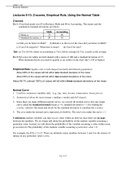
Lectures 9-10: Z-scores, Empirical Rule, Using the Normal Table
Z-scores
Ex 1: Your final grade was 85 in Business Math and 80 in Accounting. The means and the
population standard deviations are below:
Math Accounting
Mean, μ 75 60
Standard deviation, σ 20 10
(a) Did you do better in Math? (b) Relative to the rest of the class did you better in Math?
(c) Can Z be negative? What does it mean? (d) Can Z be zero?
Sol: (a) Yes (b) No, better in accounting (c) Yes, below average (d) Yes, exactly at the average
Ex 2: IQ scores for adults are bell-shaped with a mean of 100 and a standard deviation of 15.
What minimum IQ do you need to qualify as an outlier on the high side? (145 or higher)
Empirical Rule: Applies only to bell-shaped (normally distributed) populations
About 68% of the values will fall within one standard deviation of the mean.
About 95% of the values will fall within two standard deviations of the mean.
About 99.7% (almost 100%) of values will fall within three standard deviations of the mean.
Normal Curve
1. Used for continuous variables only. (e.g. Age, time, income, temperature, house prices).
2. Symmetrical about the mean (mean = median = mode) and bell-shaped.
3. Since there are many different normal curves, we convert all normal curves into one single
curve called the standard normal (mean μ = 0, standard deviation σ = 1) by finding the
z-score. (subtract the mean and divide by the standard deviation to calculate the z-score).
4. The area under the normal curve represents probability. The total area under the curve = 1.
Continuous random variables can take on any value within an interval since there are no gaps
between the numbers. We no longer talk about the probability of the random variable assuming a
particular value. Instead, we talk about the probability of the variable assuming a value within some
given interval. The probability of the random variable assuming a particular value = 0.
For example, the P(X = 3) = 0. There are infinitely many numbers between 3 and 4 so the chance of
taking on any particular value is zero.
Pg 1 of 7
, OPMT 1197
Business Statistics
1. The grades in a first-year Economics course are normally distributed with a mean of 60% and a
standard deviation of 10%. Students need to get 50% to pass the course.
(a) What percentage of students failed the course?
(b) You got 70% in the course. What percentage of students did better than you? You
did better than what percentage of students?
(c) What percentage of students got between (i) 70% and 80%? (ii) 50% and 70%?
(d) What percentage of students got a below average grade but still passed the course?
(e) What percentage of students got a grade of 99% or higher?
(f) What percentage of students got a grade between 60% and 99%?
(g) If 121 students got a grade of 67% or higher, how many students took the course?
(h) 90% of students got a grade below what value?
(i) The grades of the middle 90% of students are between what two values?
(j) What is the minimum grade needed to be in the top 5% of students?
(k) 2 out of every 3 students got a grade higher than what value?
2. A cereal maker has a machine that fills the cereal boxes. Boxes are labelled ‘350 g’ so they want
to have that much cereal in each box. But since no packaging process is perfect, there will be
minor variations. To prevent underweight boxes, they set the machine a little higher than 350
grams. They set it to 365 grams so that, on average, it fills each box with 365 grams of cereal.
Cereal weights are normally distributed with a standard deviation of 10 grams.
(a) If the machine is set at 350 g, about what percentage of boxes would be underweight?
(b) Consumer legislation states that no more than 5 boxes in 200 may contain less than the
labeled weight. Are they in compliance with the law? Hint: Calculate P(x < 350 grams).
(c) They decide to increase the amount of cereal they put in each box so only 5 boxes in 200
contain less than the labeled weight. What mean amount of cereal per box is required?
(d) They are considering buying a new filling machine with less variation. If they want to keep the
mean weight at 365 grams, how small does the standard deviation need to be?
Solutions:
1. (a) 15.87% (b) 15.87%, 84.13% (c) (i) 13.59% (ii) 68.26% (d) 34.13% (e) almost 0%
(f) ~50% (g) 500 students (h) 72.8% (i) 43.55% to 76.45% (j) 76.45% (k) 55.70%
2. (a) mean = median so about 50% of boxes would contain less than 350 grams of cereal
(b) No. 6.68% of boxes contain less than 350 grams which exceeds the 2.5% max allowed.
(c) 369.6 grams (d) 7.65 grams
Pg 2 of 7
Business Statistics
Lectures 9-10: Z-scores, Empirical Rule, Using the Normal Table
Z-scores
Ex 1: Your final grade was 85 in Business Math and 80 in Accounting. The means and the
population standard deviations are below:
Math Accounting
Mean, μ 75 60
Standard deviation, σ 20 10
(a) Did you do better in Math? (b) Relative to the rest of the class did you better in Math?
(c) Can Z be negative? What does it mean? (d) Can Z be zero?
Sol: (a) Yes (b) No, better in accounting (c) Yes, below average (d) Yes, exactly at the average
Ex 2: IQ scores for adults are bell-shaped with a mean of 100 and a standard deviation of 15.
What minimum IQ do you need to qualify as an outlier on the high side? (145 or higher)
Empirical Rule: Applies only to bell-shaped (normally distributed) populations
About 68% of the values will fall within one standard deviation of the mean.
About 95% of the values will fall within two standard deviations of the mean.
About 99.7% (almost 100%) of values will fall within three standard deviations of the mean.
Normal Curve
1. Used for continuous variables only. (e.g. Age, time, income, temperature, house prices).
2. Symmetrical about the mean (mean = median = mode) and bell-shaped.
3. Since there are many different normal curves, we convert all normal curves into one single
curve called the standard normal (mean μ = 0, standard deviation σ = 1) by finding the
z-score. (subtract the mean and divide by the standard deviation to calculate the z-score).
4. The area under the normal curve represents probability. The total area under the curve = 1.
Continuous random variables can take on any value within an interval since there are no gaps
between the numbers. We no longer talk about the probability of the random variable assuming a
particular value. Instead, we talk about the probability of the variable assuming a value within some
given interval. The probability of the random variable assuming a particular value = 0.
For example, the P(X = 3) = 0. There are infinitely many numbers between 3 and 4 so the chance of
taking on any particular value is zero.
Pg 1 of 7
, OPMT 1197
Business Statistics
1. The grades in a first-year Economics course are normally distributed with a mean of 60% and a
standard deviation of 10%. Students need to get 50% to pass the course.
(a) What percentage of students failed the course?
(b) You got 70% in the course. What percentage of students did better than you? You
did better than what percentage of students?
(c) What percentage of students got between (i) 70% and 80%? (ii) 50% and 70%?
(d) What percentage of students got a below average grade but still passed the course?
(e) What percentage of students got a grade of 99% or higher?
(f) What percentage of students got a grade between 60% and 99%?
(g) If 121 students got a grade of 67% or higher, how many students took the course?
(h) 90% of students got a grade below what value?
(i) The grades of the middle 90% of students are between what two values?
(j) What is the minimum grade needed to be in the top 5% of students?
(k) 2 out of every 3 students got a grade higher than what value?
2. A cereal maker has a machine that fills the cereal boxes. Boxes are labelled ‘350 g’ so they want
to have that much cereal in each box. But since no packaging process is perfect, there will be
minor variations. To prevent underweight boxes, they set the machine a little higher than 350
grams. They set it to 365 grams so that, on average, it fills each box with 365 grams of cereal.
Cereal weights are normally distributed with a standard deviation of 10 grams.
(a) If the machine is set at 350 g, about what percentage of boxes would be underweight?
(b) Consumer legislation states that no more than 5 boxes in 200 may contain less than the
labeled weight. Are they in compliance with the law? Hint: Calculate P(x < 350 grams).
(c) They decide to increase the amount of cereal they put in each box so only 5 boxes in 200
contain less than the labeled weight. What mean amount of cereal per box is required?
(d) They are considering buying a new filling machine with less variation. If they want to keep the
mean weight at 365 grams, how small does the standard deviation need to be?
Solutions:
1. (a) 15.87% (b) 15.87%, 84.13% (c) (i) 13.59% (ii) 68.26% (d) 34.13% (e) almost 0%
(f) ~50% (g) 500 students (h) 72.8% (i) 43.55% to 76.45% (j) 76.45% (k) 55.70%
2. (a) mean = median so about 50% of boxes would contain less than 350 grams of cereal
(b) No. 6.68% of boxes contain less than 350 grams which exceeds the 2.5% max allowed.
(c) 369.6 grams (d) 7.65 grams
Pg 2 of 7