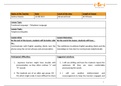
Name of the Teacher Date Level of the class Length of lesson
Andrea Noome 22/08/2021 Advanced-level 60 Minutes
Lesson Type:
Functional Language – Telephone Language
Lesson Topic:
Telephone Etiquette
Lesson Aims: Lesson Outcomes:
By the end of the lesson, students will be better able By the end of the lesson, students will have…
to…
Communicate with English speaking clients over the The confidence to address English speaking clients and the
phone using the correct phrases and pronunciation. knowledge on how best to communicate telephonically.
Anticipated difficulties: Suggested solutions:
1. Japanese learners might have trouble with 1. I will use drilling and have the students repeat the
pronunciation, as they often confuse “L” and sentences till they are more comfortable
“R” sounds pronouncing the words
2. The students are of an older age group (35 – 2. I will use positive reinforcement and
45) which might make it more difficult for them encouragement to keep the learners engaged and
1
, to learn the language or more resistent present in the lesson and the activities will
reinforce the language
3. The students might be resistant or uninterested
in the lesson since it is a requirement of their 3. I will keep the lesson upbeat and interesting, and
job, and they may be tired from work have fun activities for the learners to do to keep
them interested and energized.
Target Language Analysis
Include an analysis of the target language you will present in order for your learners to complete the ‘real-life’
task you have chosen.
● Choose your set phrases (8-12 is appropriate)
● Analyse them in a paragraph or table
● Include meaning, function/use, features of pronunciation (speaking) or spelling and punctuation (writing),
plus anything else you think is interesting
Target phrase Meaning Function/use Features of Extras
Pronunciation
Good day you are To greet the client, Greeting client gʊd ˈmɔːnɪŋ After saying “Good
speaking to (insert let them know juː ɑː ˈspiːkɪŋ tuː day” take a small
name) from (insert your name and (Insert Name) pause before
business) what company you frɒm continuing “you are
are from (Insert company) speaking to (name)”
another small pause,
“from (company)”
2
Andrea Noome 22/08/2021 Advanced-level 60 Minutes
Lesson Type:
Functional Language – Telephone Language
Lesson Topic:
Telephone Etiquette
Lesson Aims: Lesson Outcomes:
By the end of the lesson, students will be better able By the end of the lesson, students will have…
to…
Communicate with English speaking clients over the The confidence to address English speaking clients and the
phone using the correct phrases and pronunciation. knowledge on how best to communicate telephonically.
Anticipated difficulties: Suggested solutions:
1. Japanese learners might have trouble with 1. I will use drilling and have the students repeat the
pronunciation, as they often confuse “L” and sentences till they are more comfortable
“R” sounds pronouncing the words
2. The students are of an older age group (35 – 2. I will use positive reinforcement and
45) which might make it more difficult for them encouragement to keep the learners engaged and
1
, to learn the language or more resistent present in the lesson and the activities will
reinforce the language
3. The students might be resistant or uninterested
in the lesson since it is a requirement of their 3. I will keep the lesson upbeat and interesting, and
job, and they may be tired from work have fun activities for the learners to do to keep
them interested and energized.
Target Language Analysis
Include an analysis of the target language you will present in order for your learners to complete the ‘real-life’
task you have chosen.
● Choose your set phrases (8-12 is appropriate)
● Analyse them in a paragraph or table
● Include meaning, function/use, features of pronunciation (speaking) or spelling and punctuation (writing),
plus anything else you think is interesting
Target phrase Meaning Function/use Features of Extras
Pronunciation
Good day you are To greet the client, Greeting client gʊd ˈmɔːnɪŋ After saying “Good
speaking to (insert let them know juː ɑː ˈspiːkɪŋ tuː day” take a small
name) from (insert your name and (Insert Name) pause before
business) what company you frɒm continuing “you are
are from (Insert company) speaking to (name)”
another small pause,
“from (company)”
2