International Law Lectures 2020/2021
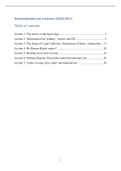
Table of contents
Lecture 1: The actors on the legal stage .............................................................. 2
Lecture 2: International law making - treaties and CIL ....................................... 4
Lecture 3: The Scope of Legal Authority: Jurisdiction of States / Immunities .. 11
Lecture 4: Do Human Rights matter? ............................................................... 20
Lecture 5: Holding actors into account ............................................................. 24
Lecture 6: Settling Disputes Peacefully under International Law ..................... 30
Lecture 7: Limits to using force under international law .................................. 36
1
,Lecture 1: The actors on the legal stage
Palestine
- A part of Palestine (Gaza strip) is occupied by Israel and because of that it is not
recognized as a sovereign state under the international law
- It is an observer state within the UN right now
- Why is it good to be a state? = Article 4 of the UN Charter, only peace-loving states
can become members of the UN
Recognition (general)
- Of states and of governments (mainly focused on recognition of states)
- Declaratory (fulfilment Montevideo convention criteria are enough to be a state = this
theory prevails) and constitutive (the fulfilment of those criteria is not enough to be a
state = this one still plays a role) theories
- Should human rights be also added to the criteria?
- Democracy – human rights?
- Collective non-recognition (Rhodesia; TRN Cyprus; Bantustans) – Annexation
Crimea?
- Collective recognition?
- through membership of the United Nations
- as party to international conventions (ICC Statute)
- or to other organizations (ICC)
- Criteria for admission (Art. 4.1 Charter)
- Some (historic) flexibility – e.g. India/Belarus/Congo
Effects of recognition
- In international law
§ Mainly political
§ No direct effect on status of the entity claiming to be a state; recognition as
evidence of acceptance of the facts
- In internal law
§ Dependent on the internal law, e.g. the capacity to sue or to be sued before a
domestic court, immunities
- Practical effects for Palestine of confirmation of statehood
- Sovereign equality and territorial integrity
- immunities/use of force/non-intervention/treaties/ICJ/ICC
2
, - Rights and duties and capacity to bring claims!
- International legal personality (Reparations for Injuries case) = state has rights and
obligations after this
Conclusion on the Status of Palestine
- A State according to the ‘objective’ criteria
- However, limited internal and international capacity due to occupation, but recognised
as a State by 138 states, though not yet full UN member.
- Continues to be an occupied territory
- That status defines the obligations of the occupying power and the rights
of the people living in the territory, not the status of the entity
- Determining its status requires interpretation of facts and law: know the relevant
legal arguments
Rights of Peoples: self-determination
- External self-determination
§ Applicable to colonial peoples and peoples living in other Non-Self-Governing
Territories, or under alien domination
§ Art. 1(2), 55 and Chapter XI UN Charter
§ GA Res. 1514 (1960)
§ Common art. 1 UN to the 1966 Conventions on Human Rights
§ GA. Res. 2625 (1970)
§ Western Sahara case; East Timor case (right erga omnes); Wall Opinion
§ Recent Chagos Advisory Opinion by ICJ
- Palestinian people: the right to self-determination is firmly established (Wall case,
para 88, 118, 122, 156); see also recent General Assembly resolution adopted in
December 2020 (A/RES/75/172)
- Uti possidetis
- Former Yugoslavia; Badinter Commission
- Internal self-determination of peoples
- The right to participate in public life of the state concerned and to enjoy
social/cultural/linguistic or other group rights (minorities v. people)
- But who are peoples? = usually minorities
- Self-determination of indigenous peoples
- UN Declaration on Rights of Indigenous Peoples (UNDRIP) 2007
(A/RES/61/295)
3
, - Territorial integrity vs. Secession
- Secession of Quebec case
- Kosovo: can the creation of an independent state be based on the right to
selfdetermination?
- ICJ advisory opinion on Kosovo (July 2010): No answer
- Catalonia, Scotland, Crimea
- secession should happen with the approval of the mother land
Other participants in international law
- International organisations
§ See Advis. Opinion – Reparation for Injuries
- Individuals (lecture 4)
§ Rights, duties and capacity
- human rights
- International criminal law
- Corporations
§ Investment protection (ISDS)
§ Subject to international legal norms
§ Mechanisms to hold corporations internationally accountable?
- Human Rights Council A/HRC/RES/17/4 and A/HRC/17/31
- Guiding Principles on Business and Human Rights (protect, respect and remedy)
- NGOs
Lecture 2: International law making - treaties and CIL
- How to determine what are legally binding obligations under international law?
- What makes this complex? – what are main theoretical approaches?
Law or Politics?
- How to determine what are legally binding obligations?
§ Art. 38.1 Statute of the ICJ
- More complex law-making in a more complex society, other actors besides states
adopt different norms that have legal impact in international law. Even though it is not
the same impact as international treaties do have but still
- There needs to be a discussion regarding creation of treaties:
§ More decision-making in international organizations
- Role of values and principles
§ Creation of treaty regimes
- The way are treaties created also matters
§ Majority decision-making
§ Normative hierarchy (jus cogens, obligations erga omnes) – what these
roles play in international law
4
Table of contents
Lecture 1: The actors on the legal stage .............................................................. 2
Lecture 2: International law making - treaties and CIL ....................................... 4
Lecture 3: The Scope of Legal Authority: Jurisdiction of States / Immunities .. 11
Lecture 4: Do Human Rights matter? ............................................................... 20
Lecture 5: Holding actors into account ............................................................. 24
Lecture 6: Settling Disputes Peacefully under International Law ..................... 30
Lecture 7: Limits to using force under international law .................................. 36
1
,Lecture 1: The actors on the legal stage
Palestine
- A part of Palestine (Gaza strip) is occupied by Israel and because of that it is not
recognized as a sovereign state under the international law
- It is an observer state within the UN right now
- Why is it good to be a state? = Article 4 of the UN Charter, only peace-loving states
can become members of the UN
Recognition (general)
- Of states and of governments (mainly focused on recognition of states)
- Declaratory (fulfilment Montevideo convention criteria are enough to be a state = this
theory prevails) and constitutive (the fulfilment of those criteria is not enough to be a
state = this one still plays a role) theories
- Should human rights be also added to the criteria?
- Democracy – human rights?
- Collective non-recognition (Rhodesia; TRN Cyprus; Bantustans) – Annexation
Crimea?
- Collective recognition?
- through membership of the United Nations
- as party to international conventions (ICC Statute)
- or to other organizations (ICC)
- Criteria for admission (Art. 4.1 Charter)
- Some (historic) flexibility – e.g. India/Belarus/Congo
Effects of recognition
- In international law
§ Mainly political
§ No direct effect on status of the entity claiming to be a state; recognition as
evidence of acceptance of the facts
- In internal law
§ Dependent on the internal law, e.g. the capacity to sue or to be sued before a
domestic court, immunities
- Practical effects for Palestine of confirmation of statehood
- Sovereign equality and territorial integrity
- immunities/use of force/non-intervention/treaties/ICJ/ICC
2
, - Rights and duties and capacity to bring claims!
- International legal personality (Reparations for Injuries case) = state has rights and
obligations after this
Conclusion on the Status of Palestine
- A State according to the ‘objective’ criteria
- However, limited internal and international capacity due to occupation, but recognised
as a State by 138 states, though not yet full UN member.
- Continues to be an occupied territory
- That status defines the obligations of the occupying power and the rights
of the people living in the territory, not the status of the entity
- Determining its status requires interpretation of facts and law: know the relevant
legal arguments
Rights of Peoples: self-determination
- External self-determination
§ Applicable to colonial peoples and peoples living in other Non-Self-Governing
Territories, or under alien domination
§ Art. 1(2), 55 and Chapter XI UN Charter
§ GA Res. 1514 (1960)
§ Common art. 1 UN to the 1966 Conventions on Human Rights
§ GA. Res. 2625 (1970)
§ Western Sahara case; East Timor case (right erga omnes); Wall Opinion
§ Recent Chagos Advisory Opinion by ICJ
- Palestinian people: the right to self-determination is firmly established (Wall case,
para 88, 118, 122, 156); see also recent General Assembly resolution adopted in
December 2020 (A/RES/75/172)
- Uti possidetis
- Former Yugoslavia; Badinter Commission
- Internal self-determination of peoples
- The right to participate in public life of the state concerned and to enjoy
social/cultural/linguistic or other group rights (minorities v. people)
- But who are peoples? = usually minorities
- Self-determination of indigenous peoples
- UN Declaration on Rights of Indigenous Peoples (UNDRIP) 2007
(A/RES/61/295)
3
, - Territorial integrity vs. Secession
- Secession of Quebec case
- Kosovo: can the creation of an independent state be based on the right to
selfdetermination?
- ICJ advisory opinion on Kosovo (July 2010): No answer
- Catalonia, Scotland, Crimea
- secession should happen with the approval of the mother land
Other participants in international law
- International organisations
§ See Advis. Opinion – Reparation for Injuries
- Individuals (lecture 4)
§ Rights, duties and capacity
- human rights
- International criminal law
- Corporations
§ Investment protection (ISDS)
§ Subject to international legal norms
§ Mechanisms to hold corporations internationally accountable?
- Human Rights Council A/HRC/RES/17/4 and A/HRC/17/31
- Guiding Principles on Business and Human Rights (protect, respect and remedy)
- NGOs
Lecture 2: International law making - treaties and CIL
- How to determine what are legally binding obligations under international law?
- What makes this complex? – what are main theoretical approaches?
Law or Politics?
- How to determine what are legally binding obligations?
§ Art. 38.1 Statute of the ICJ
- More complex law-making in a more complex society, other actors besides states
adopt different norms that have legal impact in international law. Even though it is not
the same impact as international treaties do have but still
- There needs to be a discussion regarding creation of treaties:
§ More decision-making in international organizations
- Role of values and principles
§ Creation of treaty regimes
- The way are treaties created also matters
§ Majority decision-making
§ Normative hierarchy (jus cogens, obligations erga omnes) – what these
roles play in international law
4