

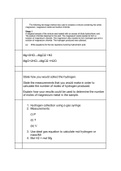
Mg+2HCl→MgCl2 +H2
MgO+2HCl→MgCl2 +H2O
State how you would collect the hydrogen.
State the measurements that you would make in order to
calculate the number of moles of hydrogen produced.
Explain how your results could be used to determine the number
of moles of magnesium metal in the sample.
1. Hydrogen collection using a gas syringe
2. Measurements:
(i) P
(ii) T
(iii) V
3. Use ideal gas equation to calculate mol hydrogen or
mass/Mr
4. Mol H2 = mol Mg
,Sodium hydroxide solution was added to the solution formed in
Stage 1 until no further precipitation of magnesium hydroxide
occurred. This precipitate was filtered off, collected, dried and
heated strongly until it had decomposed completely into
magnesium oxide. The oxide was weighed
Write equations for the formation of magnesium hydroxide and
for its decomposition into magnesium oxide.
MgCl2 +2NaOH→Mg(OH)2 +2NaCl
Mg(OH)2 →MgO+H2O
D
Q4.An aqueous solution of a sodium salt gave no precipitate
when treated with either silver nitrate solution or barium chloride
solution. Which one of the following could be the formula of the
sodium salt?
A NaI
B Na2SO4
C NaBr
D NaF
D
,State why the standard enthalpy of formation of barium and that
of aluminium are both zero.
Because they are elements
Suggest the major reason why this method of extracting barium
is expensive.
1. Aluminium is expensive to extract
2. High energy cost
3. The cost of heating strongly
Using barium oxide and aluminium powders increases the
surface area of the reactants. Suggest one reason why this
increases the rate of reaction.
There are more collisions
Write an equation for the reaction of barium with water.
, Ba + 2H2O → Ba(OH)2 + H2
White precipitate
1. Block x-rays
2. Barium sulphate is too insoluble
For the elements Mg–Ba, state how the solubilities of the
hydroxides and the solubilities of the sulphates change down
Group II.
MgO+2HCl→MgCl2 +H2O
State how you would collect the hydrogen.
State the measurements that you would make in order to
calculate the number of moles of hydrogen produced.
Explain how your results could be used to determine the number
of moles of magnesium metal in the sample.
1. Hydrogen collection using a gas syringe
2. Measurements:
(i) P
(ii) T
(iii) V
3. Use ideal gas equation to calculate mol hydrogen or
mass/Mr
4. Mol H2 = mol Mg
,Sodium hydroxide solution was added to the solution formed in
Stage 1 until no further precipitation of magnesium hydroxide
occurred. This precipitate was filtered off, collected, dried and
heated strongly until it had decomposed completely into
magnesium oxide. The oxide was weighed
Write equations for the formation of magnesium hydroxide and
for its decomposition into magnesium oxide.
MgCl2 +2NaOH→Mg(OH)2 +2NaCl
Mg(OH)2 →MgO+H2O
D
Q4.An aqueous solution of a sodium salt gave no precipitate
when treated with either silver nitrate solution or barium chloride
solution. Which one of the following could be the formula of the
sodium salt?
A NaI
B Na2SO4
C NaBr
D NaF
D
,State why the standard enthalpy of formation of barium and that
of aluminium are both zero.
Because they are elements
Suggest the major reason why this method of extracting barium
is expensive.
1. Aluminium is expensive to extract
2. High energy cost
3. The cost of heating strongly
Using barium oxide and aluminium powders increases the
surface area of the reactants. Suggest one reason why this
increases the rate of reaction.
There are more collisions
Write an equation for the reaction of barium with water.
, Ba + 2H2O → Ba(OH)2 + H2
White precipitate
1. Block x-rays
2. Barium sulphate is too insoluble
For the elements Mg–Ba, state how the solubilities of the
hydroxides and the solubilities of the sulphates change down
Group II.


