

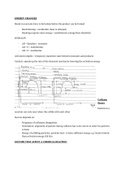
ENERGY CHANGES
Bonds in reactants have to be broken before the product can be formed
- Bond forming = exothermic (heat is released)
- Breaking requires more energy = endothermic (energy/heat absorbed)
ENTHALPY
- ΔH = Eproduct - reactants
- ΔH > 0 = endothermic
- ΔH < 0 = exothermic
Activated complex = temporary transition state between reactants and products
Catalyst: speeds up the rate of the chemical reaction by lowering the activation energy
Collision
theory
Particle in a
reaction can only react when the collide with each other
Success depends on:
- Frequency of collisions (frequently)
- Orientation: alignment of particle during collision has to be correct in order for particles
to form
- Energy of colliding particles: particles have to have sufficient energy e.g. Greater kinetic
than activation energy (Ek>Ea)
FACTORS THAT AFFECT A CHEMICAL REACTION
Bonds in reactants have to be broken before the product can be formed
- Bond forming = exothermic (heat is released)
- Breaking requires more energy = endothermic (energy/heat absorbed)
ENTHALPY
- ΔH = Eproduct - reactants
- ΔH > 0 = endothermic
- ΔH < 0 = exothermic
Activated complex = temporary transition state between reactants and products
Catalyst: speeds up the rate of the chemical reaction by lowering the activation energy
Collision
theory
Particle in a
reaction can only react when the collide with each other
Success depends on:
- Frequency of collisions (frequently)
- Orientation: alignment of particle during collision has to be correct in order for particles
to form
- Energy of colliding particles: particles have to have sufficient energy e.g. Greater kinetic
than activation energy (Ek>Ea)
FACTORS THAT AFFECT A CHEMICAL REACTION


