Chamberlain College of Nursing - NR 447 RN Exam 3 Study Guide, Collaborative
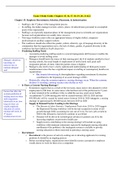
Chamberlain College of Nursing - NR 447 RN Exam 3 Study Guide-Chapter 15: Employee Recruitment, Selection, Placement, & Indoctrination • Staffing is the 3rd phase of the management process • In staffing, the leader-manager recruits, selects, places, & indoctrinates personnel to accomplish goals of the organization • Staffing is an especially important phase of the management process in health-care organizations because such organizations are usually labor intensive • This large workforce must reflect an appropriate balance of highly skilled, competent professionals & ancillary support workers • The workforce should also reflect the gender, culture, ethnicity, age, & language diversity of the communities that the organizations serve; the lack of ethnic, gender, & general diversity in the workforce has been linked to health disparities • Predicting Staffing Needs o Accurately predicting staffing needs in a crucial management skill because it enables the manager to avoid staffing crises o Managers should know the source of their nursing pool, the # of students enrolled in local nursing schools, the usual length of employment of newly hired staff, peak staff resignation periods, & times when the patient census is highest o Managers also need to have a fairly sophisticated understanding of third-party insurer reimbursement since this has a significant impact on staffing in contemporary health-care organizations ▪ Ex: hospital downsizing & shortsightedness regarding recruitment & retention contributed to the beginning of an acute shortage of RNs o Historically, when the economy improves, nursing shortages occur. When the economy declines (is receding), nursing vacancy rates decline as well • Is There a Current Nursing Shortage? o Economists suggest that as a result of the recession, many nurses who planned to retire employment to full time; & some nurses who had been out of the profession for 5 years or more returned to the workforce this is called the nursing employment bubble o An additional 712,000 nursing jobs will be created between 2010 & 2020 and that 495,500 jobs will be vacated by retired nurses between 2010 & 2020 suggests a nursing shortage of approximately 285,000 nurses between 2015 & 2020 o Supply & Demand Factors Leading to the Shortage ▪ The Bureau of Labor Statistics’ Employment Projections 2010 to 2020 suggest the Registered Nursing workforce will be the top occupation in terms of job growth through 2020, accounting for one out of every five new jobs created in 2020 this demand is expected to continue or accelerate ▪ Demand will be driven by technological advances in patient care & by the increasing emphasis on preventive health care ▪ Supply factors contributing to the nursing shortage will include an aging workforce with imminent retirements expected & inadequate nursing education enrollments the problem is the inadequate resources available to provide nursing education to those interested in pursuing a nursing career • Recruitment o Recruitment is the process of actively seeking out or attracting applicants for existing positions & should be an ongoing process o Before recruiting begins, organizations must identify reasons a perspective employee would choose to work for them over a competitor o Organizations considered best places to work have two characteristics: they’re “financially fit” organizations whose leadership is “keeping the ball rolling to keep revenue & patient satisfaction going upward” o The Nurse-Recruiter ▪ When deciding whether to hire a nurse-recruiter or decentralize the responsibility for recruitment, the organization needs to weigh the benefits against costs • Ex: an additional cost to an organization employing a nurse-recruiter might be the eventual loss of interest by managers in the recruiting process. The organization loses if managers relegate their collective & individual responsibilities to the nurse-recruiter ▪ When organizations use nurse recruiters, a collaborative relationship must exist between managers & recruiters ▪ Managers must be aware of recruitment constraints & the recruiter must be aware of individual department needs & culture ▪ Both parties must understand the organization’s philosophy, benefit programs, salary scale, & other factors that influence employee retention o Recruitment & Retention ▪ Because most recruitment is expensive, health-care organizations often seek less costly means to achieve this goal ▪ One of the best ways to maintain an adequate employee pool is by word of mouth; the recommendation of the organization’s own satisfied staff ▪ Recruitment is not the key to adequate staffing long-term; retention is and it only occurs when the organization is able to create a work environment that makes staff want to stay ▪ Turnover infuses the organization with fresh ideas; it also reduces the probability of groupthink, in which everyone shares similar thought processes, values, & goals ▪ Excessive or unnecessary turnover reduces the ability of the organization to produce its end product & is expensive ▪ Costs generally include human resource expenses for advertising & interviewing; recruitment fees such as sign-on bonuses; increased use of traveling nurses, overtime, & temporary replacements for the lost worker; lost productivity; & costs of training time to bring the new employee up to desired efficiency • Interviewing as a Selection Tool o An interview may be defined as a verbal interaction between individuals for a particular purpose o The purposes or goals of the selective interviews are threefold: (a) the interviewer seeks to obtain enough information to determine the applicant’s suitability for the available position; (b) the applicant obtains adequate information to make an intelligent decision about accepting the job, should it be offered; & (c) the interviewer seeks to conduct the interview in such a manner that regardless of the interview’s result, the applicant will continue to have respect for & goodwill toward the organization o The unstructured interview requires little planning because the goals for hiring may be unclear, questions are not prepared in advance, & often the interviewer does more talking than the applicant; most common selection tool used today o Semistructured interviews require some planning since the flow is focused & directed at major topic areas although there is flexibility in the approach o The structured interview requires greater planning time yet because questions must be developed in advance that address the specific job requirements, information must be
Written for
Document information
- Uploaded on
- July 14, 2021
- Number of pages
- 37
- Written in
- 2020/2021
- Type
- Other
- Person
- Unknown
Subjects
- collaborative
-
nursing nr 447 rn
-
exam 3 study guidecollaborative
-
chamberlain college of nursing nr 447 rn exam 3 study guide

Also available in package deal