

Relias Nursing Management of Hypertensive Disorders in Pregnancy (v2
Relias Nursing Management of Hypertensive Disorders in Pregnancy (v2)
Study online at https://quizlet.com/_gk3erv
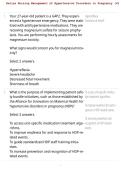
1. Your 27-year-old patient is a G4P2. They experi- Hyperreflexia
enced a hypertensive emergency. They were stabi- Shortness of breath
lized with antihypertensive medications. They are
receiving magnesium sulfate for seizure prophy-
laxis. You are performing hourly assessments for
magnesium toxicity.
What signs would concern you for magnesium tox-
icity?
Select 2 answers.
Hyperreflexia
Severe headache
Decreased fetal movement
Shortness of breath
2. What is the purpose of implementing patient safe- To access unit-specific medica-
ty bundle initiatives, such as those established by tion treatment algorithms.
the Alliance for Innovation on Maternal Health for
hypertensive disorders in pregnancy (HDP)? To improve readiness for and re-
sponse to HDP-related events.
Select 3 answers.
To increase prevention and
To access unit-specific medication treatment algo- recognition of HDP-related
rithms. events.
To improve readiness for and response to HDP-re-
lated events.
To guide standardized HDP staff training initia-
tives.
To increase prevention and recognition of HDP-re-
lated events.
, Relias Nursing Management of Hypertensive Disorders in Pregnancy (v2
Relias Nursing Management of Hypertensive Disorders in Pregnancy (v2)
Study online at https://quizlet.com/_gk3erv
3. A patient is at 32 weeks' gestation. They were di- Prompt corticosteroid adminis-
agnosed with superimposed preeclampsia with- tration.
out severe features. They are in triage. Their BP Administration of magnesium
is 152/94 mm Hg. They report visual disturbances sulfate.
and severe headaches. The urine dipstick is +1 for
proteinuria.
What interventions would you anticipate as part of
their care plan?
Select 2 answers.
Immediate cesarean delivery.
Prompt corticosteroid administration.
Administration of magnesium sulfate.
Immediate induction of labor.
4. At what gestational age is gestational hyperten- After 20 weeks' gestation and
sion defined by its appearance? resolving postpartum.
5. What is TRUE about the signs and symptoms of Most patients present with right
HELLP syndrome upper quadrant pain
Hypertension and proteinuria are always present.
Most patients present with right upper quadrant
pain.
Few patients experience nausea and vomiting.
Symptoms generally worsen slowly over time.
6. Your patient has hypertensive disorders in preg- To identify abnormal assess-
nancy (HDP). ment criteria in the obstetric
population.
, Relias Nursing Management of Hypertensive Disorders in Pregnancy (v2
Relias Nursing Management of Hypertensive Disorders in Pregnancy (v2)
Study online at https://quizlet.com/_gk3erv
What would be the purpose of using the Modified
Early Obstetric Warning System?
7. Your patient is confined to the hospital bed. What Assist with position changes
would be an important nursing responsibility to every 30 minutes.
assist the laboring?
8. Your postpartum patient was diagnosed with su- Within 3 days
perimposed preeclampsia with severe features.
They are set to be discharged. Following discharge,
how soon should the recommended follow-up ap-
pointment be scheduled?
9. A patient is a 36-year-old G3P2. They are 30 Superimposed preeclampsia
weeks pregnant and have chronic hypertension without severe features
(HTN). BP readings during pregnancy ranged from
140-144/82-88 mm Hg. During a prenatal clinic visit
they report feeling unwell. Their BP at that time
was 161/110 mm Hg. The provider had the patient
transferred to the hospital. You are now admitting
them. What diagnosis would you suspect?
10. What would be your BEST explanation for why Preeclampsia may exist in the
proteinuria is no longer required to diagnose absence of significant protein-
preeclampsia? uria
11. Your laboring patient was diagnosed with gesta- IV fluids should be administered
tional hypertension. The fetal heart rate tracing judiciously as the patient is vul-
shows reduced variability and recurrent late decel- nerable to fluid overload.
erations. You assist the patient with left lateral po-
sitioning and prepare to administer IV fluids. What
would be important for you to consider when per-
forming this intrauterine resuscitation measure?
Relias Nursing Management of Hypertensive Disorders in Pregnancy (v2)
Study online at https://quizlet.com/_gk3erv
1. Your 27-year-old patient is a G4P2. They experi- Hyperreflexia
enced a hypertensive emergency. They were stabi- Shortness of breath
lized with antihypertensive medications. They are
receiving magnesium sulfate for seizure prophy-
laxis. You are performing hourly assessments for
magnesium toxicity.
What signs would concern you for magnesium tox-
icity?
Select 2 answers.
Hyperreflexia
Severe headache
Decreased fetal movement
Shortness of breath
2. What is the purpose of implementing patient safe- To access unit-specific medica-
ty bundle initiatives, such as those established by tion treatment algorithms.
the Alliance for Innovation on Maternal Health for
hypertensive disorders in pregnancy (HDP)? To improve readiness for and re-
sponse to HDP-related events.
Select 3 answers.
To increase prevention and
To access unit-specific medication treatment algo- recognition of HDP-related
rithms. events.
To improve readiness for and response to HDP-re-
lated events.
To guide standardized HDP staff training initia-
tives.
To increase prevention and recognition of HDP-re-
lated events.
, Relias Nursing Management of Hypertensive Disorders in Pregnancy (v2
Relias Nursing Management of Hypertensive Disorders in Pregnancy (v2)
Study online at https://quizlet.com/_gk3erv
3. A patient is at 32 weeks' gestation. They were di- Prompt corticosteroid adminis-
agnosed with superimposed preeclampsia with- tration.
out severe features. They are in triage. Their BP Administration of magnesium
is 152/94 mm Hg. They report visual disturbances sulfate.
and severe headaches. The urine dipstick is +1 for
proteinuria.
What interventions would you anticipate as part of
their care plan?
Select 2 answers.
Immediate cesarean delivery.
Prompt corticosteroid administration.
Administration of magnesium sulfate.
Immediate induction of labor.
4. At what gestational age is gestational hyperten- After 20 weeks' gestation and
sion defined by its appearance? resolving postpartum.
5. What is TRUE about the signs and symptoms of Most patients present with right
HELLP syndrome upper quadrant pain
Hypertension and proteinuria are always present.
Most patients present with right upper quadrant
pain.
Few patients experience nausea and vomiting.
Symptoms generally worsen slowly over time.
6. Your patient has hypertensive disorders in preg- To identify abnormal assess-
nancy (HDP). ment criteria in the obstetric
population.
, Relias Nursing Management of Hypertensive Disorders in Pregnancy (v2
Relias Nursing Management of Hypertensive Disorders in Pregnancy (v2)
Study online at https://quizlet.com/_gk3erv
What would be the purpose of using the Modified
Early Obstetric Warning System?
7. Your patient is confined to the hospital bed. What Assist with position changes
would be an important nursing responsibility to every 30 minutes.
assist the laboring?
8. Your postpartum patient was diagnosed with su- Within 3 days
perimposed preeclampsia with severe features.
They are set to be discharged. Following discharge,
how soon should the recommended follow-up ap-
pointment be scheduled?
9. A patient is a 36-year-old G3P2. They are 30 Superimposed preeclampsia
weeks pregnant and have chronic hypertension without severe features
(HTN). BP readings during pregnancy ranged from
140-144/82-88 mm Hg. During a prenatal clinic visit
they report feeling unwell. Their BP at that time
was 161/110 mm Hg. The provider had the patient
transferred to the hospital. You are now admitting
them. What diagnosis would you suspect?
10. What would be your BEST explanation for why Preeclampsia may exist in the
proteinuria is no longer required to diagnose absence of significant protein-
preeclampsia? uria
11. Your laboring patient was diagnosed with gesta- IV fluids should be administered
tional hypertension. The fetal heart rate tracing judiciously as the patient is vul-
shows reduced variability and recurrent late decel- nerable to fluid overload.
erations. You assist the patient with left lateral po-
sitioning and prepare to administer IV fluids. What
would be important for you to consider when per-
forming this intrauterine resuscitation measure?


