

Page 1 of 191
NYC CERTIFIED IT ADMINISTRATOR (DATABASE) EXAM –
COMPREHENSIVE PRACTICE EXAM Questions &
Rationales LATEST UPDATE THIS YEAR
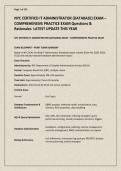
NYC CERTIFIED IT ADMINISTRATOR (DATABASE) EXAM – COMPREHENSIVE PRACTICE EXAM
EXAM BLUEPRINT – POINT FORM SUMMARY
Based on NYC DCAS Certified IT Administrator (Database) exam content (Exam No. 8283, 6018,
0112) and industry-standard database administration topics:
Exam Overview
Administered by: NYC Department of Citywide Administrative Services (DCAS)
Format: Computer-Based Test (CBT), multiple-choice
Question Count: Approximately 100–150 questions
Time Limit: Approximately 2 hours 45 minutes
Passing Score: Determined by DCAS civil service standards
Content Areas
Domain Key Topics
Database Fundamentals & DBMS purpose, relational model, normalization, keys,
Architecture schemas, ACID properties, data modeling
DDL, DML, DCL commands; indexing strategies; query
SQL & Query Optimization
performance tuning; stored procedures; functions; triggers
Installation, configuration, patching; schema management;
Database Administration
user/role management; RBAC; authentication; encryption
Full, differential, transaction log backups; RPO/RTO; disaster
Backup & Recovery
recovery planning; restore strategies
,Page 2 of 191
Domain Key Topics
Performance Monitoring Indexing, query optimization, deadlock resolution,
& Tuning performance counters, monitoring tools
NY SHIELD Act, FOIL, data encryption (TLS, AES-256), data
Security & Compliance
masking, NYC Cyber Command, breach notification
High Availability &
Always On, clustering, replication, failover strategies
Disaster Recovery
Data sharing agreements, PII protection, record retention,
NYC Data Governance
FOIL compliance
ETL & Data Warehousing SSIS, star schema, snowflake schema, fact/dimension tables
Troubleshooting & SQL Agent jobs, change control, documentation, root cause
Automation analysis
Key NYC-Specific Requirements
NY SHIELD Act: Mandates reasonable encryption (AES-256) for sensitive data at rest
FOIL (Freedom of Information Law): Requires redaction of exempt information (medical,
security) before release; agency FOIL officer must be consulted
Breach Notification: Notification to affected residents and NY Attorney General within 45 days
for breaches involving PII
TLS 1.2 or higher required for data in transit
SECTION 1: DATABASE FUNDAMENTALS & ARCHITECTURE (Questions 1–40)
1. Which of the following best describes the primary purpose of a Database Management
System (DBMS)?
A) To manage the operating system's file storage
,Page 3 of 191
B) To provide an interface for users to browse the internet
C) To efficiently store, retrieve, and manage data while ensuring security and integrity
D) To compile programming code into executable files
Answer: C
A DBMS is specialized software designed to store, retrieve, define, and manage data in a
database. It enforces security, concurrency, and integrity constraints.
2. What does SQL stand for?
A) Structured Query Language
B) Simple Query List
C) Sequential Query Logic
D) Standard Question Language
, Page 4 of 191
Answer: A
SQL is the standard language used to interact with relational databases for querying, updating,
and managing data.
3. Which database model organizes data in tables consisting of rows and columns with
predefined relationships?
A) Hierarchical model
B) Network model
C) Relational model
D) Object-oriented model
Answer: C
The relational model structures data into relations (tables) with tuples (rows) and attributes
(columns). Hierarchical uses trees, network uses graphs, and object-oriented integrates OOP
concepts.
NYC CERTIFIED IT ADMINISTRATOR (DATABASE) EXAM –
COMPREHENSIVE PRACTICE EXAM Questions &
Rationales LATEST UPDATE THIS YEAR
NYC CERTIFIED IT ADMINISTRATOR (DATABASE) EXAM – COMPREHENSIVE PRACTICE EXAM
EXAM BLUEPRINT – POINT FORM SUMMARY
Based on NYC DCAS Certified IT Administrator (Database) exam content (Exam No. 8283, 6018,
0112) and industry-standard database administration topics:
Exam Overview
Administered by: NYC Department of Citywide Administrative Services (DCAS)
Format: Computer-Based Test (CBT), multiple-choice
Question Count: Approximately 100–150 questions
Time Limit: Approximately 2 hours 45 minutes
Passing Score: Determined by DCAS civil service standards
Content Areas
Domain Key Topics
Database Fundamentals & DBMS purpose, relational model, normalization, keys,
Architecture schemas, ACID properties, data modeling
DDL, DML, DCL commands; indexing strategies; query
SQL & Query Optimization
performance tuning; stored procedures; functions; triggers
Installation, configuration, patching; schema management;
Database Administration
user/role management; RBAC; authentication; encryption
Full, differential, transaction log backups; RPO/RTO; disaster
Backup & Recovery
recovery planning; restore strategies
,Page 2 of 191
Domain Key Topics
Performance Monitoring Indexing, query optimization, deadlock resolution,
& Tuning performance counters, monitoring tools
NY SHIELD Act, FOIL, data encryption (TLS, AES-256), data
Security & Compliance
masking, NYC Cyber Command, breach notification
High Availability &
Always On, clustering, replication, failover strategies
Disaster Recovery
Data sharing agreements, PII protection, record retention,
NYC Data Governance
FOIL compliance
ETL & Data Warehousing SSIS, star schema, snowflake schema, fact/dimension tables
Troubleshooting & SQL Agent jobs, change control, documentation, root cause
Automation analysis
Key NYC-Specific Requirements
NY SHIELD Act: Mandates reasonable encryption (AES-256) for sensitive data at rest
FOIL (Freedom of Information Law): Requires redaction of exempt information (medical,
security) before release; agency FOIL officer must be consulted
Breach Notification: Notification to affected residents and NY Attorney General within 45 days
for breaches involving PII
TLS 1.2 or higher required for data in transit
SECTION 1: DATABASE FUNDAMENTALS & ARCHITECTURE (Questions 1–40)
1. Which of the following best describes the primary purpose of a Database Management
System (DBMS)?
A) To manage the operating system's file storage
,Page 3 of 191
B) To provide an interface for users to browse the internet
C) To efficiently store, retrieve, and manage data while ensuring security and integrity
D) To compile programming code into executable files
Answer: C
A DBMS is specialized software designed to store, retrieve, define, and manage data in a
database. It enforces security, concurrency, and integrity constraints.
2. What does SQL stand for?
A) Structured Query Language
B) Simple Query List
C) Sequential Query Logic
D) Standard Question Language
, Page 4 of 191
Answer: A
SQL is the standard language used to interact with relational databases for querying, updating,
and managing data.
3. Which database model organizes data in tables consisting of rows and columns with
predefined relationships?
A) Hierarchical model
B) Network model
C) Relational model
D) Object-oriented model
Answer: C
The relational model structures data into relations (tables) with tuples (rows) and attributes
(columns). Hierarchical uses trees, network uses graphs, and object-oriented integrates OOP
concepts.


