
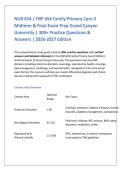
NUR 654 / FNP 654 Family Primary Care II
Midterm & Final Exam Prep Grand Canyon
University | 300+ Practice Questions &
Answers | 2026-2027 Edition
This comprehensive study guide contains 300+ practice questions with verified
answers and detailed rationales for the NUR 654 Family Primary Care II Midterm
and Final Exams at Grand Canyon University. The questions cover key FNP
domains including endocrine disorders, neurology, reproductive health, oncology,
pain management, cardiology, and mental health . Designed to mirror the actual
exam format, this resource will help you master differential diagnosis and clinical
decision-making skills required for FNP certification .
Content Area Overview
Question
Content Area Key Topics
Range
Cushing's syndrome, Addison's disease, thyroid
Endocrine Disorders 1-60
disorders, diabetes management, osteoporosis
Parkinson's disease, MS, seizures, Bell's palsy,
Neurological Disorders 61-110
dementia, headaches, stroke
Reproductive & HPV, amenorrhea, hirsutism, menopause,
111-160
Women's Health contraception, PAP guidelines
, Question
Content Area Key Topics
Range
Oncology & Cancer Breast cancer, lung cancer, colorectal cancer,
161-210
Management surveillance, risk reduction
Pain Management & Neuropathic pain, opioid stewardship, migraine
211-250
Pharmacology management, antidepressant selection
Behavioral & Mental Anxiety, depression, ADHD, eating disorders,
251-280
Health pediatric behavioral concerns
Cardiovascular & Heart failure, hypertension, COPD, asthma, ECG
281-320
Respiratory interpretation
Special Populations & Pediatric assessment, geriatric pharmacology,
321-350
Ethics cultural competency, informed consent
SECTION 1: ENDOCRINE DISORDERS (Questions 1-60)
Question 1: A 45-year-old female presents with rapid weight gain, amenorrhea
without pregnancy, and mild hypertension. After confirmatory testing, what is the
most likely diagnosis and appropriate treatment?
A) Hypothyroidism; thyroid hormone replacement
B) Polycystic ovary syndrome; oral contraceptives
C) Cushing's syndrome; pituitary tumor resection
D) Type 2 diabetes; metformin
Correct Answer: C) Cushing's syndrome; pituitary tumor resection
Rationale: The triad of rapid weight gain, amenorrhea, and hypertension is classic
for Cushing's syndrome. The most common endogenous cause is an ACTH-
secreting pituitary adenoma (Cushing's disease), for which the first-line treatment
, is transsphenoidal resection of the pituitary tumor . Hyperthyroidism would
typically cause weight loss and tachycardia, and while PCOS can cause
amenorrhea, weight gain, and hypertension is not its hallmark presentation.
Question 2: A patient presents with unexplained weight loss and increased skin
pigmentation on light-exposed skin folds along with darkened palmar creases.
Which laboratory tests should the provider order to evaluate this condition?
A) ORDER: Serum ACTH, Serum electrolytes, TB skin testing; NOT: Serum cortisol
B) ORDER: Serum cortisol, Serum ACTH; NOT: Serum electrolytes
C) ORDER: Serum electrolytes, Serum cortisol; NOT: TB skin testing
D) ORDER: TB skin testing, Serum cortisol; NOT: Serum ACTH
Correct Answer: A) ORDER: Serum ACTH, Serum electrolytes, TB skin testing;
NOT: Serum cortisol
Rationale: These findings suggest Addison's disease (primary adrenal
insufficiency), characterized by hyperpigmentation due to elevated ACTH.
Diagnosis requires serum ACTH (which will be elevated), electrolytes (showing
hyponatremia, hyperkalemia), and TB testing to rule out infectious cause. Serum
cortisol would be low, so it is not ordered as the confirmatory first step .
Question 3: A 55-year-old female with a history of type 2 diabetes presents with a
3-month history of burning pain and numbness in her feet. Her hemoglobin A1c is
8.2%. What is the most appropriate initial treatment for her neuropathic pain?
A) Gabapentin
B) Duloxetine
C) Pregabalin
D) Amitriptyline
Correct Answer: B) Duloxetine
Rationale: Duloxetine is FDA-approved for diabetic neuropathy and has a
favorable side effect profile. While gabapentin and pregabalin are also used,
duloxetine is preferred as first-line therapy due to its dual efficacy for pain and
depression . Amitriptyline is effective but has more anticholinergic side effects
making it less ideal in older adults.
Midterm & Final Exam Prep Grand Canyon
University | 300+ Practice Questions &
Answers | 2026-2027 Edition
This comprehensive study guide contains 300+ practice questions with verified
answers and detailed rationales for the NUR 654 Family Primary Care II Midterm
and Final Exams at Grand Canyon University. The questions cover key FNP
domains including endocrine disorders, neurology, reproductive health, oncology,
pain management, cardiology, and mental health . Designed to mirror the actual
exam format, this resource will help you master differential diagnosis and clinical
decision-making skills required for FNP certification .
Content Area Overview
Question
Content Area Key Topics
Range
Cushing's syndrome, Addison's disease, thyroid
Endocrine Disorders 1-60
disorders, diabetes management, osteoporosis
Parkinson's disease, MS, seizures, Bell's palsy,
Neurological Disorders 61-110
dementia, headaches, stroke
Reproductive & HPV, amenorrhea, hirsutism, menopause,
111-160
Women's Health contraception, PAP guidelines
, Question
Content Area Key Topics
Range
Oncology & Cancer Breast cancer, lung cancer, colorectal cancer,
161-210
Management surveillance, risk reduction
Pain Management & Neuropathic pain, opioid stewardship, migraine
211-250
Pharmacology management, antidepressant selection
Behavioral & Mental Anxiety, depression, ADHD, eating disorders,
251-280
Health pediatric behavioral concerns
Cardiovascular & Heart failure, hypertension, COPD, asthma, ECG
281-320
Respiratory interpretation
Special Populations & Pediatric assessment, geriatric pharmacology,
321-350
Ethics cultural competency, informed consent
SECTION 1: ENDOCRINE DISORDERS (Questions 1-60)
Question 1: A 45-year-old female presents with rapid weight gain, amenorrhea
without pregnancy, and mild hypertension. After confirmatory testing, what is the
most likely diagnosis and appropriate treatment?
A) Hypothyroidism; thyroid hormone replacement
B) Polycystic ovary syndrome; oral contraceptives
C) Cushing's syndrome; pituitary tumor resection
D) Type 2 diabetes; metformin
Correct Answer: C) Cushing's syndrome; pituitary tumor resection
Rationale: The triad of rapid weight gain, amenorrhea, and hypertension is classic
for Cushing's syndrome. The most common endogenous cause is an ACTH-
secreting pituitary adenoma (Cushing's disease), for which the first-line treatment
, is transsphenoidal resection of the pituitary tumor . Hyperthyroidism would
typically cause weight loss and tachycardia, and while PCOS can cause
amenorrhea, weight gain, and hypertension is not its hallmark presentation.
Question 2: A patient presents with unexplained weight loss and increased skin
pigmentation on light-exposed skin folds along with darkened palmar creases.
Which laboratory tests should the provider order to evaluate this condition?
A) ORDER: Serum ACTH, Serum electrolytes, TB skin testing; NOT: Serum cortisol
B) ORDER: Serum cortisol, Serum ACTH; NOT: Serum electrolytes
C) ORDER: Serum electrolytes, Serum cortisol; NOT: TB skin testing
D) ORDER: TB skin testing, Serum cortisol; NOT: Serum ACTH
Correct Answer: A) ORDER: Serum ACTH, Serum electrolytes, TB skin testing;
NOT: Serum cortisol
Rationale: These findings suggest Addison's disease (primary adrenal
insufficiency), characterized by hyperpigmentation due to elevated ACTH.
Diagnosis requires serum ACTH (which will be elevated), electrolytes (showing
hyponatremia, hyperkalemia), and TB testing to rule out infectious cause. Serum
cortisol would be low, so it is not ordered as the confirmatory first step .
Question 3: A 55-year-old female with a history of type 2 diabetes presents with a
3-month history of burning pain and numbness in her feet. Her hemoglobin A1c is
8.2%. What is the most appropriate initial treatment for her neuropathic pain?
A) Gabapentin
B) Duloxetine
C) Pregabalin
D) Amitriptyline
Correct Answer: B) Duloxetine
Rationale: Duloxetine is FDA-approved for diabetic neuropathy and has a
favorable side effect profile. While gabapentin and pregabalin are also used,
duloxetine is preferred as first-line therapy due to its dual efficacy for pain and
depression . Amitriptyline is effective but has more anticholinergic side effects
making it less ideal in older adults.


