
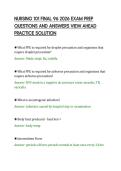
NURSING 101 FINAL 96 2026 EXAM PREP
QUESTIONS AND ANSWERS VIEW AHEAD
PRACTICE SOLUTION
◉ What PPE is required for droplet precaution and organisms that
require droplet precaution?
Answer: Mask; stept, flu, rubella
◉ What PPE is required for airborne precaution and organisms that
require airborne precaution?
Answer: N95 mask in a negative air pressure room; measles, TB,
varicella
◉ What is an iatrogenic infection?
Answer: infection caused by hospital stay or examination
◉ Body heat produced - heat lost =
Answer: body temp
◉ Intermittent Fever
Answer: periods of fever, periods normal at least once every 24 hrs
,◉ Remittent fever
Answer: fever spikes, and falls with out return to normal
◉ Relapsing fever
Answer: days febrile, days afebrile
◉ Sustained fever
Answer: maintained fever above 100.4 F
◉ Mild hypothermia range
Answer: 93.2-96.8
◉ Moderate hypothermia range
Answer: 86-93.2
◉ Severe hypothermia range
Answer: below 86 F
◉ Cardiac output =
Answer: HRxSV
◉ Respiratory rates by age
, Answer: Newborns: 35-40, infant: 30-50, toddler: 25-32, child: 20-
30, adolescent: 16-20, adult: 12-20
◉ Muscles involved in labored breathing
Answer: intercostal, substernal and suprasternal muscles
◉ 5 Senses
Answer: Visual, Auditory, Olfactory, Gustatory, Kinestetic
◉ What is Sensory Deficit?
Answer: deficit in normal sensory reception and perception
◉ What is sensory deprivation?
Answer: reduced sensory input, restricted environment. Person feels
confused, changes in behavior, electrolyte imbalance
◉ Sensory changes by age
Answer: Age 30- hearing change, Age 40- visual change, Age 50-
taste and smell change, Age 70- proprioceptive change, risk for falls
and coordination changes
◉ Nursing Process: What does PES stand for? Diagnosis
Answer: Problem, Etiology, Signs/Symptoms
QUESTIONS AND ANSWERS VIEW AHEAD
PRACTICE SOLUTION
◉ What PPE is required for droplet precaution and organisms that
require droplet precaution?
Answer: Mask; stept, flu, rubella
◉ What PPE is required for airborne precaution and organisms that
require airborne precaution?
Answer: N95 mask in a negative air pressure room; measles, TB,
varicella
◉ What is an iatrogenic infection?
Answer: infection caused by hospital stay or examination
◉ Body heat produced - heat lost =
Answer: body temp
◉ Intermittent Fever
Answer: periods of fever, periods normal at least once every 24 hrs
,◉ Remittent fever
Answer: fever spikes, and falls with out return to normal
◉ Relapsing fever
Answer: days febrile, days afebrile
◉ Sustained fever
Answer: maintained fever above 100.4 F
◉ Mild hypothermia range
Answer: 93.2-96.8
◉ Moderate hypothermia range
Answer: 86-93.2
◉ Severe hypothermia range
Answer: below 86 F
◉ Cardiac output =
Answer: HRxSV
◉ Respiratory rates by age
, Answer: Newborns: 35-40, infant: 30-50, toddler: 25-32, child: 20-
30, adolescent: 16-20, adult: 12-20
◉ Muscles involved in labored breathing
Answer: intercostal, substernal and suprasternal muscles
◉ 5 Senses
Answer: Visual, Auditory, Olfactory, Gustatory, Kinestetic
◉ What is Sensory Deficit?
Answer: deficit in normal sensory reception and perception
◉ What is sensory deprivation?
Answer: reduced sensory input, restricted environment. Person feels
confused, changes in behavior, electrolyte imbalance
◉ Sensory changes by age
Answer: Age 30- hearing change, Age 40- visual change, Age 50-
taste and smell change, Age 70- proprioceptive change, risk for falls
and coordination changes
◉ Nursing Process: What does PES stand for? Diagnosis
Answer: Problem, Etiology, Signs/Symptoms


