
NR 667 FNP Final Exam Prep – 300 Practice Questions &
Rationales
NR667 FNP Capstone Practicum and Intensive Final
Exam | 2026/2027 Edition | Chamberlain University
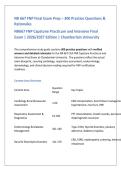
This comprehensive study guide contains 300 practice questions with verified
answers and detailed rationales for the NR 667 CEA FNP Capstone Practicum and
Intensive Final Exam at Chamberlain University . The questions reflect the actual
exam blueprint, covering cardiology, respiratory assessment, endocrinology,
dermatology, and clinical decision-making required for FNP certification
readiness .
Content Area Overview
Question
Content Area Key Topics
Range
Cardiology & Cardiovascular EKG interpretation, heart failure managemen
1-60
Assessment hypertension, murmurs, PMI
Respiratory Assessment & PFT interpretation, breath sounds, percussio
61-100
Diagnostics diaphragmatic excursion
Endocrinology & Diabetes Type 2 DM, thyroid disorders, pituitary
101-140
Management adenoma, diabetes insipidus
CKD, ESRD, nephropathy screening, electroly
Renal & Electrolyte Disorders 141-170
imbalances
, Question
Content Area Key Topics
Range
Dermatology & Infectious Skin lesions, actinic keratosis, SLE, HIV
171-210
Disease management
Anemia workup, hepatitis serology, lymphom
Hematology & Immunology 211-240
assessment
Abdominal exam order, peritonitis signs, BPH
GI & GU Assessment 241-270
hydrocele
Neurological & Cranial nerve assessment, gout, Parkinson's,
271-300
Musculoskeletal stroke evaluation
SECTION 1: CARDIOLOGY & CARDIOVASCULAR ASSESSMENT (Questions 1-60)
Question 1: A 72-year-old male with stable cardiac-type chest pain underwent a
stress test. Results show ST-segment depression in leads V3 and V4 with
concurrent chest discomfort. Based on these findings, which of the following is
NOT a priority medical decision?
A) Prescribe metoprolol (Lopressor) 12.5 mg PO BID
B) Prescribe aspirin 81 mg PO daily
C) Refer to cardiology for angiography
D) Check for thyroid dysfunction
Correct Answer: D) Check for thyroid dysfunction
Rationale: ST-segment depression with chest pain indicates myocardial ischemia.
Priority management includes beta-blockade, aspirin, and angiography referral.
Thyroid dysfunction does not address acute ischemia and is not a priority in this
context .
, Question 2: The nurse practitioner assessing a patient with a rapid cardiac rhythm
may assess for a pulse deficit by auscultating the heart while watching the EKG
rhythm. Where would the S1 heart sounds correlate with the electrocardiographic
waves?
A) At the end of the T wave
B) At the start of the T wave
C) Peak of the R wave
D) At the start of the P wave
Correct Answer: C) Peak of the R wave
Rationale: S1 heart sounds (mitral and tricuspid valve closure) correlate with the
onset of ventricular systole, which occurs at the peak of the R wave on the ECG.
This is the point where the ventricles begin to contract .
Question 3: During a post-hospital discharge visit, a 71-year-old female patient
has been diagnosed with a "new murmur" found during hospitalization for CHF
exacerbation. In evaluating the patient, during which phase of the cardiac cycle
would you anticipate auscultation of an S3 or S4 heart sound?
A) Diastole
B) Systole
C) S3 in systole while S4 in diastole
D) S4 in diastole while S3 in systole
Correct Answer: A) Diastole
Rationale: Both S3 (ventricular gallop) and S4 (atrial gallop) are diastolic filling
sounds. S3 is associated with volume overload (CHF), and S4 is associated with
stiff ventricles (hypertension, aortic stenosis). They are heard during diastole .
Question 4: The point of maximum impulse (PMI) is MOST often palpable in
healthy adults when positioned in the supine or left lateral decubitus position.
Which location is most commonly described as the PMI?
A) Left 2nd intercostal space, midaxillary line
B) Left 5th intercostal space, midclavicular line
C) Right 4th intercostal space, midaxillary line
D) Right 2nd intercostal space, midclavicular line
Rationales
NR667 FNP Capstone Practicum and Intensive Final
Exam | 2026/2027 Edition | Chamberlain University
This comprehensive study guide contains 300 practice questions with verified
answers and detailed rationales for the NR 667 CEA FNP Capstone Practicum and
Intensive Final Exam at Chamberlain University . The questions reflect the actual
exam blueprint, covering cardiology, respiratory assessment, endocrinology,
dermatology, and clinical decision-making required for FNP certification
readiness .
Content Area Overview
Question
Content Area Key Topics
Range
Cardiology & Cardiovascular EKG interpretation, heart failure managemen
1-60
Assessment hypertension, murmurs, PMI
Respiratory Assessment & PFT interpretation, breath sounds, percussio
61-100
Diagnostics diaphragmatic excursion
Endocrinology & Diabetes Type 2 DM, thyroid disorders, pituitary
101-140
Management adenoma, diabetes insipidus
CKD, ESRD, nephropathy screening, electroly
Renal & Electrolyte Disorders 141-170
imbalances
, Question
Content Area Key Topics
Range
Dermatology & Infectious Skin lesions, actinic keratosis, SLE, HIV
171-210
Disease management
Anemia workup, hepatitis serology, lymphom
Hematology & Immunology 211-240
assessment
Abdominal exam order, peritonitis signs, BPH
GI & GU Assessment 241-270
hydrocele
Neurological & Cranial nerve assessment, gout, Parkinson's,
271-300
Musculoskeletal stroke evaluation
SECTION 1: CARDIOLOGY & CARDIOVASCULAR ASSESSMENT (Questions 1-60)
Question 1: A 72-year-old male with stable cardiac-type chest pain underwent a
stress test. Results show ST-segment depression in leads V3 and V4 with
concurrent chest discomfort. Based on these findings, which of the following is
NOT a priority medical decision?
A) Prescribe metoprolol (Lopressor) 12.5 mg PO BID
B) Prescribe aspirin 81 mg PO daily
C) Refer to cardiology for angiography
D) Check for thyroid dysfunction
Correct Answer: D) Check for thyroid dysfunction
Rationale: ST-segment depression with chest pain indicates myocardial ischemia.
Priority management includes beta-blockade, aspirin, and angiography referral.
Thyroid dysfunction does not address acute ischemia and is not a priority in this
context .
, Question 2: The nurse practitioner assessing a patient with a rapid cardiac rhythm
may assess for a pulse deficit by auscultating the heart while watching the EKG
rhythm. Where would the S1 heart sounds correlate with the electrocardiographic
waves?
A) At the end of the T wave
B) At the start of the T wave
C) Peak of the R wave
D) At the start of the P wave
Correct Answer: C) Peak of the R wave
Rationale: S1 heart sounds (mitral and tricuspid valve closure) correlate with the
onset of ventricular systole, which occurs at the peak of the R wave on the ECG.
This is the point where the ventricles begin to contract .
Question 3: During a post-hospital discharge visit, a 71-year-old female patient
has been diagnosed with a "new murmur" found during hospitalization for CHF
exacerbation. In evaluating the patient, during which phase of the cardiac cycle
would you anticipate auscultation of an S3 or S4 heart sound?
A) Diastole
B) Systole
C) S3 in systole while S4 in diastole
D) S4 in diastole while S3 in systole
Correct Answer: A) Diastole
Rationale: Both S3 (ventricular gallop) and S4 (atrial gallop) are diastolic filling
sounds. S3 is associated with volume overload (CHF), and S4 is associated with
stiff ventricles (hypertension, aortic stenosis). They are heard during diastole .
Question 4: The point of maximum impulse (PMI) is MOST often palpable in
healthy adults when positioned in the supine or left lateral decubitus position.
Which location is most commonly described as the PMI?
A) Left 2nd intercostal space, midaxillary line
B) Left 5th intercostal space, midclavicular line
C) Right 4th intercostal space, midaxillary line
D) Right 2nd intercostal space, midclavicular line


