

Psy 341 Exam 1 (CSUF Dr. Mori)
Study online at https://quizlet.com/_8q259a
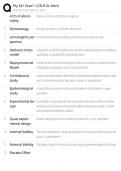
1. 4 D's of abnor- Deviance, Distress, Dysfunction, Dangerous
mality
2. Demonology the study of demons or of beliefs about them
3. somatogenic per- the view that abnormal psychological functioning has physical causes
spective
4. diathesis-stress a diagnostic model that proposes that a disorder may develop when an underlying
model vulnerability is coupled with a precipitating event
5. Biopsychosocial A model of illness that holds that physical illness is caused by a complex interaction
Model of biological, psychological, and sociocultural factors.
6. Correlational research procedure used to determine the relationships between variables as they
study exist in nature (measured as they exist in nature, no manipulation)
7. Epidemiological a study that measures the incidence and prevalence of a disorder in a given
study population
8. Experimental de- the variable is manipulated and the manipulation will have an effect on another
sign variable being observed (manipulated variable=independent variable ; variable
being observed=dependent variable)
9. Quasi experi- Research design that fails to include key elements of a "pure" experiment
mental design
10. Internal Validity The accuracy with which a study can pinpoint one of various possible factors as the
cause of a phenomenon
11. External Validity The degree to which the results of a study may be generalized beyond that study.
12. Placebo Effect
, Psy 341 Exam 1 (CSUF Dr. Mori)
Study online at https://quizlet.com/_8q259a
: improvement in physical or psychological condition that is attributable to a
patient's expectations of help rather than to any specific active ingredient in a
treatment
13. Masked design experiment in which participants do not know which assigned group they're in
14. Double blind pro- experiment in which both participants and experimenters are unaware of the
cedure groups to which participants are assigned
15. Control group research participants who are not exposed to the independent variable, but whose
experience is similar to that of the experimental group
16. Inter-rater relia- A measure of the reliability of a test or of research results in which the consistency
bility of evaluations across different judges is assessed.
17. Test-retest relia- a method for determining the reliability of a test by comparing a test taker's scores
bility on the same test taken on separate occasions
18. Biological Model Dysfunctional brain = psychopathology
All psychopathology is caused by dysfunctional biological (brain) processes
(Hippocrates)
19. Difficulties of Bio- unknown etiology of mental illness; no independent means of verifying the exis-
logical Model tence of disease other than patient self-report in many cases
20. Treatment for Bi- drug therapy, medication, ECT (electroconvulsive shock therapy), TMS (transcranial
ological Model magnetic stimulation), psychosurgery like lobotomies and deep brain stimulation
(DBS), light therapy, etc
21. 4 Neurotransmit- gamma-aminobutyric acid (GABA): anxiety disorders (d/o's)
ters norepinephrine (NE): anxiety d/o's
serotonin (SE): depression
dopamine (DA): schizophrenia
Study online at https://quizlet.com/_8q259a
1. 4 D's of abnor- Deviance, Distress, Dysfunction, Dangerous
mality
2. Demonology the study of demons or of beliefs about them
3. somatogenic per- the view that abnormal psychological functioning has physical causes
spective
4. diathesis-stress a diagnostic model that proposes that a disorder may develop when an underlying
model vulnerability is coupled with a precipitating event
5. Biopsychosocial A model of illness that holds that physical illness is caused by a complex interaction
Model of biological, psychological, and sociocultural factors.
6. Correlational research procedure used to determine the relationships between variables as they
study exist in nature (measured as they exist in nature, no manipulation)
7. Epidemiological a study that measures the incidence and prevalence of a disorder in a given
study population
8. Experimental de- the variable is manipulated and the manipulation will have an effect on another
sign variable being observed (manipulated variable=independent variable ; variable
being observed=dependent variable)
9. Quasi experi- Research design that fails to include key elements of a "pure" experiment
mental design
10. Internal Validity The accuracy with which a study can pinpoint one of various possible factors as the
cause of a phenomenon
11. External Validity The degree to which the results of a study may be generalized beyond that study.
12. Placebo Effect
, Psy 341 Exam 1 (CSUF Dr. Mori)
Study online at https://quizlet.com/_8q259a
: improvement in physical or psychological condition that is attributable to a
patient's expectations of help rather than to any specific active ingredient in a
treatment
13. Masked design experiment in which participants do not know which assigned group they're in
14. Double blind pro- experiment in which both participants and experimenters are unaware of the
cedure groups to which participants are assigned
15. Control group research participants who are not exposed to the independent variable, but whose
experience is similar to that of the experimental group
16. Inter-rater relia- A measure of the reliability of a test or of research results in which the consistency
bility of evaluations across different judges is assessed.
17. Test-retest relia- a method for determining the reliability of a test by comparing a test taker's scores
bility on the same test taken on separate occasions
18. Biological Model Dysfunctional brain = psychopathology
All psychopathology is caused by dysfunctional biological (brain) processes
(Hippocrates)
19. Difficulties of Bio- unknown etiology of mental illness; no independent means of verifying the exis-
logical Model tence of disease other than patient self-report in many cases
20. Treatment for Bi- drug therapy, medication, ECT (electroconvulsive shock therapy), TMS (transcranial
ological Model magnetic stimulation), psychosurgery like lobotomies and deep brain stimulation
(DBS), light therapy, etc
21. 4 Neurotransmit- gamma-aminobutyric acid (GABA): anxiety disorders (d/o's)
ters norepinephrine (NE): anxiety d/o's
serotonin (SE): depression
dopamine (DA): schizophrenia


